
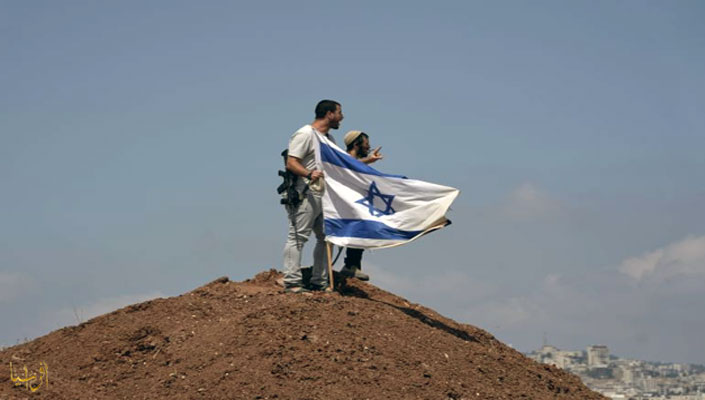
Israeli settlement activity in the West Bank reaches unprecedented levels and sparks widespread international outrage (Associated Press)
Afrasianet - Britain is entering a new phase in its relationship with Israel after Andy Burnham's government announced a package of sanctions targeting trade with Israeli settlements in the West Bank and threatening action against companies that finance or facilitate settlement projects.
The move, which came in conjunction with the escalation of settler violence and Israel's push to expand the E1 settlement, opened up a broad debate about Europe's ability to turn political criticism into economic and legal pressure, and whether the measures would actually affect Israel or remain symbolic.
New Line
The Guardian's editorial sees British Foreign Secretary Ed Miliband put his country at the forefront of a coalition of 12 countries that is considering economic restrictions on settlements, with Britain, France and Canada committing to a national trade embargo.
The announcement represents "Britain's strongest official condemnation" of Israeli behavior in the Palestinian territories in recent years, especially after the escalation of settler attacks and the proceeding of construction of 1,200 units in the E1 area, which could separate the north of the West Bank from its south.
The significance of the move goes beyond the commodity ban, with Miliband vowing to target construction services, infrastructure and finance, as well as extremist settlers, and to halt licences for arms sales that "reinforce the occupation". The real test will be in the implementation of these sanctions.
Financing the occupation
The trade in goods produced in settlements is a small part of Israel's export economy, so the impact of a direct embargo may be limited. But targeting banks, insurance companies and institutions that finance settlement projects may be more impactful, as they may have to choose between their business interests in Britain and their activity in the occupied Palestinian territories.
The number of settlers in the West Bank has risen from about 270,000 in 1993 to 770,000 today, an expansion supported by substantial government subsidies.
According to Israeli human rights lawyer Michael Seward, the sanctions redraw the line between Israel within the borders of the 1949 armistice and the occupied territories, and re-link economic relations to the rules of international law.
Test for Europe
In an article in Foreign Policy, researchers Sven Koopmans and Grace Wormbull argue that Europe has not been a key player in the Israeli-Palestinian file for decades, due to its dependence on Washington and the divisions of the European Union. But they say that the shift in American and European public opinion, and the mounting criticism of Israel's war on Gaza and settlements, are giving Europe an opportunity to pursue a more independent policy.
The authors propose what they call a "constructive condition" of supporting Israel's security, while linking European cooperation to respect for international law and the rights of Palestinians.
These include halting trade with settlements, banning the export of materials that help build them, and demanding compensation for the destruction of European-funded humanitarian projects. They also call for the EU-Israel agreement to be used as a leverage card, linking trade concessions to human rights obligations.
Remarkable endorsement
The British move received significant support from Michael Ben-Yair, the former Israeli attorney general, in an article in the Financial Times, in which he said that the sanctions are not an attack on Israel, but rather a distinction between the legitimacy of the state and the occupation, considering that the continued control over millions of Palestinians and their denial of political and civil rights has reached a stage that cannot be ignored.
He points out that settler violence, and what he describes as the complicity of state institutions, make international intervention necessary to correct the course. According to his account, large sums of money have been spent since the collapse of the Oslo process on building homes, roads and infrastructure in the West Bank, at the expense of the Palestinians and needs inside Israel as well. The most important message, he believes, is that the entrenchment of the occupation will come at a cost.
Counter-sanctions
In contrast to that supportive stance, U.S. Ambassador to Israel Mike Huckabee hinted at sanctions against Britain if London imposed sanctions on Israeli settlements, but a White House official later told Axios that Huckabee's comments on British sanctions were not coordinated with the White House or the State Department.
Huckabee told the BBC's Newsday programme that London's action against Israel "will have consequences, and British companies may not be able to operate in some US states".
Huckabee claimed that the sanctions would trigger backlash at the level of some US states, and could have a significant impact on British companies and possibly even lead to them being banned from doing business in a number of them.
Between principle and calculations
Britain's iPaper offered more divided views on the subject. Writer Patrick Cockburn argues that sanctions against Israel are a moral imperative in the face of violence and displacement against Palestinians, and rejects the link between opposition to Israeli government policies and anti-Semitism.
Commentator Jonathan Sacerotti argues that the British move will not improve the lives of Palestinians or advance peace efforts, and that its timing may be linked to electoral pressure within Britain and competition from the Green Party.
In any case, the British sanctions represent a turning point in the European debate and raise an important question about the extent to which London and its partners can transform international law from a rhetorical reference to concrete economic tools in light of the extent of sanctions, their targeting of financing and services, and Europe's ability to coordinate its position.
While the direct commercial impact may be relatively limited, pressure on the institutions that make settlement possible can raise its political and financial cost, and redraw the relationship between cooperation with Israel and respect for international law.
In this context, six Western countries announced on Tuesday the imposition of sanctions on Israeli settlers and settler entities, in addition to Finance Minister Bezalel Smotrich, against the background of what the countries described as the "appalling violence" they are practicing against Palestinians in the occupied West Bank, while Israel announced its categorical rejection of what it described as "disgraceful measures."
The foreign ministers of France, Britain, Canada, Australia, New Zealand and Norway announced the imposition of sanctions on extremist settlers, and France banned the entry of Smotrich, along with four leaders of settlement organizations, and 21 settlers from the West Bank.
France: Smotrich called for annexation of the West Bank
Regarding the reasons for the ban on the entry of the Israeli minister, French Foreign Minister Jean-Noël Barrow explained that Smotrich publicly calls for the annexation of the West Bank and the establishment of new settlements there, the reoccupation of Gaza and the economic collapse of the Palestinian Authority.
Barrow warned that this would have serious consequences for the Palestinian people, a policy that could not be accepted by the overwhelming majority of the international community, which is firmly committed to the two-State solution.
Smotrich, who leads the far-right Religious Zionist Party, is the second Israeli minister to be banned from entering its territory by France in recent months.
Last month, Paris banned National Security Minister Itamar Ben-Gvir from entering its territory after he released a video showing the abuse of detained activists from the "Steadfastness Flotilla" seeking to deliver humanitarian aid to the Gaza Strip.
Ben-Gvir and Smotrich are the cornerstone of Prime Minister Benjamin Netanyahu's government, who is wanted by the International Criminal Court on charges of genocide and war crimes.
Ireland has also recently banned the ministers and Britain barred them from entering in June last year, before other countries, including Spain and Slovenia, followed suit.
Britain: 6 entities that fund settler violence
The British government announced that it would impose a sanctions package on six entities and one individual involved in financing, empowering and carrying out settler violence in the West Bank.
The government said in a statement that the sanctions seek to disrupt the flow of funding that has "allowed extremist settler groups to act with impunity" in the West Bank.
It said that the continuation of illegal settlement expansion undermines the possibility of a two-state solution, in light of unprecedented levels of settler violence "aimed at deliberately destroying Palestinian homes and livelihoods in the West Bank."
Britain renewed its call on the Israeli government to halt settlement expansion, curb settler violence, prosecute those responsible, and lift restrictions on the Palestinian economy.
The British government has threatened to take further action unless the situation improves.
The British sanctions follow a UN investigation that found that Israeli authorities were directly involved in settler attacks that have led to the death, injury and displacement of Palestinians in the West Bank, while Israeli security forces have provided protection to settlers.
Israel responds
In response to the countries, the Israeli Foreign Ministry announced its rejection of what it described as the "disgraceful measures" it had taken against "Israelis, Israeli entities and a government minister."
In a statement, the Israeli Foreign Ministry accused the governments that announced the sanctions of failing miserably to combat what it claimed was "rampant anti-Semitism " in their countries.
Israel considered that the aforementioned countries seek to impose a political position on "the right of Jews to live in the Land of Israel and the Israeli-Palestinian conflict, under the guise of fighting violence."
Some 750,000 Israeli settlers reside in 141 settlements and 224 outposts in the West Bank, including 250,000 in 15 settlements in East Jerusalem, and commit daily attacks against Palestinians with the aim of forcibly displacing them.
Palestinians warn that the Israeli army and settlers are committing daily attacks against them, paving the way for the annexation of the West Bank to Israel, which would mean the elimination of the possibility of Palestinian statehood.
In the Gaza Strip, Israel continues to commit genocide through daily bloody shelling and a tight blockade, as part of a war it began with US support on October 7, 2023.
"Diplomatic collapse."
In a series of new international stances that tighten the global diplomatic and political noose on the occupying power, Canada and 11 European countries on Tuesday called on Israel to immediately stop expanding settlements, announcing its intention to restrict trade in goods with illegal settlements, while the Israeli opposition attributed the crisis to the diplomatic failure of the current government.
This came in a joint statement by the foreign ministers of Canada, Denmark, Finland, France, Iceland, Ireland, Norway, Poland, Portugal, Spain and Sweden, as well as Britain.
In the statement, they said that Israel must immediately stop expanding settlements and ensure accountability for settler violence. The statement reiterated their intention to restrict trade in goods with illegal settlements under international la
Protecting the two-state solution
The situation is deteriorating rapidly with unprecedented levels of settler violence and settlement expansion, including the unacceptable decision to publish tenders for the E1 settlement project, blaming the Israeli government for undermining the possibility of a two-state solution due to its "behavior in the occupied West Bank," the statement added.
The 12 countries "strongly" opposed any measures that amount to annexation of Palestinian territories and the forced displacement of the population, expressing their determination to protect the two-state solution and to take the necessary measures to achieve a just and lasting peace, according to the statement.
Britain is one of the most resolute countries among the signatories of the statement, with Foreign Secretary Ed Miliband announcing that London will impose sanctions on companies and individuals that provide construction and financing services that contribute to the expansion of settlements, and will reject all applications for arms licenses, stressing that his country "will no longer be silent about the gross injustice."
In addition to the new British "language" in dealing with Israel on developments in the Palestinian scene, French Foreign Minister Jean-Noël Barrow said that France intends to start measures to ban settlement products in the occupied West Bank, in light of the escalation of settler violence that further undermines the chances of a two-state solution with the Palestinians.
France: We will end trade with settlements
"France will end its trade with settlements in Palestine, along with 11 other countries that have also pledged to take similar measures," Barrow wrote on the X platform.
"Why are we doing this? Because the West Bank is about to explode, there is a crazy expansion of settlements, an escalation of violence against Palestinians by extremist settlers, and acts of terrorism that the Israeli authorities themselves have criticized."
A French diplomatic source said at a press briefing before the announcement: "Given the situation on the ground, we cannot wait, so we are making this national decision."
The statement of the 12 Western countries, and the statements of the foreign ministers of Britain and France, in one way or another, represent a general European and Western frustration, from which some EU countries sought to get out by pushing the bloc to adopt a resolution, but failed to obtain a qualified majority due to the striking opposition from Germany.
Despite the announcement that the United States would not follow up on countries that chose to punish the settlements, it hinted that it would not accept any change on the ground that would blow up the situation in the West Bank, a language that American policymakers used to use when they were dissatisfied with Israel's actions toward the Palestinians.
Arab welcome
The Western positions aroused Arab satisfaction, expressed in statements welcoming the punitive measures against the settlers and holding Israel responsible for the deterioration of the situation in Palestine in general, and in the West Bank in particular.
Palestine welcomed the statement of the 12 countries in support of the two-state solution and called for binding measures to stop settlement and annexation of territories, in a statement by Palestinian Vice President Mahmoud Abbas.
Qatar, Egypt, Jordan and other Arab countries have joined the list of countries that welcome Western positions condemning Israel's policies in the West Bank.
Perhaps Israel has never before found itself as isolated internationally, diplomatically and popularly, as it is today. The evolution of the positions of States and the unprecedented popular anger in the streets of Europe that preceded the past two years, which was characterized by mass demonstrations in major European capitals against Israel's war of extermination in the besieged Palestinian Gaza Strip, suggest that many of these States have decided to take a step forward in the face of Israeli intransigence.
Despite this isolation and the global diplomatic and political "aversion" from Israel, the latter's claws are still clinging to a policy of "crazy" settlement expansion, as described by the Western statement, under a right-wing government that is the most extreme since Israel's establishment, according to observers.
Israeli convulsion
So far, Israel has not issued any indication that it may pay attention to international condemnation of its policies, at least as indicated by the reactions of Israeli officials, whose responses to Western positions have been tinged with sharpness and tension.
The tension was echoed by Israeli President Isaac Herzog, who saw the British sanctions as "blatant interference in the democratic elections of a sovereign state."
Israeli Foreign Minister Gideon Sa'ar broke from the framework of diplomatic language, calling his British counterpart's accusations "disgraceful and false" and saying that Israel would prevent 10 British officials and citizens from entering the country, and that the British consulate in Jerusalem would be closed.
While the Israeli media wrapped up its response to these developments in terms that were overwhelmingly cautious and anticipated, Channel 12 described what was happening as a "deluge of European sanctions" against settlements in the West Bank, while the Yedioth Ahronoth newspaper saw it as a "diplomatic collapse."
Israeli opposition leader Yair Lapid criticised Britain's decision as "dangerous and wrong" but blamed Prime Minister Benjamin Netanyahu's government for "a massive diplomatic failure".
Channel 12 quoted Knesset member Gilad Kareb as saying that the responsibility for announcing sanctions lies with Netanyahu, Finance Minister Bezalel Smotrich, Defense Minister Yisrael Katz and Foreign Minister Sa'ar.
The government's policy toward settler violence, the Palestinian Authority and construction in the E1 area leads us to international isolation and damages Israel's strategic depth in the world, he said.
For how long?
The reactions of Israeli officials may create the impression that Israel is cohesive from within, and that the government is continuing its dangerous policies in the West Bank and in Palestine as a whole.
But this impression may be shaken by questions about how long Israel can withstand the political winds that blow against it loaded with rejection and condemnation, and how long it can remain isolated on the island of Talmudic narcissism that dominates its government's policy, without being swept away by a torrenting global condemnation that is rising day by day.
________________

