
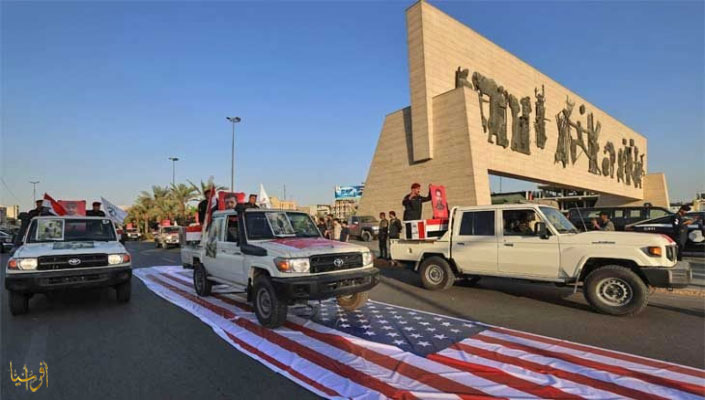
Afrasianet - Ibrahim Nawar - It is not its first military and strategic failure in the greater Middle East, nor its second, nor its third, but at least its fourth failure in the region stretching from the mountains of Afghanistan in the east to the Greater Horn of Africa in the west.
This is the failure embodied by the US military withdrawal from Iraq after 23 years of heavy occupation of Mesopotamia. Before that, there was the withdrawal from Somalia, the withdrawal from Afghanistan, and the resounding failure in Libya.
Every time the US forces intervened under the slogan of eliminating terrorism and building democracy, and each time they came out dragging the tails of defeat, because their destructive wars did not achieve their declared goals.
In Somalia, it withdrew and left behind a failed and dismembered state shared by weak governments, terrorist groups and groups of mercenaries agents, in Afghanistan, the US forces went to remove the Taliban, and after 21 years, the occupation ended up handing over power to the Taliban government!
In Libya, the US forces abandoned it, after a suspicious intervention, and it is a failed state after its destruction, and turned it into pieces whose wealth is disputed by groups And military militias with no purpose other than the continuation of the control of selfish interests at the expense of Libya as a nation and its people.
The security system that Washington wants to impose on the Arab countries is aimed first and foremost at ensuring Israel's security and superiority and encouraging it to engage in more aggressive actions and move forward with the displacement and annihilation of the Palestinian people
In Iraq, it leaves behind a state that needs decades to rise and reach what it aspired to before the occupation. The United States certainly did not find the nuclear weapons that it claimed Saddam Hussein had, which were the justification for the invasion of Iraq. The invasion was the key to building one of the largest U.S. military bases outside the United States, and the largest U.S. embassy in the world, whose purpose was to manage its foreign operations.
Yet the occupation has failed miserably to achieve the goals of the U.S. National Security Strategy and protect its interests in the Middle East, except to provide diplomatic cover and military support to Israel. U.S. forces have failed, as we can see, to secure the flow of oil from producing countries to the world, a strategic interest enshrined in the National Security Strategy.
It has failed to secure maritime shipping lanes, which is also an interest like the previous one. It has also failed to ensure the security of its allies with the exception of Israel. The United States failed miserably to provide protection and support to the Kingdom of Saudi Arabia when it was attacked on its largest oil facilities in Abqaiq in 2019, which resulted in a severe rift between the governments of the two countries, to the point that the US Secretary of Defense at the time was almost banned from visiting Saudi Arabia, and what measures have been taken by the US administration in the last days of the announcement of the supply of a battery of Patriot missiles for air defense to both Qatar and Saudi Arabia (its management and use are subject to the decisions of the Central Command).
But these latest measures will not work, because the Gulf countries, which believed in the credibility of American defense and protection guarantees, have realized with certainty that defense guarantees stem from within the region itself of their own free will and not from outside it, and that the security system that Washington wants to impose on the Arab countries is a system that aims first and foremost to ensure Israel's security and superiority and encourage it to practice more aggressive actions and move forward with the displacement and annihilation of the Palestinian people.
In addition to failing to achieve the objectives of the National Security Strategy, we note that the United States has also failed to rebuild the model it had devised after World War II, in terms of linking military intervention to political and economic reconstruction, a model that succeeded in transforming war-ravaged Western Europe into a rising global power through the Marshall Plan for Development and Reconstruction.
Contrary to what it did in rebuilding Europe, it did nothing systematic that could be described as a process of rebuilding the countries it occupied for more than two decades, Afghanistan and Iraq, nor the countries it had militarily destroyed, Somalia and Libya.
I can say, as I witnessed this while serving as the political officer of the United Nations Mission in Iraq (2003-2007), that the U.S. occupying forces did not have a clear strategy for the post-Saddam period, which plunged them into a fierce diplomatic conflict with the United Nations Assistance Mission for Iraq (UNAMI).
UNAMI During the period following the occupation, a conflict in which Sergio de Mello, the Special Envoy of the United Nations Secretary-General for Iraq, Sergio de Mello, lost his life as a result of a rocket attack on his office, in the manner used by Israel to kill the leaders of the Palestinian resistance. The period immediately following the overthrow of Saddam was a difficult period full of bickering between Bremer and de Mello, due to disagreements over the way Iraq was governed.
While the United Nations was adopting an Iraqi-led constitutional transition program Bremer themselves tended to appoint a "governing council" that owes allegiance to him and claims for himself the right to veto the council's decisions, even though he is the one who chose its members.
What was most important to the U.S. military leadership and civil administration was to work to create groups of Iraqi loyalists of U.S. policy, who did not impede the survival of U.S. forces under any pretext or justification, which led to the spread of a great deal of corruption within the U.S.-sponsored Iraqi administration. Iraq is still suffering from the effects and repercussions of the Iraqi occupation (2003-2026), including the prevalence of administrative corruption, and these repercussions may continue for years to come until they are completely eliminated.
U.S. losses
The American failure in Iraq did not stop at the limits of its inability to achieve the strategic goals of the military intervention, but went beyond that to expose the United States itself to human, political, and economic losses, of a strategic nature.
The number of casualties of the war in what it called "Operation Iraqi Freedom" was almost double the number of those who died in the parallel war in Afghanistan (2000-2021). As for the human casualties in the Iraq war alone, according to the Watson Institute for International and Public Affairs at Brown University, more than 4,500 American soldiers were killed, and the number of Iraqi civilian casualties ranged from 186,000 to 210,000.
In terms of economic losses, Brown University estimates the total direct cost of US wars and military interventions (after 9/11) in Afghanistan, Iraq, Libya, and Somalia at more than $8 trillion, equivalent to 38% of the US GDP in 2020. The war in Afghanistan is the most costly, at $2.3 trillion, followed by the Iraq war at more than $2.1 trillion.
The military intervention in Libya in 2011 cost about $1.1 billion. The cost of military intervention in Somalia (post-9/11) was at least $2.5 billion, in addition to the direct cost of military operations in other regions such as Syria, Yemen, and the African Sahel, estimated at tens of billions of dollars, and the indirect cost of those wars is estimated at between $2.2 trillion and $2.5 trillion, including covering the needs of medical care and disability insurance programs for military personnel who participated in those wars.
Ironically, the US withdrawal from Iraq came amid an atmosphere of military escalation against Iran in the Strait of Hormuz, reflecting the continued confusion of the US strategy in the Middle East between the pressures leading to the withdrawal and the interests of the Zionist lobby and the arms company lobby that calls for increasing military buildups.
This confusion, which is clearly reflected in the increase in the budget of the US War Department by about 50%, will cost the US force more bleeding, which will increase the speed of weakness and impotence.
________________
Ibrahim Nawar - Egyptian writer

