
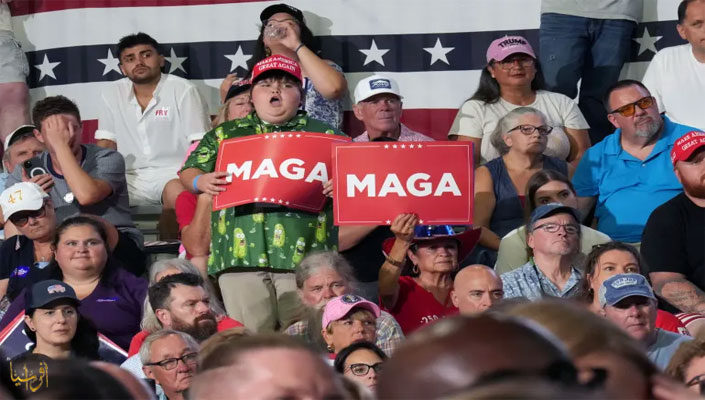
Republicans face stiff competition as midterm elections approach amid divisions in the party's base (AP)
Afrasianet - Khalid Al Jaber - The Republican Party's predicament is no longer limited to a crisis of leadership or the search for a successor to Trump, but reflects a deeper problem of the shift of political loyalty from principles and institutions to the person of the leader. In light of this shift, the relationship with Trump seems closer to the duality of "loyalty and innocence," where affiliation is measured by how close to the president is, and disagreement with him becomes a gateway to questioning party loyalty.
Herein lies the paradox: How can a party founded on the values of conservatism, freedom, and limitation of state power find itself confronted with a more complex question: loyalty to the principles on which it was founded, or to the man who reshaped it in his own image?
The 10 years of Trumpism were long enough to destroy much of the old Republican establishment, but not enough to build a new one that could survive without the man who made it. The result, the Republican Party, which years ago seemed to have become the undisputed party of Trump, is now entering a more turbulent phase with the selection of candidates to succeed.
As the midterm elections approach, Republicans are facing growing discontent with the cost of living and the economy, while the war with Iran has become an additional political burden. In the latest Associated Press and AP-NORC poll, only 26% of Americans approve of Trump's economic performance, and the percentage has dropped to just 17% on the cost of living.
So Trump and Vance have launched an intense campaign even in traditionally Republican states, at a time when party leaders are talking about a lack of enthusiasm and tougher-than-expected electoral contests.
"Trump has made a Republican electorate less respectful of the establishment, more skeptical of wars, and more hostile to experts, lobbies, and traditional alliances. But he has discovered the problem that confronts every political revolution: When your followers learn to rebel, you can't guarantee that they won't rebel against you"
________________
This is not just a fleeting polling problem ahead of the Nov. 3 midterm elections, but the beginning of a deeper crisis in the political narrative that brought Trump to the White House: his promise to Americans to end "never-ending wars," bring back factories, cut costs for the middle class, and draw a line between U.S. interests and those of its allies. Today, part of his base finds that war, prices, tariffs, and foreign commitments are reproducing some of what Trump himself promised to eliminate.
The revolution is eating its owner
The most prominent opposition to Trump no longer comes from Democrats or his traditional Republican opponents, but from within the environment that made America First itself. Figures such as Thomas Massey, Tucker Carlson, and Marjorie Taylor Greene, while their positions differ, reflect a growing rift within the populist right over a simple and embarrassing question: If America First, why is Washington returning to an open war in the Middle East?
This is the historical paradox that Trump faces: He taught Republicans to question the establishment, and then found a part of them questioning his institution. He was the one who attacked the wars in Iraq and Afghanistan, and then he became required to explain a new war. He was the one who attacked the Republican elites because they put the world before America, and then there appeared on his right those who accuse his administration of moving away from "America First."
Trump has made a Republican electorate less respectful of the establishment, more skeptical of wars, and more hostile to experts, lobbies, and traditional alliances. But he has discovered the problem that faces every political revolution: When your followers learn to rebel, you can't guarantee that they won't rebel against you.
Trump's declining approval rating is more serious than a poll number. If it continues, it opens up the question that the party has been postponing since 2016: Did the Republican power come from Trump himself, or from the issues Trump picked up before others?
"No serious Republican in 2026 can speak the way Republicans did before Trump. The old party is pretty much dead, even if some of its ideas and institutions remain"
________________
Vance and the Conflict Over the Next Alternative
J.D. Vance is dealing with this dilemma more than most of his rivals. He needs Trump to get beyond Trump. And that's irony enough to define his political future. Vance can't turn against the president who made him vice president without risking losing the Trump base. But at the same time, he can't enter the 2028 election carrying all the burdens of Trump if the war, the economy, and the cost of living become a heavy electoral legacy.
So the most difficult political task for Vance is not to become the "new Trump." Rather, he must convince the base that he can maintain Trumpism and get rid of Trump's mistakes at the same time.
Intellectually, there are important spaces between Vance and the wing that Carlson and Massey represent in the critique of foreign wars. Vance is more skeptical of open commitments than the international Republicans, and more willing to link foreign policy to manufacturing, energy, jobs, immigration, and the cost of living within the United States.
But he's also vice president. And that's not a small detail. When Trump's policy becomes objected to within America First, Vance can't be the vice president and leader of the opposition to the president at the very moment. So he's going to have to walk a very tightrope: close enough to Trump to inherit MAGA, and far enough away from him to inherit America First.
Rubio waits on the other side
Marco Rubio represents a different possibility. He does not need to resolve the contradiction in the same way, because he is closer to the international republican traditions: alliances, deterrence, Israel, confronting Iran, the global American presence, and viewing China as a challenge that requires a global network of partners and power.
But Rubio has changed, too. No serious Republican in 2026 can speak the way Republicans did before Trump. The old party is pretty much dead, even if some of its ideas and institutions remain.
So the potential competition between Vance and Rubio is not so much between Trumpism and the old republic as it is between two versions of what will come after Trump: Vance most likely wants to make Trump's revolution more ideological and sustainable; and Rubio could represent an attempt to reconcile that revolution with some of America's old traditions of power.
There is still no Republican consensus on either; the party's convention in Dallas showed Vance's strength, but it also showed the presence of Rubio, DeSantis and Cruz and the absence of a decisive heir.
"The Republican Party today stands in three ways. It can remain Trump's party, where loyalty to men is the criterion of belonging. It could become the party of Vance, where "America First" shifts from personal populism to more theoretical and disciplined political nationalism. It could move toward a formula closer to Rubio, one that accommodates the Trump revolution internally but restores traditional American leadership abroad"
________________
The Upcoming Elections and the War of the Succession
The midterm elections will be more of a battle for the House and Senate. It will be the first major referendum on Trumpism's ability to continue to govern after it has become responsible for the results, not just a protest force against the establishment.
If Republicans achieve strong results, Trump will say that the base is still with him, and it will be difficult for any potential heir to walk away from him. Vance will benefit from this as vice president and institutionally closest to the center of power.
If the Republicans suffer a setback, a battle more dangerous than losing seats in Congress will begin: a battle to determine responsibility. Each wing will say that the other betrayed the project. The hawks will say that populism has failed to govern; and the "America First" wing will say that the problem was not Trumpism, but that Trump himself abandoned some of its promises.
But one thing needs to be settled: The Republican Party that preceded 2016 will simply not go back. Its social base, its political language, its attitude on trade, globalization, immigration, institutions, and wars have changed. Even those who want to restore something of the traditional republic are forced to speak the language that Trump imposed. This is perhaps his greatest historic victory, regardless of his current popularity: he has made a return to what came before him nearly impossible.
But that doesn't mean the party will remain its own forever. Political revolutions often last after their leaders, but they change their names and slogans and rewrite the story of their founders.
Where is the Republican Compass headed?
The Republican Party today faces three paths. It can remain the party of Trump, where loyalty to men is the criterion of belonging. It can become the party of Vance, where "America First" shifts from personal populism to a more theorized and disciplined political nationalism. It can move toward a formula closer to Rubio, one that accommodates the Trump revolution internally but restores the credibility of traditional American leadership externally.
There is no way yet to say which path the Republicans will choose, nor who their candidate will be in 2028. But what is clear is that the struggle has already begun, and Vance is strongly present without being a decisive heir. The question that will determine the party's future is not ultimately: Who could be the next Trump?
The irony may be that the man who took over the Republican Party in 2016 and more than any politician of his generation is the same one who makes the party today forced to look for a way out of his shadow.
The danger for Trump is no longer that MAGA dies after him. The most dramatic danger is quite the opposite: that "America First" will survive, but that it decides it no longer needs it.
________________
Khalid Al Jaber - Executive Director of the Middle East Council for International Affairs in Doha.

