
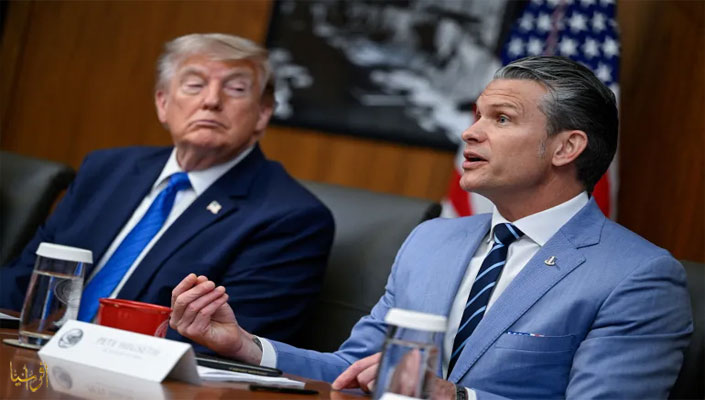
Planned to broadcast Nidal Hassan's execution represents a serious moral setback, says Baxter (Reuters)
Afrasianet - Three articles published by Britain's iPaper and the Financial Times on fears of a decline in democratic and moral values in the United States during President Donald Trump's era intersect three articles, warning of the repercussions on state institutions and America's image and international standing.
Sarah Baxter and Patrick Cockburn, in their articles for the "iPaper" newspaper, discuss the manifestations of moral and political decline in the United States, while Edward Luce, in their article in the Financial Times, focused on the political and moral implications of the plan to broadcast the execution of Nidal Malik Hassan.
Baxter sees the plan to broadcast the execution of Hassan, who was convicted of killing 13 people at the Fort Hood military base in 2009, represents a serious moral setback, as the judicial sentence could turn into a mass spectacle that serves media and political purposes.
Turning the penalty into a review
The author links this approach to the style of Defense Secretary Pete Hegseth , who she believes gives media visibility increasing importance in presenting the military and warns against using the issue to boost the popularity of the MAGA movement ahead of the midterm elections.
Luce recalls the experience of Rainey Petia's public execution in 1936, warning that the new plan could return the United States to practices it has been away from for decades, noting that turning the death penalty into public display raises questions about the limits of state power and the moral and legal constraints imposed on it.
The articles go beyond the issue of the death penalty itself to broader concerns about the normalization of violence, the erosion of humanitarian considerations, and the damage to the image of the United States as a defender of democracy and the rule of law.
Erosion of soft power and rising corruption risks
In his essay, Cockburn offers a broader reading of the American crisis, restoring the image of the United States as a haven from fascism, violence, and corruption, as it appeared in the 1942 film Casablanca.
This image, which contributed to the building of American soft power during the twentieth century, is being eroded by Trump's policies and what he describes as increasing cruelty and violations of the law.
He points to the use of immigration law enforcement agencies, controversial military operations, and dealing with political opponents as manifestations that reinforce suspicions about respect for legal and ethical controls.
It also highlights accusations of conflicts of interest between the Trump family's business and government policies, citing reports of investments in a cryptocurrency company linked to members of the president's family, as well as an agreement to make U.S. computer chips available to some countries.
Such incidents raise questions about the separation between public interest and private gain, according to Cockburn, noting that the White House has denied that there is a link between the cryptocurrency deal and government business.
Cockburn links these developments to the decline of American soft power, i.e., the ability of the United States to influence the world through the attractiveness of its culture, institutions, and values, and not only to its military and economic power, but he does not exclude the ability of American society, with its diversity and political and cultural vitality, to resist authoritarian tendencies.
A crisis of values, institutions and an international image
While the three articles on the death penalty focus on the dangers of turning violence into political and media spectacle, Cockburn places the issue in a broader context that includes corruption, polarization, and declining trust in institutions.
The articles also agree that the United States' international standing depends not only on its military and economic power, but also on its commitment to the law and the democratic values it proclaims to defend.
The three articles paint a critical picture of the Trump United States, warning that the normalization of violence and the overlap of special interests with public decisions could weaken trust in institutions and undermine American soft power.
While Baxter and Luce focus on the moral and political implications of the execution plan, Cockburn expands the discussion to include the decline of America's historical image and rising fears of corruption and authoritarianism.
These readings remain an expression of the writers' positions and analyses, but they raise a fundamental question about the ability of the United States to maintain its international standing in light of the tension between its power and principles.
________________
Source: iPaper + Financial Times

