
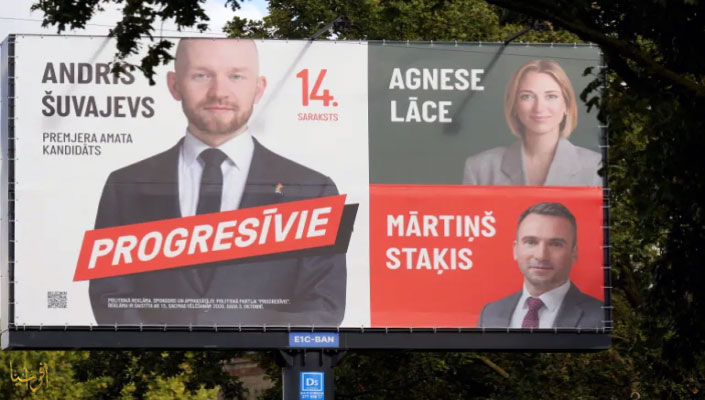
Latvia's elections are overshadowed by alignment between supporters of the West and those who want to get closer to Russia
Afrasianet - Sayed Ahmed Khader - "We will save the Russian language, you will not have to learn Latvian, you will be able to go to Russia again to get cheap fuel and food, and let's not give money to Ukraine."
The pledges, which are being made publicly by politicians in central Riga, are reassuring to music teacher Angela after she recently lost her job due to failing a Latvian language test.
But it goes beyond jobs and equal opportunity to something much more serious: the "marginalization of the Russian minority" was one of the justifications used by Moscow in its invasion of Ukraine in 2022 and the annexation of Crimea in 2014.
As the political landscape in Latvia is divided, concerns about Russia's ability to play with the skies are reinforced, while NATO continues to strengthen its presence on the ground.
Latvians are due to cast their ballots on Saturday in parliamentary elections that will be held five months after the collapse of the government over the so-called drone crisis.
Latvia is located in northeastern Europe, bordered by Estonia to the north, Lithuania to the south, and Russia to the east. Belarus to the southeast, the Baltic Sea to the west, and a maritime border with Sweden.
The bill of love of the West
Contrary to what the United Alliance party would like, the run-up to the elections reflected the depth of divisions and divergent loyalties in the Baltic state, whose government is aligned with the West and supports Ukraine, while political forces are aligned with the Russians.
Throughout his election campaign, Prime Minister Andreas Kolbergs promised "unwavering support for Ukraine" and strengthened Latvia's anti-drone capabilities.
Kohlbergs plays the chord of fear of "Russian aggression" that would make Latvia suffer a fate similar to Ukraine, which has been hit hard by the West's love for 20 percent of its territory, and has suffered severe damage in lives, equipment and the economy.
Kohlbergs' center-right United Alliance party leads in the polls, but with just 14.4% of the vote, meaning it will not be able to form a government on its own.
Earlier, Kohlbergs told Reuters: "The Ukraine war has divided our society, and many people don't share the same vision."
The Western-loyal man acknowledged that "a large part of society does not see Russia as a threat, and they don't understand why the government is investing huge sums of money in defense," saying, "They are wrong."
In second place is the pro-Russian Sovereign Power party, which is given 9.4 percent in the polls.
The party draws its support from Latvia's Russian-speaking minority, which numbers 430,000, which makes up 23 percent of Latvia's 1.8 million population.
The Sovereign Power party has vowed to halt aid to the war effort in Ukraine, and its leader, Yulia Stepanenko, has said: "Our voters want peace."
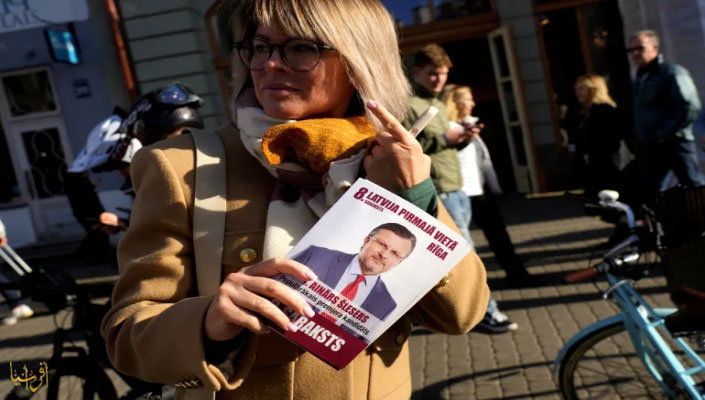
A woman holds a Latvia First party leaflet with a picture of its leader Ainaars Schlesers ahead of the general election (Reuters)
"We're not okay"
In the same direction is the Latvia First party, which ranks third in the polls and is attracting a growing number of pro-Russian voters.
The party is pledging to bridge the gaps between ethnic Latvians and the Russian minority, "which is generally aligned with Moscow," according to pollster Arnes Kaktins.
Activist Olga Petkevića said she recently joined the "Latvia First" party in the hope that it would become a cornerstone of the coalition's formation and push Latvia towards a more pragmatic relationship with Russia.
"I'm not saying Ukraine is bad or Russia is good... I'm looking at our lives and we're not okay. Yes, they have a war there, but we're living worse here."
Angela laments that she lost her job after failing the Latvian language test, and hopes that the next parliament will remove this requirement.
The requirement to pass the Latvian language test is part of several policies aimed at curbing Russian influence in public life in Latvia.
Journalist Inna Plavoka notes that many share Angela's sense of marginalization by decision-makers, which strengthens the appeal of the Sovereign Power and Latvia First parties.
"They tell them: 'We will save the Russian language, you won't have to learn Latvian, you will be able to go to Russia again to get cheap fuel and food. Let's not give money to Ukraine, we give it to the elderly here instead.'"
Provoking the "ex-father"
Returning to Ukraine, the Russian minority's sense of marginalization is a dangerous indicator that Moscow could move eastward to impose new realities on the ground.
Until 1991, Latvia was part of the Moscow-led Soviet Union, which means that its inclusion in the West's lap could provoke Kremlin decision-makers.
It seems that something has already happened, as NATO forces have begun to strengthen their position in this land, mainly known for the production of grains, vegetables, timber and textiles.
The Latvian army has 8,000 troops, armored vehicles, rocket launchers and air defense systems, but no fighter jets, while the state defense budget is $2 billion.
Of course, Riga is not counting on these possibilities in the face of any decision that Vladimir Putin may make to make fundamental adjustments to the maps and borders.
Just a few miles from Zylupi in eastern Latvia is one of the oldest and most powerful air bases of the Russian military, giving Moscow full control over the skies of this Western-clinging Baltic state.
The Astrov-Ferretti base was a Soviet-era nuclear bomber facility and currently houses the 15th Brigade of the Russian Air Force.
Also in Pskov, close to the border, is the base of the 76th Paratrooper Division, one of the most efficient and ready elite forces in the Russian army.
In the same city, the barracks of the Special Forces-Brumieri and the 2nd Special Forces Brigade of Military Intelligence, which specializes in reconnaissance and operations behind enemy lines, are located.
Night Resolutions
Latvia and its Western allies may not rule out waking up in the morning to Russian tanks and troop carriers crossing the border and announcing the birth of a new Moscow republic.
Russia, which has the largest nuclear arsenal and the second most powerful military on earth, has imposed its word on the West twice in the past few years:
The first, on February 23, 2014, when Putin met overnight with the heads of the security services, and before bidding them farewell, he addressed them, saying, "We must start working on returning Crimea to Russia."
Less than four days after the nightly meeting, Russian forces undercover seized Crimea's parliament and vital institutions, and the matter was resolved and a referendum was held three weeks later to officially confirm Russia's accession.
The second was at dawn on February 24, 2022, when Putin appeared on television to announce that he had decided to take decisive and immediate measures "after the Donbas republics went to Moscow to ask for help."
At the same moment, Lenin's descendants returned to the depths of Ukraine and later took control of 20% of its territory, while the Western countries were content to supply Kyiv with money and weapons, and for the second time distanced themselves from entering into a military confrontation with the Russians.
This fate is feared by Latvia, which represents about 23 percent of the Russian minority, and is sharply divided between two camps: a team with the West, a team that looks with admiration on Vladimir Putin, the lord of Crimea and the Donbas, and 89 republics and territories over an area of more than 17 million square kilometers, stretching from the Baltic borders of eastern Europe to the far Pacific Ocean.
In a recent interview with Al Jazeera, Latvian President Edgars Rinkevich said that the United States and NATO take the security concerns of the Baltic states seriously.
"Our basic assessment is that we do not currently expect ground military incursions like in Ukraine due to the lack of military reinforcements, but we do expect further provocations and an increase in cyberattacks, hybrid and sabotage actions," he added.
Testing, deterrence and warning
Latvian Prime Minister Andreas Kolbergs said Paris had agreed to start negotiations on his country's participation in France's "nuclear deterrence" initiative.
This is a very sensitive issue for Russia, which issued a stern warning to Lithuania, which neighbors Latvia after its parliament passed a constitutional amendment allowing for the deployment of nuclear weapons and the hosting of foreign military bases.
On September 11, Moscow warned Lithuania not to fall within the crosshairs of its nuclear weapons if it deployed similar weapons on its territory, saying the move would lead to a serious escalation of tensions.
On Wednesday, Russia warned NATO that it would be prepared to use nuclear weapons if it tried to isolate Russia's Baltic Sea region of Kaliningrad.
In the face of this tense situation, Kohlbergs called on European allies in NATO to increase their defense spending to 5% of GDP by 2035, pointing out that his country is close to reaching this percentage.
He stressed that keeping the United States engaged in Europe's security and deterring Russian threats is one of the most important tasks of the day.
NATO Secretary-General Mark Rutte stressed on Thursday the need to prepare for the continuation of what he described as Russia's hostile campaigns against the alliance.
In Rutte's view, Moscow is testing the alliance across the European continent by violating airspace and carrying out hybrid attacks.
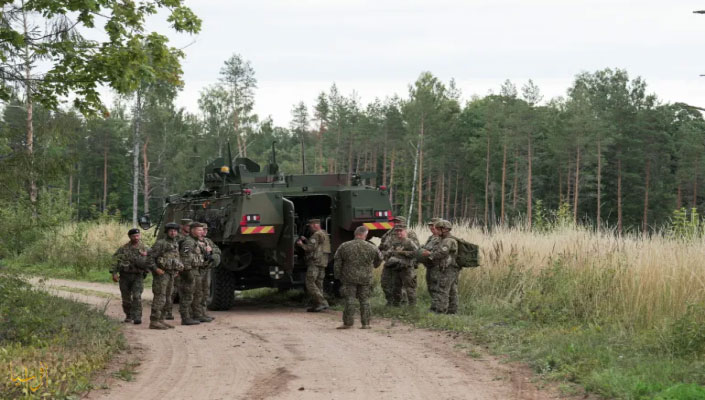
Members of the Latvian National Guard gather ahead of a search for the wreckage of an intercepted drone (Reuters)
Desire, Ability, and Readiness
The alliance is now responding by consolidating its strength on Latvian territory, where troops from 12 countries are stationed at the Adazi base near the capital, Riga.
The brigade is part of the alliance's northeastern flank protection mission and is gaining momentum amid "possible attacks from Russia on the Baltic states."
On September 1, the Latvian armed forces announced that the NATO mission to monitor the airspace in the Baltic States had deployed fighter jets.
The move followed a warning of a possible threat in Latvian airspace near the Russian border town of Lodza.
A few weeks ago, Italian fighter jets operating under NATO shot down a drone over Latvian skies.
At the time, the Latvian Armed Forces clarified, in a statement, that the plane entered Latvian airspace "following Russian electronic warfare operations," before it was intercepted over the Balvi region in the east of the country.
In anticipation of similar breaches, the Latvian military announced the deployment of additional air defense units along the country's eastern border, while strengthening airspace surveillance, adding in its statement that "as long as the Russian aggression against Ukraine continues, it is likely that cases of foreign drones entering or approaching the airspace will be repeated."
Earlier in June, French Rafale jets flew a similar mission over Latvia, foreshadowing a direct clash between Moscow and the West.
In a detailed presentation of the capabilities of its eastern wing, NATO said on its website that it was "ready, capable and willing to defend every ally, and any attack on any member state will be met with a strong response."
"Russia has been testing NATO's resolve and ability to respond along the eastern flank for years, and in recent months its reckless and escalatory actions have increased," the presentation said.
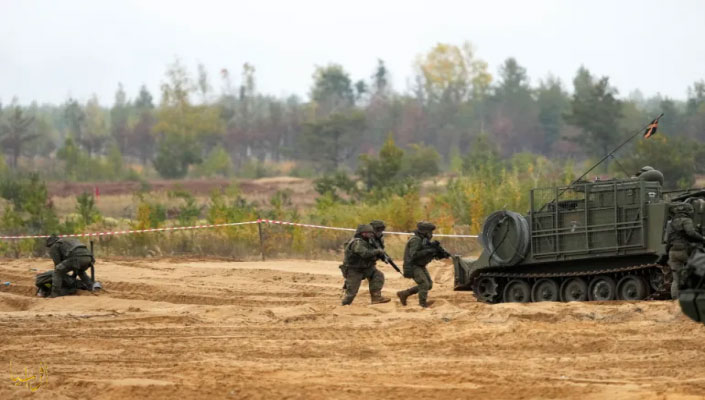
NATO deploys multinational brigade at Adazi base in Latvia (Reuters)
Collective defense and "reassurance"
In a recent military bulletin, NATO stressed that its integrated air and missile defense system "protects allies from air and missile threats coming from all strategic directions, whether they come from states or non-state actors."
"The system includes a set of measures aimed at deterring any party from launching air or missile threats, detecting, disabling and destroying any threat launched if it poses a threat to the security of allies," he said.
According to politicians and experts in NATO countries, Russia is leading a "hybrid war" in the region that could have high-risk consequences, with attempts to test the limits of NATO forces' response.
Earlier, a group of 115 members of the armed forces took off from Valcartier Air Base in the province of Quebec for Latvia.
In the coming weeks, Canadian military personnel will lead NATO's "reassurance" operation, which aims to strengthen the collective defense of allied countries against Russia.
In preparation for this mission, the military participated this spring in large-scale exercises that took place across Quebec.
The Canadian soldiers will be deployed for six to 12 months, according to Colonel David Brasser, who will command NATO's multinational brigade in Latvia.
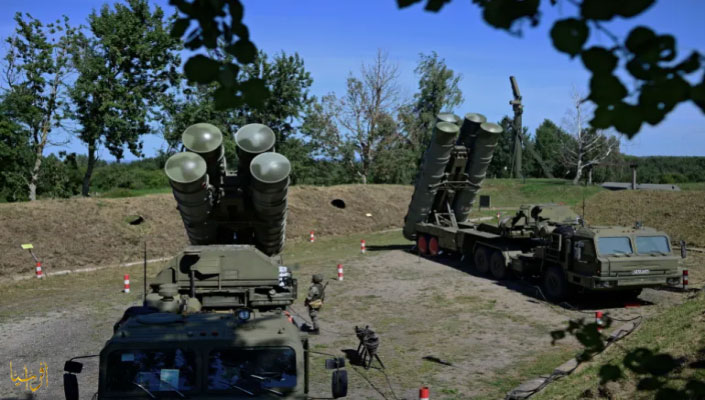
Russian S-400 air defense missile systems during a drill at a military base in Russia's Kaliningrad region (Reuters)
Precedents of plunder and subjugation
Latvia is one of the three Baltic Sea states, along with Estonia and Lithuania. These three countries were among the republics of the former Soviet Union and joined NATO in 2004.
Since these countries are officially members of NATO, they are in a different situation than Ukraine, because any of them have been attacked by Russia means that the West can no longer avoid a military confrontation with Moscow.
In a recent report, the European Institute for Security Studies argues that Russia is already waging a parallel hybrid war targeting power cables and gas pipelines in the Baltic Sea, revealing deep weaknesses at the heart of the European energy system as a whole.
Colonel David Brasser, who will lead NATO's multinational brigade, said: "After more than a year of training, our soldiers are fully prepared."
"We have a well-trained, reliable and combat capability brigade to send a message of deterrence and defense to the Russians," the Canadian colonel added.
In an article in The Atlantic titled "The Baltic States Prepare for War," Isaac Stanley-Baker argues that Lithuania, Latvia, and Estonia are preparing to repel a Russian attack, with or without U.S. help.
Since Russia's invasions of other countries that were part of the former Soviet space, Georgia in 2008, and Ukraine in 2014 and 2022, the prospect of conflict with Moscow has been firmly present in the minds of the people of the Baltic states.
These countries are geopolitically linked to a common experience with Russia that is "characterized by subjugation and plunder," which means that the upcoming attack will not be a cacophony in the course of relations between the two parties.
But the lesson is in the ends: will Russia move to reinstate music teacher Angela to her job, which means making changes to Latvia's borders, identity, and history, or has NATO taken its decision to defend the West's honor, even if it means engaging in a war that will not survive and endure?
________________
Source: Agencies

