
French Financial Advisory: A Time Bomb Threatens Europe
Afrasianet - Mahmoud Al Qassas - France's debt crisis has worsened as investors have turned to a large-scale sale of Treasury bonds, sending yields soaring to the highest level since 2002, after confidence in the Paris government's ability to reduce budget deficits and control massive public debt plummeted, especially as inflation soared and the country was deeply politically divided.
The yield on the 10-year government bond rose to around 4.9% at the end of last week's trading, pushing the gap between them and the yield on the same term German Treasuries, which investors consider safer, to exceed 1.2 percentage points, its highest level since 2012, according to Bloomberg.
Concerns in markets about France's public debt escalated after Prime Minister Sébastien Le Cornu presented his draft budget for 2027, which includes a deficit of 5.4% of GDP, up from 5.1% this year, by not approving any increase in the wages of public sector employees and imposing tax increases.
The British newspaper The Telegraph noted that Le Cornu had previously targeted a deficit of about 5%, which he was unable to achieve. The French official had been seeking to reduce the budget deficit by about 54 billion euros (about $60 billion) and is expected to face stiff opposition in parliament, especially from parties demanding the departure of President Emmanuel Macron.
'Punishing France'
The Supreme Council of Public Finance, which is tasked with evaluating the government's financial plans, criticized the prime minister's draft budget, describing the government's plan to control the budget deficit as "limited" and calling for greater efforts to reduce public debt.
Financial markets quickly reacted to the fact that the large budget deficit persisted, "punishing France and its current level of debt," Marie Jaccot, chief executive of the country's asset management firm Edmond de Rothschild, said in an interview with Bloomberg, adding that this may not have happened at the same level before, and that the negative outlook on French debt risk is exacerbating.
The Telegraph noted that investors are now viewing France as Europe's new "sick man" as its debt crisis deepened. Greece was given the nickname during its years-long financial crisis from April 2010, and the European Union and international institutions such as the International Monetary Fund intervened to help Athens overcome its sovereign debt crisis.
Worrying Indicators
According to figures recently released by France's National Institute of Statistics and Economic Studies and quoted by the Associated Press, the contours of France's debt crisis look as follows:
• The total volume of public debt at the end of June was 3.59 trillion euros (about $4 trillion).
• The ratio of public debt to GDP in 2026 reached about 119%, compared to 97.9% in 2019.
• France's gross domestic product (the size of the economy) reached about $3.37 trillion in 2025, according to World Bank data.
• Public debt repayment accounts for about 7% of the French state budget. Interest costs are expected to exceed €90 billion ($101 billion) by 2027, far exceeding the €65.5 billion ($73 billion) the government plans to spend on the education sector.
• France's Treasury has announced it will issue a record 340 billion euros ($382 billion) of debt next year, up 10 percent from the current year.
• France's sovereign debt-to-GDP ratio is almost double that of its eastern neighbor, Germany.
Cost of living
The French prime minister's efforts to cut public expenditures and increase tax revenues come at a time when the cost of living is rising due to higher fuel prices as a result of the US-Israeli-Iran war, which led to a higher-than-expected rise in inflation in the eurozone to reach 3.8% last September, according to data from the European Union Statistics Office (Eurostat).
The cost of servicing France's public debt has exceeded what it spends on education or health, and the European Central Bank is expected to raise interest rates as inflation increases, meaning an increase in France's public debt servicing burden.
Paris needs austerity measures to reduce the budget deficit and exacerbate the debt burden, while the French are suffering from high fuel prices and the overall cost of living, and the public will not easily accept any additional burdens on citizens.
Analysts interviewed by Bloomberg say there are no easy solutions to France's debt crisis at the moment due to the sharp political divide and disagreements between parties over how to handle the fiscal file, a situation that could continue until next year's presidential election.
French voters' resistance
John Hardy, head of macroeconomic strategy at Saxo, who describes France as "Europe's sick man", said that investors are looking forward to French politicians making effective efforts to fix financial conditions, but French voters are resisting the needed reforms, in his view.
"We know from the facts of France's political history that it is very difficult to convince the public of any serious idea, for example, to raise the retirement age, or to take any other similar step," Hardy said, as the masses soon came out angry and protesting.
The only source of reassurance for investors is the safety net provided by the European Central Bank, which sees France as "too big to collapse" as its weight in the eurozone, as its second-largest economy, means that any financial collapse will spread to the rest of the eurozone.
Credit Rating Mode
Mike Bell, head of market strategy at RBC Blue Bay, told the Wall Street Journal that credit rating agencies could downgrade France.
Bell added that the yield difference between French and German 10-year bonds could reach unprecedented levels if right-wing presidential candidate Marine Le Pen becomes the frontrunner to win next year's election.
Leftist candidate Jean-Luc Mélenchon has proposed a freeze on the ECB's government bonds in order to stop paying interest on them and provide liquidity for public spending.
ECB President Christine Lagarde was quick to dismiss the proposal, saying it was a clear violation of the EU treaty, which prohibits central banks from financing government debt.
It is clear that, in light of France's political struggles, the implementation of any effective policies to improve the state of public finances is linked to ensuring that it has a political bid in parliament, and until this is achieved, the pressure on France's budget will continue, and the size of its sovereign debt will continue to rise.
The writer Abdulrahman Jumaat says: France is facing increasing fiscal pressures as public debt, weak growth and deficits continue to widen, while the energy crisis and international tensions are making the economic landscape more difficult. Reform options look difficult in a divided political climate and the approaching presidential elections scheduled for May 2027.
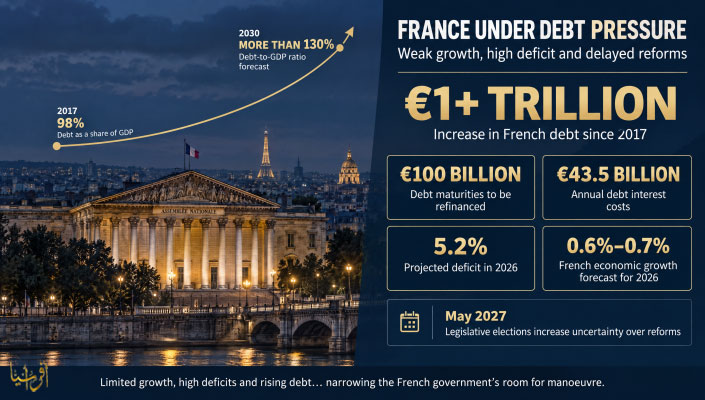
France's debt has risen by more than €1 trillion since President Emmanuel Macron took office in 2017, when it was equivalent to about 98% of GDP. Official forecasts suggest it will rise from 118% to more than 130% by 2030.
Between cutting public spending and raising taxes, the government finds itself facing politically costly economic decisions, at a time when the debt bill is growing and the economy's ability to grow remains limited.
Debt, deficits and weak growth are economic pressures that interfere with France's policy calculations
Debt is inflated and growth is not enough
The pressures do not stop at the size of the debt alone, as France is facing modest economic growth. The French central bank expects the economy to grow by 0.7% in 2026, while the International Monetary Fund estimates it will not exceed 0.6%.
According to the Bank of France's forecast for June 2026, the economy is expected to grow by 0.9 percent in 2027 and 1.1 percent in 2028. In contrast, annual inflation rose to 2.1 percent in July, according to the French National Institute of Statistics and Economic Studies (INSI).
Camille Al-Sarri, a professor of economics and international relations at Sorbonne University, believes that tackling the debt crisis is linked to the economy's ability to regain stronger growth, as it is difficult to continue to finance spending and public liabilities as economic activity slows.
Al-Sari told Al Jazeera that France has been affected by a series of crises, from the Corona pandemic to the war in Ukraine and the war on Iran, pointing out that the country is a net importer of oil and gas, which makes it more vulnerable to the repercussions of energy market turmoil.
Interest on debt. A bill that expands
Pressures are also reflected in the cost of servicing debt, with interest on debt in the first half of this year reaching €43.5 billion. France needs to achieve annual savings of up to €100 billion, in an equation that puts the government with sensitive choices related to public spending and revenues.
Sari said that reducing the deficit and debt cannot be done through a single action, but needs to be addressed more broadly, including the way in which expenditure is managed and the state's ability to stimulate the economy and achieve sustainable resources.
He predicted that the deficit would reach 5.2% of GDP in 2026, before rising to 5.7% in 2027, adding new pressure on France's public finances.
Reform collides with politics
But the numbers don't tell the whole story: reforms that could ease the debt burden and deficit are colliding with complex political and parliamentary calculations.
Camille Sarri, a professor of economics and international relations at Sorbonne University, said the absence of a coherent parliamentary majority makes it more difficult to pass drastic economic measures, especially if they involve spending cuts or tax increases.
The approaching presidential elections in May 2027 compounds the sensitivity of these options, he said, as unpopular decisions could turn into electoral costs for the political forces that adopt them.
The debt and deficit crisis also confront the French government with sensitive economic choices. Cuts in public spending could raise social and political objections, while higher taxes could add burdens on individuals and businesses.
Postponing reforms avoids a temporary political clash with the government, but it keeps debt, deficit pressures, and the cost of financing remaining.
The challenge is not limited to choosing a specific economic measure, but also the government's ability to provide a political consensus that will allow it to be passed and implemented, especially with the presidential elections approaching.
Buying for time or postponing the cost?
France's debt crisis does not seem to be just a matter of budget numbers, but a test of the government's ability to make tough fiscal decisions at a time when growth remains weak, deficits are high, and the cost of borrowing is increasing.
Between austerity, taxation, and the postponement of reforms, France is faced with an open question: Will it succeed in addressing its fiscal imbalances before its economic cost becomes a greater political burden?
________________
Source: Bloomberg + Telegraph + Wall Street Journal

