
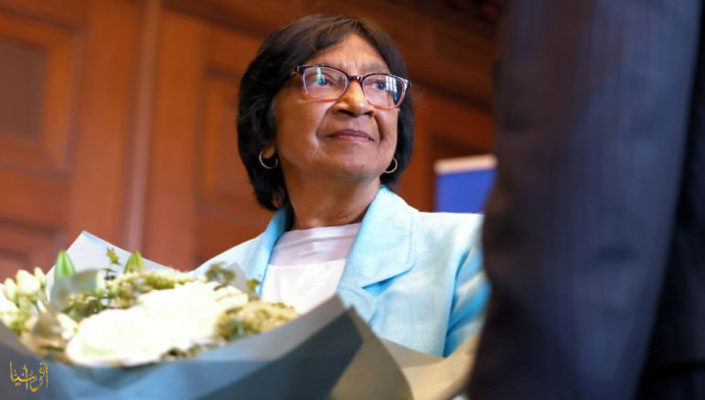
Navi Pillay at a press conference at the International Academy in Nuremberg, Germany
Afrasianet - The Norwegian Nobel Committee announced on Friday that it has awarded the 2026 Peace Prize to South African judge Navanithim (Nephi) Pillay, in recognition of her role in promoting international law and prosecuting perpetrators of war crimes, crimes against humanity and genocide. The decision was widely welcomed internationally, from the United Nations to judicial and human rights institutions, while the announcement sparked Israeli outrage, embodied by statements by the Israeli Foreign Ministry accusing the judge of promoting lies and hatred, likening her to Joseph Goebbels, the Nazi propaganda minister, and accusing the Nobel Committee that elected her of "adopting a propaganda line that serves Hamas."
Israel's attacks on Pillay follow previous campaigns against the famous judge since she chaired the International Independent Commission of Inquiry (ICICI) that concluded in September 2025, until Israel committed genocide in Gaza. But what distinguishes this latest report is that it was the conclusion of a long career for the judge, which began with the struggle against apartheid in South Africa, through her role in the trials of those responsible for genocide crimes in Rwanda and international investigations related to war crimes, which makes the genocide in Gaza part of a global legal process that cannot be separated, and because it places the Palestinian issue at the peak of this path, it strongly highlights Israel's role in it, and transforms the award from a tribute to a judicial figure who defended the universality of law to a major occasion to condemn the Israeli genocide and to an astonishing global political polarization in its diversity and deep meanings.
This polarization can be read in the context of major shifts in the world's political, cultural, and identity spaces, as Palestine has become a huge "brand" that opens up in the fields of ideological, political, and cultural affiliations.
This is evident, for example, in the transformation of Palestine into an electoral issue within Western political trends, as we recently witnessed when the British Green Party restored the UN resolution (which was abandoned in 1991) to consider Zionism a racist movement, and as we have witnessed, in the rapid positions taken by new right-wing governments in Latin America (Colombia) and Europe (Slovenia), after the formation of right-wing governments, to repudiate the positions taken by left-wing governments towards Palestine. The latest manifestation of this phenomenon was manifested in Benjamin Netanyahu's call for presidential candidate Flavio Bolsonaro to Israel, in response to current President Luis Lula da Silva's pro-Palestinian positions.
The deeper side of this issue is that it is not limited to governments but has gone deep into personal affiliations. In the recent French student protests, for example, 17-year-old high school student Elwan Benoit, wearing a Palestinian keffiyeh, appeared discussing the state of education, social inequality, and the marginalization of the French suburbs. A video of him confronting a right-wing media outlet who tried to refute his proposals went viral, and the matter turned against him, becoming a student A symbol of youth protest, his recordings are circulated by dense French and Arab audiences.
For the above reasons, the Pillay Prize is of great importance because it comes at a time when the conflict is no longer only about the application of international law, but also about the legitimacy of the institutions that govern it, the powers to define crimes and victims, and who truly deserves global moral recognition, after the institutions that are supposed to guard universal values have become part of the struggle over those values.
The great irony here is that the Palestinian cause is achieving an increasing presence in the global political and cultural consciousness, but this heavy presence does not turn into actual protection for the Palestinians, or the transfer of accusations against the perpetrators of crimes against them to a higher level.
In her first comment after receiving the news of her award, Pillay said, "The last thing I did was prepare the Gaza report that describes what is happening there as genocide," and continued: "Why do you need the courage to tell the truth? You interpret the law and look at all the facts, so it's an honest decision." With her win, in effect, Pillay turned the question into a general human moral responsibility.
US President Donald Trump expressed his displeasure at not receiving the Nobel Peace Prize this year, saying he had "never heard" of the prize winner Navi Pillay.
"The United States, represented by me, I'm your president, should have won the Nobel Peace Prize, but that didn't happen," he said at a rally in Syracuse, New York.
"It is an indelible stain on Norway and those who made this shameful and embarrassing decision. The Nobel Peace Prize has been discredited forever by a handful of extremist anti-democratic ideologues who are in fact enemies of civilization."
He pointed out that the United States' failure to award the Nobel Peace Prize is further proof that Norway and other parties are exploiting his country, saying that "the decision not to award us the Nobel Peace Prize is disgraceful and shameful."
An urgent desire to win the Nobel
Since returning to the White House in January 2025, Trump has made no secret of his desire to win the Nobel Peace Prize.
But his war against Iran, his expansionist ambitions, as in Greenland, his hardline stance on migrants and his attacks on the media have excluded him from the list of eligible candidates, according to experts in Oslo who spoke to AFP before Pillay was announced the winner.
The prize includes a gold medal, a certificate and a cash prize of $1.2 million.
________________

