
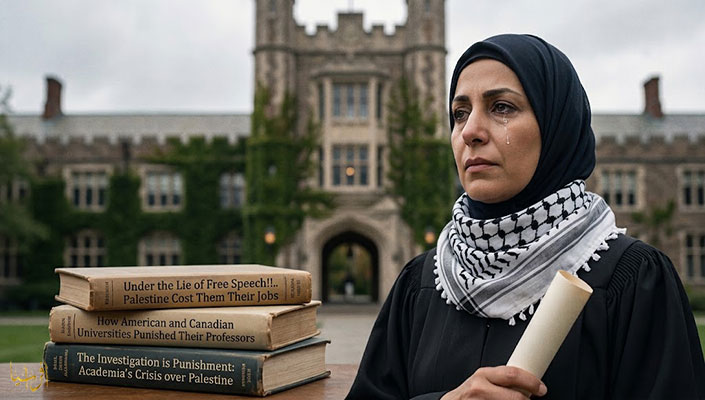
Afrasianet - University professor Andrea Brauer didn't expect her solidarity with the Palestinians and her defense of students' right to demonstrate would lead to a seven-month investigation that ended in her losing her job at Gonzaga University.
Her ordeal began with a complaint accusing her of anti-Semitism, and then accusations continued for her participation in a protest, her signing a letter in support of students' right to demonstrate, and circulating a call for a vigil to mourn the victims of the war.
Although the investigation did not substantiate the original accusations, the pressure and actions she was subjected to led her to leave the university in July 2025, according to her testimony in a new report by the Middle East Studies Association.
Brouwer's story is no exception, as the association has documented 196 incidents that it said represent reprisals against professors and staff at universities in the United States and Canada for their pro-Palestinian rights positions since October 7, 2023.
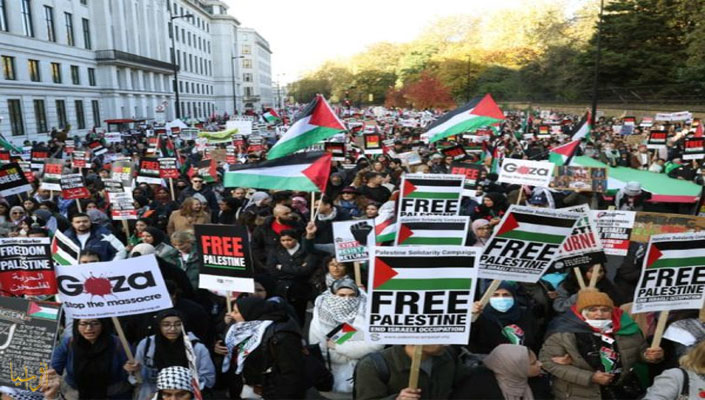
Pro-Palestinian Demonstration at an American University in Light of the Student and Academic Movement in Support of Gaza
76 Lost Jobs
The report, titled "Lessons in Repression," revealed that 76 incidents, or about 39% of the documented cases, ended in termination, compared to 59 cases of suspension or denial of entry to the university, 35 cases of investigation, and 26 cases of reprimand or other measures.
Its authors were based on interviews with 31 academics and staff who had been subjected to punitive measures, in which they concluded that university administrations had used investigations and disciplinary measures to restrict expressions of solidarity with Palestine.

Threats to families
At Washington University in St. Louis, anthropology professor Brett Gustafson was subjected to a campaign of threats after a social media post in which he expressed support for a protest in front of the home of an official of the American Israel Public Affairs Committee (AIPAC).
According to his testimony, he received dozens of death threats, photos of his home were posted online, and the harassment reached his children's school, prompting him to seek police protection.
But instead of protecting him from threats, the university has assigned officials to attend his lectures under the pretext of ensuring the safety of students, according to the report.
At Indiana University, police arrested seven professors during pro-Palestine protests, after some tried to protect students from security interference.
One of them, who did not want to be named, recounted that police threw him to the ground and arrested him, before the university barred him from entering the campus for a year. Although prosecutors declined to bring criminal charges, he said he later received death threats.
Investigation is a punishment in itself
The association says some universities have used anti-Semitic complaints to open lengthy investigations of academics for criticizing Israel or defending Palestinian rights.
Among the cases documented in the report was University of Arkansas professor Mahaja Qahf, who was investigated for pro-Palestinian posters on her office door.
According to the report, the proceedings continued even though the student who raised the complaint did not want to file a formal complaint, and the investigations ended with the professor being considered a violation of the university's policy on discrimination.
Academics also spoke of investigations that, according to their testimonies, lacked clarity and defense guarantees, some of which lasted for months, making the proceedings themselves a means of pressure and intimidation.
Outside the classrooms
The report data showed that 54% of the incidents were related to on-campus activities outside the classroom, 16% to off-campus activities, and 12% to social media posts, and only 11% related to teaching itself.
The researchers found that two-thirds of the cases in which racial identity information was available related to people who were minorities or non-whites.
The report accused politicians, donors and members of university boards of trustees of exerting pressure that contributed to the measures taken against pro-Palestine workers.
The Association for Middle East Studies warned that punitive measures against professors and staff for their pro-Palestinian positions threaten freedom of expression and academic independence at U.S. and Canadian universities.
The report concludes that the effects of sanctions do not stop at job loss or investigation, but extend to creating a climate that pushes professors and staff to remain silent for fear that expressing their political positions could become a threat to their future careers.
________________

