
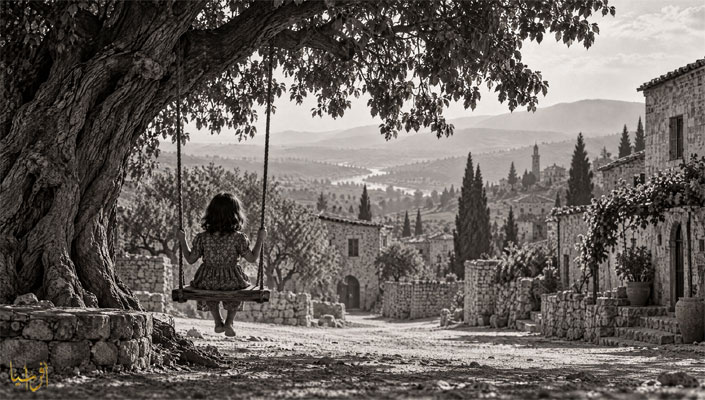
Afrasianet - Munther Abu Haltam - It is enough for me to know that time, with all its cruelty, could not take away from my soul the smell of the tabun, nor the roughness of the stone, nor the warmth of my grandfather's hand, nor the dust that hung on the shoes of a little boy, and still, 55 years later, refuses to fall.
Whenever I try to remember my village, the colors disappear first. I don't know if time stole it, or if my memory hid it in a place where the hand can't reach. I close my eyes and see the houses, the alleys, the faces, the trees, but I see them all in black and white, as if someone took an old photo of my childhood and then forgot to return the colors to it.
I was six years old, and I don't know why I feel, after 55 years, that I had never visited the village, but that I had a dream, and that I had left enough in my heart to spend the rest of my life looking for it.
I remember the road to it more than I remember the way from it. The dust was running behind the cars, and then he came back to the ground, reassuring as if he knew he would never leave them, and on both sides of the road the fields stretched out without a hurry, while I glued my face to the windshield, trying to memorize everything, not knowing that I would need those details after a lifetime.
The first thing that greeted me was my grandfather's house, or perhaps the huge pine that shaded it, and to this day I can't separate them. I used to think that the house had grown under it, and that its roots extended in its walls as it did in the ground. It would cast its shadow on the stone plaza, so that the day would cool down a little, and the meeting under it would become a small feast that needed no occasion. I would sit at its trunk, lift my head so that the branches would intertwine with the sky, and I would feel the innocence of the children that the big trees knew secrets that they could only tell the birds.
Around the houses, the cactus stood in silence. I never understood why people chose it as a wall for their homes. I saw it as a good neighbor rather than a guard who had been standing in its place for countless years. He knew those who came in and out and only bloomed once a year, to confirm that patience for a long time is not without reward.
In the middle of the square was an old mulberry tree, from one of its branches dangling a hammock made of two ropes and a wooden board.
I ran to it every morning and pushed it with my feet until it almost touched the sky. Every time I climbed up, the village seemed smaller, the houses were closer together, and the people seemed like one family that had come out to breathe the air.
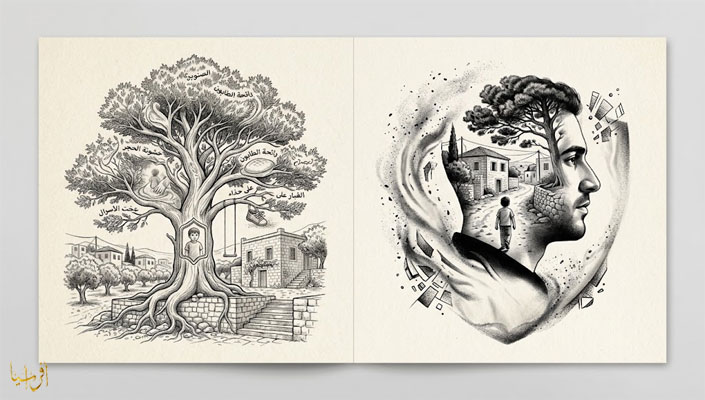
Sometimes I would close my eyes while swinging, and I didn't know I was training, because I didn't feel like I was traveling the long way between being present and absent.
In the evening, the square was full of people, and they said there was a wedding. I didn't understand the meaning of the wedding that day, but I understood the joy. The tambourines were beating like the heart of the village, the feet were beating the dirt and the dust was dancing with them, the women were releasing their trumpets, and the men were clutching their hands in the dabke.
I was looking through the faces, taking in that secret that makes people all smile at the same moment. I don't remember the faces of the newlyweds, but I still remember that the night for the first time, seemed to me to be illuminated without a moon.
In the morning, the smell of the tabun woke up the alleys before the people. The smell knew the way alone. It would come out of my grandmother's house, pass by the neighbors, and then mix with the smell of firewood and flour, until I imagined that the whole village was one loaf breathing.
Next to the little shop, my grandfather sat quietly, like olive trees. The shop wasn't big, but it could accommodate everything. Bags of wheat, oil sheets, colorful sugar grains, men's talk, and children's laughter. I would walk into it and feel like the whole world could be placed on modest wooden shelves.
Near the shop was an oil press, and to this day, if I touch my nose with the smell of new oil, I have seen the huge stone spin slowly, and I have seen the green oil flowing as if the trees are melting their ages in a small pot. As for the wheat mill, I can still hear its roar whenever there was silence. Its sound was like a deep pulse coming out of the heart of the earth.
The strange thing is that I don't remember the day I left, I look for it and I can't find it, as if someone tore up the last page of that day and left me only the pages that preceded it. I don't remember saying goodbye to the pine tree, the hammock, the cactus, my grandfather's shop, the tabun, or the dirt alleys that kept our feet safe. Maybe because a six-year-old child doesn't know that some doors, if closed, can take a lifetime to open.
Fifty-five years have passed, during which cities have grown up, others have disappeared, and many faces have changed. As for Kretif, she is still six years old. She still waits for me in the shade of the pine and lets the swing move a little, as if a child had just gotten up from it.
Whenever I close my eyes, I walk through its alleys again. I don't ask if the houses are still standing, or if the trees are still blooming. Suffice it for me to know that time, with all its cruelty, could not take away from my soul the smell of the tabun, the roughness of the stone, the warmth of my grandfather's hand, or the dust that hung on a little child's shoes, and still, 55 years later, refuses to fall.
________________

