
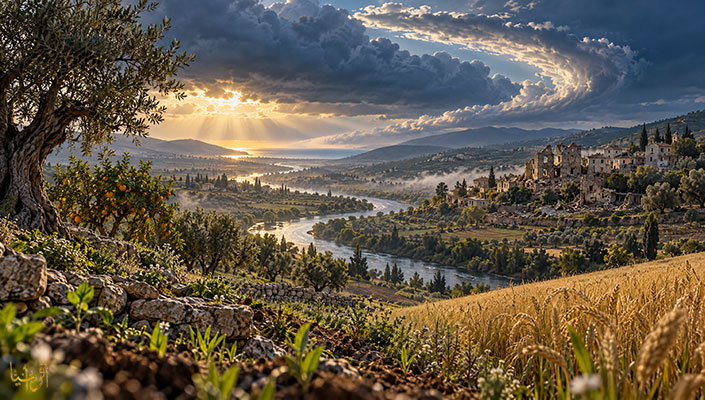
Afrasianet - Zahi Wehbe - We return because our return is not an end-of-life run, but an eternal cycle: we evaporate in the pain of absence, we intensify in the hardness of determination, and then we rain on our land to irrigate the olive roots and tobacco seedlings, and to tell the clouds that carried us that the estuary was never the end of the river.
At first glance, it seems to us that the river does not return, and that its flow from its source to its mouth is irreversible, as if age is a straight line that does not turn, as if every beginning is doomed to an end. But the river returns. Yes, it returns. It does not return as passers-by think, nor like a torrent that recoils on its heels. It returns in silence without a rumble, and in a way that does not resemble its first flow, as if there are two paths in this universe, one visible to the eye, and the other read by the Spirit.
We return to the south, the return of the soul to its body after an absence, or the return of the body to its soul that awaits it on the threshold of the first tremor. A return like birth, carrying its secret and leaving no trace of it, like a river that goes to the sea and does not ask it for the taste of salt, it gives it its sweetness in silence. But after it has given all that is in it, it returns. And the secret is how it returns, and this is what we know when the spikes tell their story, when the pebbles reveal the names of those who return, and when we reach the end of the speech.
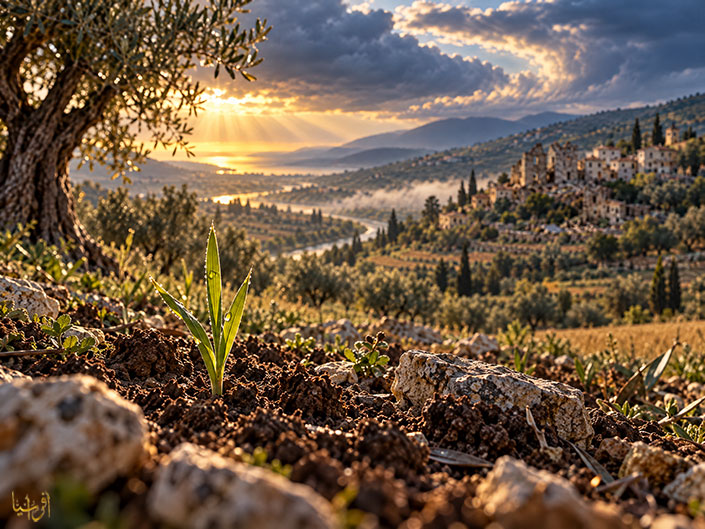
This return is an attraction to the original after being forcibly uprooted, when fire used to write our biography with gunpowder on pages of dirt and stone partitions, and when the aggression redrew our maps on the foreheads of children every summer, erasing what it had written, and then returning to erase it again, so that our borders would remain suspended between one blood and another, and between the smoke of one raid and another.
The south to which we return has carried us through the years of our lives under the weight of unquenchable fires, and invasions that follow like seasons. But it is also a picture lemon, in its shell the bitterness of absence and the sweetness of return, and its oranges flowing like a miniature sun hiding in the shell.
The olive of Kafr Kalla, which stood for centuries on the borders of the invaders, and every trunk of it became a record of steadfastness, the monastery of Mimas hanging from its sides with vines and its slopes covered with blessed olives, and the plain of tents, where the ears of wheat ripple like the sea, bowing their heads to the soil with reverence for the worshippers, as if declaring that bread in the south is baked on the fires of aggression, and that the harvest will come, even if it is 1000 years late, because the seeds know that the land does not betray those who sow it. Here, the ears sprout stubbornly among the fragments of the rockets, and shout in the face of the tanks: You cannot burn a spike that has been carrying in its hollows for so long.
Ainatha vines mix the sweetness of the soil with the bitterness of the years, and the tobacco seedlings in Aita and Mays al-Jabal stretch out their broad leaves like open palms that receive rain and gunpowder together. The farmer grows them between two rows of leads, and picks them with hands that never tire of shaking hands with the rich, and this plant that does not burn comes out of the heart of the fire.
From the row of air in Bint Jbeil to the pine of the jarmac and basil, which raises its branches like hands in prayer, and the roses sprout on the thresholds like the smell of safety that never leaves.
Lemons are picked from under the lead, oranges fall with bombs, and their juices are mixed with stone dust, but the olives burn in seasons and their trunk remains steadfast, and the next year new branches return, as if the earth teaches us that life resists fire with the determination of the pulse.
Beneath those trees, the sacred ancestors embrace bones that did not yield, and the tombs of martyrs have turned into hidden seeds that have penetrated the roots of figs, olives, and wheat, as every handful of dust here tells the biography of those who recommended their return before they left, and their souls become dew that waters the ears at every dawn, as if the entire south is a paradise in which memory is green like wheat in every season.
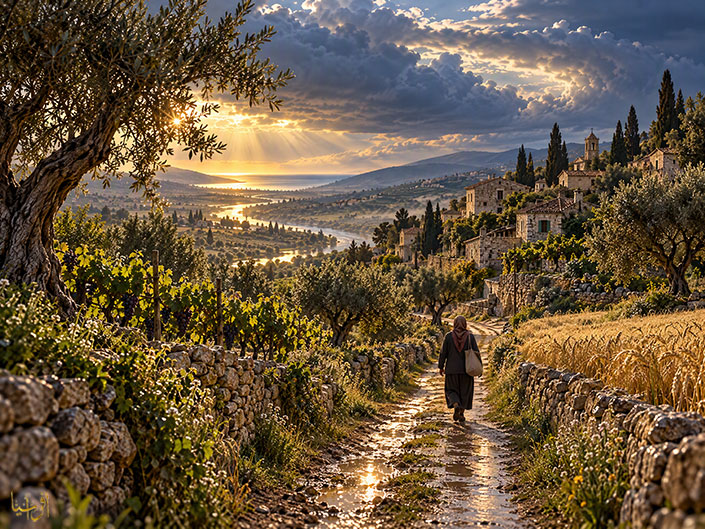
This south, today, at this moment, is not an image that hangs in the memory. It is here, under a sky that is still trembling from the hum of planes, and on a land that is still bleeding under the rubble of the recent aggression. It is the displaced person who returns to his feet, finds his village in ruins, cries, and then wipes his tears with a spike that has stubbornly sprung in the rubble, as if to say to him: "I am sprouting in your absence, so how can you not sprout?" Here, the return is an act of daily resistance, a break of the siege with the harvest, and a response to the aggression by saying that the south does not die, because it sows where it is destroyed, and it returns where it is abandoned.
Despite all this, the roots pull us from under the rubble, and the pores of the earth breathe our names in our absence. We did not leave voluntarily, the biography of fire carried us to where we did not want to, and the aggression wrote on our backs as a temporary title. But we knew, as we moved away, that the south remained here with its oils, oranges, and spikes that awaited us as resisters who did not give up. It waits, like wounds that heal only when we return, and as a promise that can only be fulfilled if we step on its soil again, even if only on our tiptoes.
Now we return, knowing that the land on which we walked has not forgotten us, and that the wind that carried the dust of the houses is looking for us, to give us back what the fire has taken. We return to touch the fig leaves with our palms, and to pick the grapes with hands that have become handkerchiefs of longing for the absentee, and to sit on the shore of Tyre where the waves bring back to us the pebbles of our childhood, and we stand at the ancestors of the martyrs to tell them that we have fulfilled our promise, so that we and they become one body that penetrates this day.
The south is waiting for us here, every lemon that says "you are late", every olive shouts "You have come", and every spike that cries in the wind "I have carried your sweat and blood in your absence, and today you have come to take your share of bread and dust".
Here, at the threshold of the end, the secret that we have been glimpsing in the morning dew is revealed, in the vapor of the earth after the rain, and in the southern cloud that does not leave its sky for long. Here we are back, like a river that does not die in the arms of the sea, but evaporates a light dew, ascending to the sky in a cloud that knows never to be lost, and then drops return to the dust of the south, washing away the wounds of the stones and reviving the wheat seeds that have slept long under the ashes.
We return because our return is not an end-of-life process, but an eternal cycle: we evaporate in the pain of absence, we intensify in the hardness of determination, then we rain on our land to irrigate the olive roots and tobacco seedlings, and to tell the cloud that carried us that the estuary was never the end of the river, but a promise to return when our water becomes rain that knows how to seep into the cells of the earth.
Thus we return, each drop of us carrying the salt of the sea and the sweetness of the spring together, as if the earth were reshaping us from its vapor, so that we do not stay away for long, because the clouds in our south have an inexhaustible date, and the rain in our soil has an inexhaustible secret.
________________

