
The government avoided a direct diplomatic clash by avoiding the noisy declaration of political and sovereign annexation, and instead resorted to engineering "a silent legal and administrative annexation that reshaped the bureaucratic structure of the occupation from its roots.
Afrasianet - Nevin Abu Rahmoun - The rise of the religious nationalist right in Israel to the forefront of the executive scene was not just a passing shift in the balance of party alliances, but rather an epistemological and political break with the doctrines that governed the approach of the ruling system to the Palestinian conflict for decades.
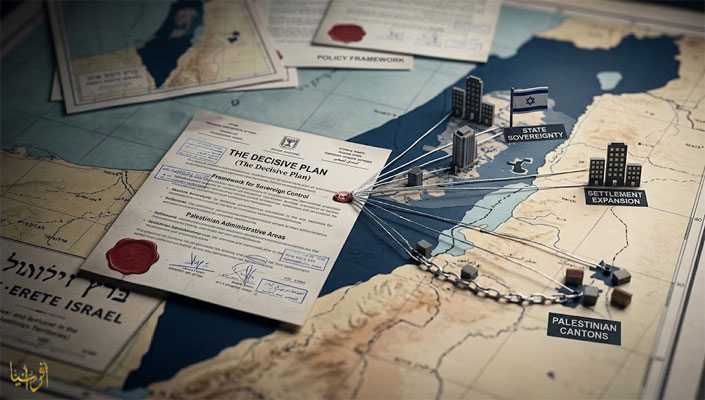
However, the "Decisive Plan" (the Decision Plan), formulated by Bezalel Smotrich in 2017 and published in the journal Hashiloah, came to undermine the underlying logic of both tracks, considering that the idea of managing the conflict is nothing but a tactical illusion and a structural impotence that must be discarded in favor of a decisive historical option that would eliminate any possibility of the establishment of a Palestinian political entity and impose absolute and complete Israeli sovereignty over the entire geographical space west of the Jordan River.
This thesis is based on a radical dismantling of the previous premises, based on the premise that the conflict between the Zionist movement and the Palestinian national project is an existential conflict that is zero in nature, with which it is impossible to reach a coexistence settlement or even preserve the status quo indefinitely.
Based on this doctrinal vision, the plan proposed a coercive equation that left Palestinians with defined choices: either accept Israeli sovereignty and live in dismembered geographical enclaves run by municipal and local councils deprived of any political representation or national aspirations, or leave the country voluntarily in exchange for incentives and financial compensation paid by the state to empty the land demographically, or confront the machine of military decisiveness and security eradication without legal restrictions or considerations of proportionality for anyone who raises the banner of resistance or refuses to acquiesce.
Although traditional political and security elites have treated these proposals for years as radical ideological discourse isolated on the margins of pastoral settlements, it is the crisis of the Israeli political system that has paved the way for them to pass directly to the heart of power.
The protracted constitutional and partisan crisis between 2019 and 2022, which saw five consecutive election rounds, eroded the traditional power centers on the right, and coincided with a judicial and personal impasse that besieged Benjamin Netanyahu and threatened his political future. In the midst of his search for a solid parliamentary bloc that would not back down from his support, the prime minister's pragmatic interest intersected with the ideological program of the Religious Zionist movement and the Jewish Power Party, creating an implicit and tight political deal based on trading Netanyahu's survival and securing his political and judicial immunity by handing over the keys to control of the West Bank and the Jewish Power movement.
This convergence culminated in the December 2022 coalition outline document, which opened its program with a decisive and unambiguous declaration that the Jewish people alone have an exclusive and inalienable right throughout the Land of Israel, officially dropping even the rhetorical cover that Tel Aviv had been using to the international community about the two-state option or future negotiations.
The government avoided a direct diplomatic clash by avoiding the noisy announcement of political and sovereign annexation, and instead resorted to engineering a "silent legal and administrative annexation that reshaped the bureaucratic structure of the occupation from its roots", as it created a second civilian minister in the Ministry of Defense, whose powers were detailed to the size of Smotrich, and the "Settlement Administration" was formed to extract the files of planning, land registration, and enforcement from the grip of military officers in the Civil Administration of the Central Region Command.
This measure brought about a pivotal shift in the nature of governance, as the administration of settlements and its expansion projects turned into a civilian sector that reports directly to the Israeli ministries of state and applies the laws in force within the Green Line, while the Palestinian population remained subject to exceptional military orders on the same land, thus enshrining a declared and fully structured institutional and legal separation structure under the supervision of a legal and ideological team loyal to the settlement project that was appointed as an alternative to the classic military prosecution consultations.
At the legislative and executive levels, during the first nine months of 2023, the government proceeded to dismantle all the tracks of control and braking that the security system used to put in place to curb settlement escalation, so that essential parts of the "disengagement" law were repealed to open the door to the reoccupation of the northern West Bank and the legalization of isolated outposts such as "Homesh", which constituted a message that the era of settlement evacuation or unilateral withdrawal has been irreversibly folded.
This was accompanied by the adoption of Government Decision No. 47, which reduced the stages of approval of settlement construction plans from six gates requiring the approval of the Minister of Defense and the Prime Minister to a single planning stage that falls entirely under the supervision of the Smotrich administration, which opened the door to a record approval that exceeded 13,000 settlement units within a few months, in addition to giving a wide cover to the phenomenon of "pastoral settlements", which was used as a spearhead to expel the Palestinian Bedouin and pastoral communities in Masafer Yatta and the Jordan Valley with the force of intimidation, cutting off tens of thousands of dunams without the need for official confiscation procedures.
This geographical engulfment paralleled a systematic process of dismantling the functional elements of the Palestinian Authority, based on the first principle of the Decisive Plan, which is to strip the Palestinians of any representative framework, as the Ministry of Finance unleashed a severe campaign of financial attrition by deducting hundreds of millions of shekels from Palestinian clearance funds under various pretexts, ignoring the serious economic consequences on the ability of Palestinian institutions and institutions to operate.
This financial strangulation coincided with the near-total closure of the urban and urban development potential of Palestinians in Area C, tightening restrictions on movement and linking the networks of bypass settlement roads to tear off communication between Palestinian governorates, and turning cities and villages into closed population cantons that are easy to suffocate and subject to security when needed.
This accelerated transformation has sparked a sharp and unprecedented clash within Israel's deep state, where the traditional army leadership (especially the Central Region Command) and the Shin Bet security apparatus found themselves in an open confrontation with coalition ministers and settlers.
On the other hand, right-wing ministers and their allies in the Knesset launched a scathing attack on the military leaders, accusing them of submitting to "defeatist concepts inherited from the Oslo era," exerting political pressure to restrict the prosecution of settler attacks and obstructing the evacuation of slums, and even accusing the security establishment of betraying the Zionist project when it classified the attacks on Huwara and neighboring villages as "national terrorism."
While the military was depleted in containing the West Bank and engaged in an internal conflict to repel the incursion of settler leaders, the Military Intelligence Division and the Southern Command continued to adopt a comfortable assumption that the Gaza Strip was economically neutral, and that Hamas was deterred by financial facilities and workers' permits.
What was missing from the intelligence assessment centers was that The sweeping proceeding with the implementation of the "Decisive Plan" in Jerusalem and the West Bank, by imposing the realities of Judaization on the ground, canceling political prospects, and depleting the elements of Palestinian steadfastness, would not have passed in isolation from the dynamics of the total conflict, as this transformation contributed to emptying any possibility of mediation or calm, turning the conflict into a fateful and zero-sum confrontation, so that the thesis of decisiveness, which began in the pages of an intellectual magazine, became the objective engine of Israeli policies and the structural lever that accumulated the causes of the great explosion on October 7.
________________
Nevin Abu Rahmoun - Palestinian writer and politician.

