
The significance of what is happening in France lies in the fact that it confronts the West with a broader question than Islam itself: Can it explain its crises from within its own structure, or will it return to looking for an adversary that will give it a simpler interpretation of a world that has become more complex?
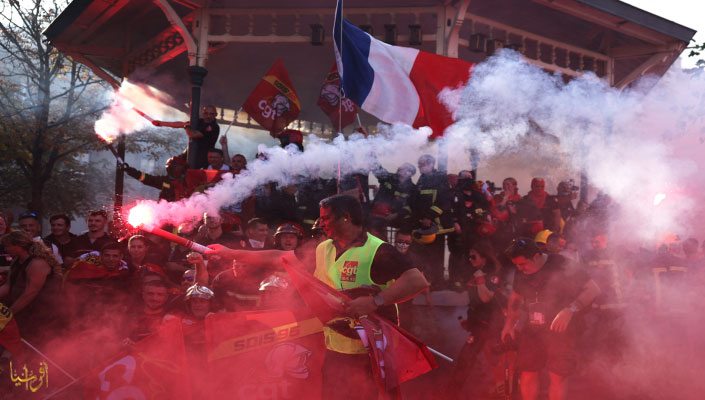
Afrasianet - Shaher Al Shaher - France has been witnessing a wave of protests since late September, starting in secondary schools, after students took to the streets to protest the lack of teachers, overcrowded classrooms, the deterioration of some educational buildings, the length of school hours and what they see as a decline in the level of public education.
In less than two weeks, the movement has expanded from poor suburbs around Paris to several French cities, with more than 1,000 affected schools before the protests morphed into a national movement involving students, teachers, parents and unions.
On October 6, the Interior Ministry estimated the number of participants in the movements at 266,000, while the number of arrests since the beginning of the protests exceeded 6,000, most of them minors.
At the outset, this movement was not a protest against immigration, religion, or foreign policy, but rather an expression of a clear internal problem related to public services and the future of a generation that feels that the state, which is supposed to provide them with a safe path to university and work, does not even provide them with basic conditions in school.
As the protest grew, other issues related to poverty, social inequality, the police and the future of young people entered the school, transforming the school from a place of education to a space where broader feelings about the state, society and the future gathered.
This is where the importance of the French landscape begins, because the school crisis cannot be separated from the crisis of the state that finances it. France wants to maintain its social model, while facing high public debt and budget pressures, wants to increase defense spending in a turbulent European environment, participates in supporting Ukraine, and deals with the fallout from wars in the Middle East and rising energy prices.
Therefore, the question posed by the protests, even if not coined by the students, is about the state's ability to continue to deliver on the same promises in a world where the cost of security, energy, and war is much higher.
When War Reaches School
The Ukraine war is no longer an external issue for Europe in the sense it was at the beginning. It has become tied to the rebuilding of European military capabilities, to defense spending, to energy prices, to the reordering of economic relations with Russia, and to the debate about the size of the obligations that European governments can afford in the coming years.
The longer the war drags on, the more complex governments face the equation between what they want to spend on security and what society needs to spend on education, health, and social protection.
France is more sensitive to this equation because it wants to play an independent role within Europe, push for a greater European defense capability, and continue to support Ukraine, without abandoning the social state model that is an essential part of the republic's legitimacy.
Therefore, it is not true that the war in Ukraine has taken students to the streets, but it is true that the war is part of an environment in which the space for financial and political decision-making for the French government is limited.
The Middle East war added new pressure to the equation, especially with rising energy prices and disruption of trade routes. The International Monetary Fund has warned that the fallout from the war and rising energy prices are putting pressure on the French economy at a time when it is already suffering from weak growth, high public debt, and fiscal pressures.
In the Hormuz crisis, the issue is clearer, because the strait is not just a geographical point away from Europe, but one of the corridors that directly affect the global energy market. Although France has a large nuclear base that makes it less dependent on oil and gas than some European countries, its economy cannot be separated from global energy prices or international trade, so any protracted crisis in the Gulf becomes an additional strain on industry, transportation, prices, and the budget.
In this sense, the distance between the school and the Strait of Hormuz is shorter than it appears on the map. Higher energy prices increase the cost of the economy, weak growth puts pressure on revenues, and rising debt limits the state's ability to spend, while wars increase defense and security spending.
Ultimately, this contradiction emerges within the most mundane places in a citizen's life, from the electricity bill to the school his son attends.
From Social Crisis to Identity Crisis
At this point, Donald Trump stepped in, but he didn't read the French protests from the perspective of education, public debt, or teacher shortages. On Oct. 6, he said that what was happening in France was caused by "uncontrolled mass immigration," adding that it was "not about schools," but about Islam, which, in his words, wants to take over France.
The significance of Trump's statement lies not only in its content, but also in the way in which he redefined the event. A protest that began with school and social demands suddenly moved in the American political discourse to the issue of immigration, religion, and identity, as if the problem that drove thousands of students to close their schools was not the lack of teachers or the poor educational infrastructure, but the presence of Muslims in France.
French Foreign Minister Jean-Noël Barrot responded that France should tell its own story, an apparent reference to the rejection of the American reading of what is happening inside the country.
This is where one of the most important phenomena of contemporary Western politics emerges: when a social crisis is complicated, it becomes more politically easy to explain through identity than it is through economics.
The problems of education need to be debated about the budget, public debt, the distribution of resources, the status of teachers, and disparities between regions, while immigration and religion allow the crisis to be reframed in sharper and more polarized language, talking about borders, security, citizenship, and the future of the nation.
This is not to say that problems of immigration, integration, or political Islam do not exist in France, nor that the security concerns associated with extremism can be ignored. But the confusion between Islam as a religion, political Islam as multiple political currents, jihadist organizations as a specific security phenomenon, and Muslim immigrants as part of French society shifts the debate from analyzing the phenomenon to generalizing it. This point becomes even more important when the term "Islam" is used to describe protests that originated in schools.
From the Red Enemy to the Green Enemy
To understand why Islam has so easily returned to the center of this discourse, one must go back a bit to the end of the Cold War. The Soviet Union provided the West with a clear and specific adversary, and the confrontation with it was based on an ideological and strategic divide with institutions, states, armies, alliances, and known borders.
When the Soviet Union collapsed, the international conflict was not over, but the West lost the framework that governed the definition of danger, and new questions began to emerge about the nature of the adversary that would replace communism in the strategic and political imagination.
In the 1990s, theses emerged that linked future conflicts to identity, culture, and civilizations, and then the September 11 attacks came to give "jihadist terrorism" a central place in U.S. and Western strategy.
Al-Qaeda, or later the Islamic State, was not an equivalent alternative to the Soviet Union in terms of power or nature, but the threat picture changed from a Western-facing superpower to networks, organizations, and ideas that could emerge within Western societies themselves.
Hence, the concept of the "green enemy" is taking shape in some Western discourses, not as a unified Western doctrine, but as a transition in the form of an adversary from communism to Islam, political Islam, or jihadist terrorism, and then to issues of migration, identity, and integration.
The problem that has arisen with this transition is that the boundaries between these concepts have become expandable, as the confrontation can begin with a specific terrorist organization and then move to political Islam, then to emigration, and in some discourses to Islam and Muslims in general.
This shift is important because the "enemy" in politics performs not only a security function, but also an interpretive function. When societies face an economic crisis, social unrest, or a sense of loss of control, the presence of an apparent adversary can become a means of explaining more complex problems.
Therefore, the return of Islam to the heart of the French crisis does not necessarily reflect a change in the nature of the protest itself so much as it reveals the need for some political discourses to place different events within a single story of migration, loss of identity, and the rise of Islam.
Trump... Disagreement over the causes of the crisis or who has the right to define it
Trump's speech comes in this context, but it also carries its American specificity. The US president has made immigration a central focus of his political discourse for years, linking it to issues of security, borders, crime, and national identity, and his talk about France came at a time when the United States is preparing for the midterm elections, so AFP also read his statement as part of the global right-wing narrative that Trump uses in confronting immigration and mobilizing his political base.
But what matters in the French case is that Trump did not merely say that immigration was part of the problem, but in practice denied the explanation offered by the protesters themselves, when he said that the issue is not a school issue, but an issue of Islam.
The debate shifts from disagreement over the "causes of the crisis" to disagreement over "who has the right to define it," a very important political issue because determining the cause of the crisis ultimately determines what kind of solution will make sense to the public.
If the problem is the shortage of teachers, the solution is spending, administrative reform, and redistribution of resources. If the problem is public debt, the solution is budget, taxation, and growth. If the problem is the weakness of the state, the solution needs to reform public institutions and services.
If the problem becomes Islam and immigration, the solution moves to borders, policing, integration, identity, and security policies. Therefore, the struggle to explain the crisis can sometimes be more important than the crisis itself.
This is not to say that the discourse of identity does not find fertile ground in France. The French Republic has a long history of tension between secularism and religion, and immigration, integration, and political Islam have become issues present in elections and public debate.
But the existence of these issues does not make them an automatic explanation for every protest, and the existence of real problems with integration does not negate the fact that the students who took to the streets were essentially demanding better schools, teachers, and fairer educational conditions.
France faces a crisis bigger than protest
Reading the French landscape through Islam alone can mask an important aspect of the country's transformation. France is not facing the collapse of the state, and the current protests are not enough to say that the model of the republic has come to an end, but it faces a clear shrinking of the margin of maneuver between what society demands, what public resources allow, and what the international environment imposes.
The country is required to improve education at a time when it needs to spend on defense, to protect its purchasing power at a time when energy costs are rising, to support Ukraine at a time when the war is straining European budgets, and to protect its interests in the Middle East at a time when energy security and trade are becoming more fragile.
Each of these issues can be managed individually, but their meeting makes political decision more difficult and increases the distance between society's expectations and the state's ability to respond.
Therefore, the French protests can be understood as a meeting point between an internal crisis and external transformations, without confusing the immediate cause with the general environment.
The students left because of school, but the school operates within a country facing a financial and political crisis, this country is working within Europe rebuilding its security system because of Ukraine, and Europe itself is affected by the Middle East war, energy prices, and the Hormuz turmoil, while the American discourse is on the line to reinterpret it all through migration and Islam.
It is precisely here that the return of Islam to the heart of Western discourse becomes a matter worth stopping at. The problem is not that the West discusses Islam, political Islam, or extremism, as this is a legitimate discussion in any society, but that Islam becomes a ready-made explanation for crises that do not begin there.
When a faltering school becomes evidence of immigration, social protest becomes evidence of Islam, and economic tension becomes evidence of a failure of integration, it becomes easy to disappear behind identity the tougher questions of state, economy, war and energy.
This is what makes the current French moment more important than the scale of the protests themselves. It reveals how a crisis that begins with a relatively small issue, such as the absence of teachers or the deterioration of school buildings, can in a highly polarized political space turn into a debate about immigration, religion, identity, and Europe's place in the world.
It is precisely in this shift that the difference between understanding the crisis and using it politically becomes apparent: the former tries to deconstruct its causes, while the latter tends to place it within the narrative that serves his battle.
The world has changed since the end of the Cold War, but the political need to define an adversary has not disappeared. As the ability of some Western societies to provide convincing answers to their internal crises declines, the search for an adversary becomes more enticing, especially when that adversary is relatable in public discourse to issues of security, migration, and identity.
The historical transition from confronting communism to countering terrorism, and then expanding the debate in some directions to include Islam and migration, can be understood not as an automatic transition or a single conspiracy, but as an evolution in the way the West redefined sources of threat after the collapse of the Soviet Union.
But France today presents a more complex paradox: the crisis that drove young people to the streets began with a direct social question about school, while an external explanation came from an identity question about Islam. Between the two questions are all the seemingly separate and in fact overlapping issues: public debt, defense spending, Ukraine, energy, Hormuz, the Middle East, migration, elections, and the future of the social state.
The question of the return of Islam to the heart of the Western crisis should therefore not end with condemning one speech or defending another, but rather examining the way Western policy changes when crises become too much for the state to manage on its own.
When resources are scarce, wars are prolonged, energy costs are increasing, and the trust gap between youth and institutions is widening, identity becomes more present in politics because it gives society a quick explanation of a conflict that really needs a more complex explanation.
In France in particular, the most important lesson may be that the state cannot address the school crisis with a security answer, nor can it address the economic crisis with an identity answer, nor can it address social anxiety by producing a permanent adversary.
A citizen who came out to protest against a school that does not provide teachers does not need to become a party to a clash of civilizations in order for his protest to be understood, and a society that faces real questions about migration and integration needs a careful political debate that distinguishes between religion, politics, security, and citizenship, not to put them all in one basket.
The importance of what is happening in France is that it confronts the West with a broader question than Islam itself: Can it explain its crises from within its economic, social, and political structure, or will it return to looking for an adversary that will give it a simpler interpretation of a world that has become more complex?
________________

