
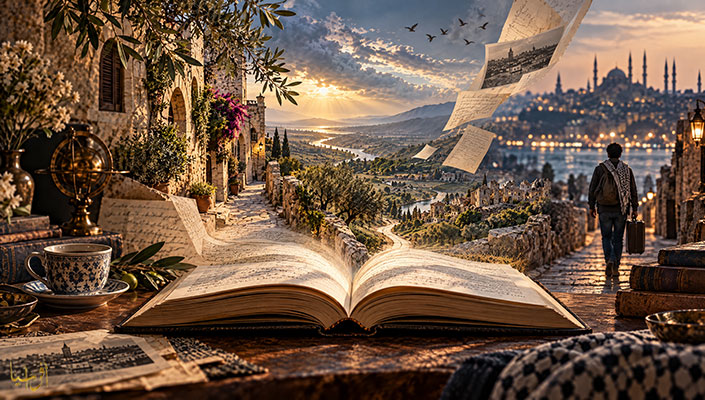
Afrasianet - Iyad Shamsneh - The Palestinian novel, in its most recent stage, is no longer content with the image of the Palestinian trapped in a stricken geography: a demolished village, a camp, a checkpoint, a prison, a besieged city, or a house threatened with confiscation. Certainly, these places have not lost their centrality; they are the first scar of the bloody experience, and their solid moral material.
However, as the novel matures, I discover that the Palestinian resides in memory, language, exile, and family name, in addition to place, as well as in the story that passes from mouth to mouth, and he also leaves the horse alone, crosses the bridge, then stumbles outside it, leaves in a tank, and then returns to play the concerto of different faces.
Hence the emergence of what can be called the global Palestinian: the man who brought his Palestine to the world, and transformed it from an issue confined to a local map into an open humanitarian question. Here, the world is not a reward given by publishing houses or award lists, but rather a harsh test of the text's ability to remain faithful to its wound and catastrophe. A humanity that does not abolish politics and does not reduce it to a fleeting emotion, nor to a ready-made and pre-packaged moral discourse.
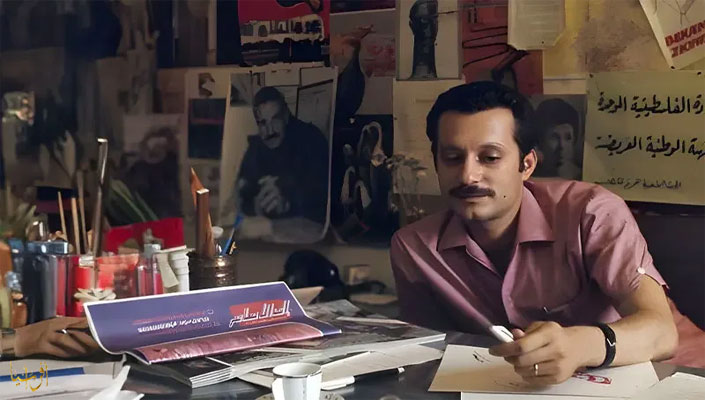
Mark.. The difference is not the name
When Farouk Wadi wrote about Ghassan Kanafani, Emile Habibi, and Jabra Ibrahim Jabra as three signs in the Palestinian novel, he meant the artistic transformation that makes the writer separate between two phases, so that the novel will no longer be the same as it was before. Today, it can be said that the Palestinian novel has given birth to a broader mark, the most important of which is the transition of the Palestinian from a local subject to a universal novelist.
The Palestinian novel no longer says to the world, "This is our tragedy, so look at it," but rather it says something deeper: "O world, from Palestine, the questions of the whole age can be read: identity, uprooting, borders, memory, exile, violence, law, purification, and the deferred right."
The local presence of the Palestinian was essential in the beginning. For Ghassan Kanafani, the Nakba appears as a machine that grinds bodies, choices, and destinies. In "Men in the Sun," the three men move through a transient desert, but, in the depths of meaning, they cross the entire Arab void, and their silence collides before they collide with death. The reservoir is a political and symbolic grave, and a hurtful representation of a thick-walled Arab reservoir. So the question: "Why didn't they knock on the walls of the reservoir?" remained, one of the harshest questions in Palestinian literature.
Similarly, the position of the Palestinian in Emile Habibi has changed. The refugee is no longer the center of the story, but the remaining Palestinian entered the occupied territory in 1948, living in a state that recognizes him as lacking in rights, identity, and humanity. In "The Strange Facts of the Disappearance of Said Abi Al-Nahs, the Pessimistic Father," the irony turns into a cold resistance. Said is a torn being, who survives by laughing and is defeated by it, he is neither a pure hero nor a pure traitor, but a pessimist who reveals the fragility of reality by parting with him.
As for Jabra Ibrahim Jabra, he opened another window. In "The Ship" and "The Search for Walid Massoud", where Palestine is presented as an internal loss, as a wound in the intellectual, and as a concern for the intellectual. It settles, more than it is a broken map. Jabra made the Palestinian a son of the Nakba and a son of modern culture together. This is where the seed of the global Palestinian began: someone who does not leave Palestine because he has forgotten it, but because it has come to inhabit him wherever he goes.
The Palestinian world is not born from travel alone, or even from asylum, migration, or just traveling. Many people may travel and not become global in the novel sense. Universality is not a passport, nor a foreign language, nor a successful translation; it is a way of building character, time, and memory. When a Palestinian lives between multiple places, he is no longer able to narrate himself in a straight line, because his life itself is cut or broken: a house in memory, a camp in his childhood, a university in another country, a mother language that is threatened, and a second language that gives him a chance and steals another from him.
Therefore, the Palestinian novel began to abandon the single voice. Letters, testimonies, documents, photographs, maps, family tales, and conflicting voices entered the country. The narrator no longer owns the whole truth; he collects its fragments. This transformation is a natural result of a torn historical life. Those who do not have a complete archive of their memories write a novel from the absence. Those who cannot return home, build a house and return to the language.
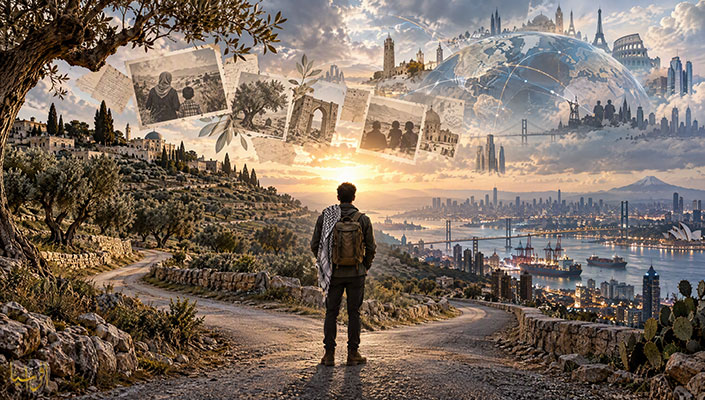
"Bab al-Shams": Palestine as an archipelago of tales
This idea reaches one of its peaks in Elias Khoury's "Bab al-Shams", knowing that this novel is not Palestinian in the narrow national sense, as its author is Lebanese, but it is one of the works that is most capable of capturing Palestine as an open story. There is not a single hero here, no straight memory, and no Nakba that ends in a specific chapter. There are stories that are being produced: villages, fighters, women, lovers, the dead, survivors, camps, and names that fall and then return.
The novel gives the Palestinian a global dimension because it presents him as a human being who makes mistakes, loves him, is afraid, sometimes he lies, sometimes he remembers, and sometimes he forgets. This unpolished humanity is the secret of its strength. Universality does not come from the beauty of the victim, but from its liberation from the mold. The Palestinian here is not a picture on a political poster; he is a whole life. Turbulent, incomplete, but real.
In Suzanne Abu al-Hawa's "While the World Sleeps," the global Palestinian takes a different path: the path of the family that spans generations and countries. The story begins with the wound of 1948, but it does not stay there. It moves between camps, exile, languages, and new births. The novel addresses a clear global reader, and uses a familiar structure in the global novel: family, generations, loss, love, death, and memory.
Critics may object to this style because it brings Palestine closer to the foreign reader through a broad family affection, and it may sometimes fall into over-interpretation. But its value is undeniable. This model conveyed the Palestinian story to a reader who does not know its details, and made the Nakba an experience that he enters through the door of the mother, the son, the house, and the name. This is not a simple matter; the Palestinian novel, when it reaches the world, struggles for memory in a space that has long been left to the counter-narrative.
The form of the universal Palestinian changes once again with Adania Shibli, especially in "Minor Detail." In this novel, there is frugal, almost cold, language that revolves around a small incident that is inherently terrifying. The novel does not scream, but it confronts the reader with a silence that is more painful than screaming.
This is an important mark. The Palestinian text has become able to address the world with subtle aesthetic tools that do not rely on explanation. It does not ask the reader to sympathize immediately; it pushes him to become involved in the gaze. This small detail reveals an entire system of erasure. Thus the margin exposes the center. The forgotten crime opens up the question of all history. Here the international Palestinian is no longer only a witness to a general tragedy, but a seeker of a near-obliterated trace, in a small scar left by violence and forgotten by the victors.
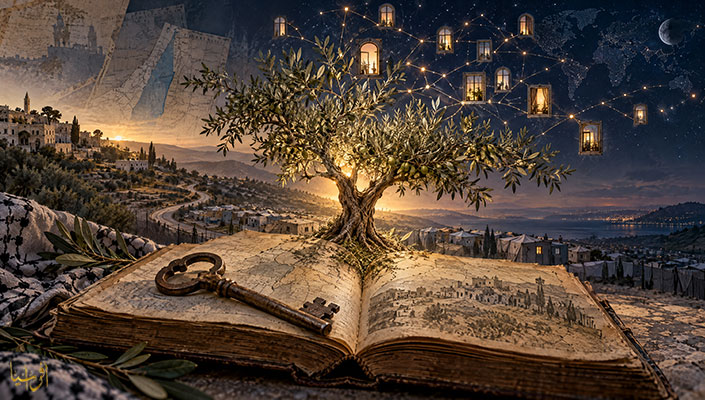
Mutual Memories
In "Fate: The Holocaust and the Nakba Concerto" by Rabi al-Madhoun, the Palestinian narrative enters a very sensitive area. This novel not only meets the Palestinian with the Israeli, but also puts the Nakba in contact with the memory of the Holocaust, and with questions of return, identity, mixed marriage, and language. This is arguably a difficult adventure, because the comparison of suffering may slide into moral simplification or competition in the victim. But the novel's value is that it attempts to construct a multiple composition, not a quick slogan.
The global Palestinian, here, is neither closed in nor relinquished in his memory. He is able to see the memories of others without allowing his memory to be erased. This is a degree of narrative and political maturity at the same time. The novel does not escape complexity, but rather enters it, and makes art a space where pain, truth, and ambiguity are juxtaposed with pain.
Going out into the world is not innocent. There is a market that likes a specific image of the Palestinian: the noble victim, the crying child, the crushed woman, the angry young man, the miserable camp. These images become dangerous when they become a single identification card.
The deeper novel is the one that goes into the world and retains its difficulty. It is not ashamed of its locality, it does not dissolve the names of places, and it does not simplify history so that it becomes expendable quickly. Literature does not reach universality by compromising on privacy, but by taking it to the utmost truthfulness. The more Palestinian the text is, the more it will be able to touch a distant reader, because man does not get to know others through generalities, but through living details.
The Palestinian-universal in the Palestinian novel is its broadest extension. The local is the root: the village, the house, the smell, the dialect, the cemetery, the road, the barrier, the key, and the olive tree. The universal is the horizon: exile, translation, multiplicity of readers, multiplicity of roots, intertwining of memories, and the great human question. When the Palestinian novel leaves the map, it does not escape from it; it carries it to another place, making it revisible.
In this process, the Palestinian novel has moved from asking for recognition to producing knowledge. It no longer just says, "We are here." It has become a saying: Through our story, the world can be understood as it has become: the world of walls, refugees, harsh borders, and maps drawn by the strong and paid for by the weak.
Therefore, in the modern novel, the Palestinian becomes a central figure in the imagination of the age, not because he is more painful than others, but because His experience intensifies a question from which the world cannot escape: What is left of man when he is robbed of his place, and he has nothing left but to tell?
________________

