
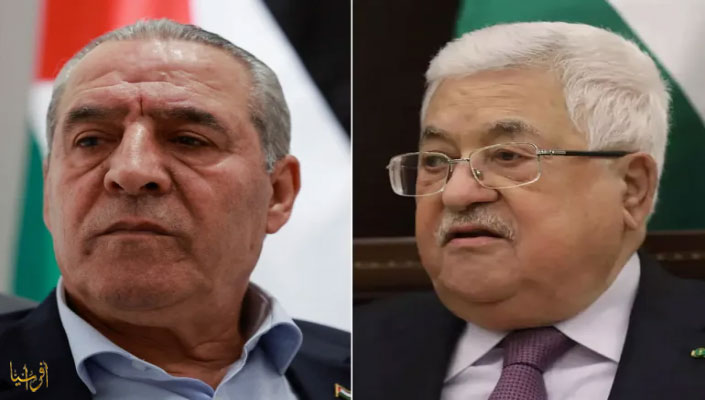
Palestinian President Mahmoud Abbas (right) and Vice President Hussein Al-Sheikh
"During the preparation of this report, French President Macron called on Abbas and his government to reverse the postponement of the elections!!"
Afrasianet - Abbas announces the postponement of the Palestinian elections In the words of his deputy, the leadership of the Fatah movement and the PA decided to postpone the legislative elections, amid the escalation of disagreements over possible electoral alliances, and the divergent positions within the movement regarding the participation of the democratic reform movement and internal reconciliation dialogues.
According to Fatah sources, the movement's Central Committee submitted a recommendation to PA President Mahmoud Abbas to postpone the elections, noting that the recommendation is based on the circumstances surrounding the completion of the electoral arrangements.
According to the same sources, the committee recommended the issuance of the postponement decree on Saturday or Sunday evening, while estimates differed on the timing of the decision, in light of Abbas' desire to postpone it until the picture of the lists and alliances preparing to run for the elections is clear.
Electoral alliances worry Fatah leadership
The file of alliances emerges as one of the main factors behind the concerns within the Fatah leadership, especially with talk of contacts made by those close to the prisoner Marwan Barghouti movement with Fatah forces and figures excluded from the decision-making circle, in addition to the possibility that figures affiliated with the movement will join an alliance that includes Hamas, the Democratic Reform Movement, and Islamic Jihad.
The sources believe that these moves put the movement's leadership in front of two difficult scenarios: first, the formation of an electoral alliance that includes Hamas, the Democratic Reform Movement, and other forces, which may pose an unprecedented political challenge to the Fatah leadership, and second, Fatah figures will run the elections with an independent list that competes with the movement's official list, which may exacerbate internal divisions.
In this context, Fatah leaders warned of the repercussions of the widening gap between the movement's central leadership and Marwan Barghouti, who is detained in Israeli prisons, and who received the highest number of votes in the Fatah Central Committee elections.
The Islah Movement and the Alliance with Hamas
On the other hand, a source in Fatah's Democratic Reform Movement denied the validity of the news circulating about the movement's intention to end its alliance with Hamas, stressing that communication with the movement and other forces supporting the alliance is still ongoing, and that work to complete the electoral list has reached its final stages.
For his part, a leading Hamas source confirmed the movement's readiness to run in the elections, stressing the cohesion of the national alliance. He also refused to exclude the Democratic Reform Movement, led by Mohammed Dahlan, from the national dialogue sessions, considering that its participation should be on an equal footing with the rest of the Palestinian factions.
Fatah reconciliation and factional participation
According to the sources, Jibril Rajoub, during the meeting of the Central Committee, conveyed an Egyptian position that stipulates the participation of all factions in the dialogues, in addition to the existence of serious guarantees for the implementation of what is agreed upon.
She said that the absence of the Islah movement from the meetings calls for a direct dialogue with it to reach an internal reconciliation within the movement.
The sources pointed out that the meeting did not address Marwan Barghouti's initiative, which he presented about a month ago, nor did it discuss the demands put forward by the deputy head of the Democratic Reform Movement, Samir al-Mashharawi, during his meeting with Hussein al-Sheikh and Majed Faraj on August 24.
These developments come in conjunction with arrangements to resume factional dialogues in Cairo, amid warnings that delaying the postponement decision, without a clear timetable, could negatively impact the chances of reaching understandings between the Palestinian forces.
According to the sources, Rajoub warned that the procrastination in deciding on the date of the postponement may hinder the completion of the dialogue, at a time when the meetings are expected to resume on Tuesday or the end of this week. The ongoing moves reveal complexities that go beyond the issue of the election date, to include the future of Palestinian alliances, the crisis of division within Fatah, and the limits of participation in the national dialogue.
The alliances of Hamas, Islamic Jihad and the Popular Front. Have the calculations of the Palestinian elections been confused?
Palestinian President Mahmoud Abbas's decision to postpone the legislative and presidential elections until September 11, 2027, has revived the debate over the future of the Palestinian political system, in light of the continuing internal division, the escalation of Israeli aggressions, and the decline in the chances of renewing Palestinian institutions through the ballot box, nearly two decades after the last legislative elections .
While the presidential decree was based on the obstacles imposed by Israeli measures and the need to create conditions for the holding of free, fair and inclusive elections, political analysts differed on their readings of the decision and its motives, between those who saw it as the result of political assessments that did not withstand developments on the ground, and those who saw it as an expression of the Palestinian Authority's faltering calculations regarding the form and outcome of electoral participation.
Possible alternatives in light of the current challenges, as well as its implications for the legitimacy and future of Palestinian institutions.
Writer and political analyst Mohammed Hawash believes that the decision to hold elections was taken last July under international and regional pressure, in light of demands to reform the Palestinian political system and hold elections as soon as possible, but he described the decision as hasty and did not take into account the complexities of the Palestinian scene.
Hawash explained that developments in the West Bank, the escalation of settler attacks, and the expansion of settlements, as well as the technical difficulties related to holding elections in the Gaza Strip, contributed to the revision of the decision to hold elections on schedule.
He added that the elections were a Palestinian necessity to affirm the right to self-determination and end the state of division that prevented presidential and legislative elections from being held nearly 20 years ago, but pointed out that the current political and security conditions have imposed major challenges to the implementation of the entitlement.
On the other hand, the director of the Palestinian Center for Policy Research and Strategic Studies (Masarat), Hani al-Masri, said that the calculations on which the previous decree was based were not accurate, and that they collided with a different political reality, whether at the level of regional developments or Israeli positions.
Al-Masri pointed out that the perceptions of holding the elections were linked to a plan put forward by US President Donald Trump, which included the Islamic Resistance Movement "Hamas" relinquishing power in the Gaza Strip, disarming it and turning it into a political party, but he said that Israeli Prime Minister Benjamin Netanyahu rejected the plan, which led to the faltering of the perceptions associated with it.
He added that the existence of an elected Palestinian Legislative Council may raise the problem of dual reference with the Peace Council, which he said had received a Security Council resolution granting it the mandate until the end of next year, with the possibility of extending it.
Al-Masri said that the Israeli escalation in the West Bank and Gaza Strip reflects, in his estimation, Israel's unwillingness to hold elections that would unite the West Bank and the Gaza Strip and embody the Palestinian national identity, at a time when it seeks to impose new political and geographical realities.
Factional calculations and power
For his part, the director of the Palestinian Media Corporation, Ibrahim al-Madhoun, said that the problem began, according to his reading, with the first decree that set the date for the elections without a comprehensive national consensus.
Al-Madhoun said that the readiness of Hamas, Islamic Jihad, the Popular Front, the Reformist Movement and other factions to run in the elections, and the dialogue that took place between them, may prompt the Palestinian Authority to recalculate its calculations, after it became clear that the possible results of the polls may not be in line with the perceptions on which the call for elections was based.
He added that each Palestinian party has its own calculations in dealing with the postponement decision, pointing out that the alternatives have not yet crystallized in a clear form, and that calls for dialogue are not enough unless they turn into specific executive steps.
In this context, al-Masri said that Fatah and the PA's calculations regarding the chances of victory were not separate from the conditions for participation in the elections, noting that some factions were facing restrictions on participation, and that the election law, he said, included exclusion conditions linked to the PLO's program.
But he stressed that these calculations have changed with attempts to form electoral lists that could reshape the Palestinian political landscape.
Although analysts differed on the motives of the decision, their interventions agreed that postponing the elections alone does not address the crisis of the Palestinian political system, and that the continued division and the lack of consensus on the rules of participation and representation weaken the chances of reaching a sustainable internal settlement.
Does the postponement give a new political opportunity?
In justifying the potential feasibility of waiting, Hawash said that the coming months may reveal new features of the Israeli political landscape, in light of the upcoming Israeli elections, as well as the directions of US policy after the midterm congressional elections.
He considered that these developments may give the Palestinians an opportunity to make decisions based on concrete positions, rather than relying on uncertain expectations, in parallel with the continuation of the internal Palestinian dialogue.
He pointed out that Hamas acknowledged, in its statement on the resolution, that the current circumstances do not allow for the holding of elections from a procedural and political point of view, which may open the way for a more serious Palestinian dialogue.
However, al-Madhoun warned that postponing the elections does not guarantee the achievement of Palestinian priorities, foremost of which is saving the Gaza Strip, facing challenges in the West Bank, and ending the division. He said that the Palestinian Authority is required to take action to confront the situation in Gaza and the threats facing Palestinians in the West Bank, calling for investing the interval in reforming political institutions, instead of leaving them hostage to differences between factions.
He added that the national consensus can represent a temporary alternative to the elections, provided that it is not used to perpetuate the monopoly of the decision, and is based on the comprehensive participation of all Palestinian forces without exclusion or discrimination.
The Crisis of Legitimacy and the Future of Palestinian Institutions
The absence of elections for years has put Palestinian institutions increasingly questionable about their legitimacy and ability to represent Palestinians at a time when political and security challenges are escalating.
Al-Masri warned that the continuation of the current situation and a return to dialogues whose outcomes are not implemented, may contribute to weakening the PLO and the Palestinian Authority, and open the way for alternatives that Israel, with American support, he estimates, seeks to impose.
He called for a comprehensive national dialogue that is not limited to factions, but also includes representatives of youth, women, the diaspora, civil society institutions, the private sector and national figures, with the aim of agreeing on a national project, a political program, the foundations of partnership, a strategy of struggle and a unified leadership.
He stressed that such a dialogue should lead to a clear road map, of which elections would be a part, and not that internal negotiations should turn into a new series of agreements that could not find their way to implementation.
Al-Masri considered that the continuation of internal disputes while the settlements are expanding, attacks on Jerusalem are increasing , destruction and displacement in Gaza continues, and the steps to annex the West Bank continue, forcing the Palestinian forces to change their political approach and not be satisfied with repeating previous experiences.
He stressed that setting a new date for the elections, in itself, does not provide a guarantee that they will be held, unless it is preceded by a representative national consensus on all contentious issues, including the form of the political system, partnership mechanisms and the rebuilding of institutions.
Al-Madhoun believes that reforming the PLO and the Palestinian Authority and rehabilitating institutions should be top priorities, in a way that ensures the participation of all and prevents a monopoly of decisions by any party.
Al-Masri stressed the need for the next dialogue to be different from the previous dialogues, and to involve representatives of the various components of Palestinian society, in order to reach an agreement on an inclusive national project and an implementable road map.
________________

