
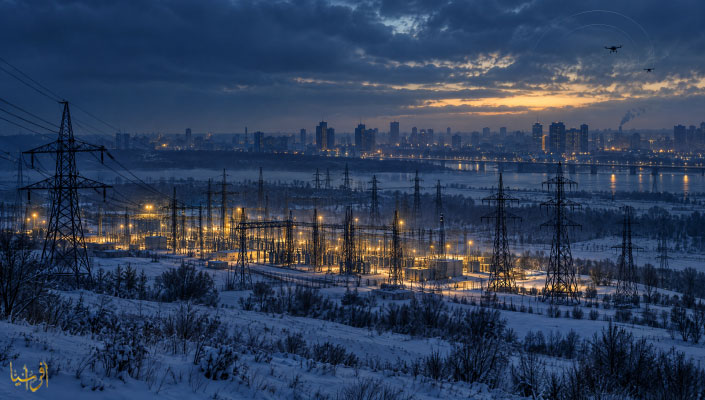
The central question this winter is not whether Ukraine can shoot down every march or protect every station, but whether it can keep the front, the state, and society in action at the same time.
Afrasianet - Ali Issa - In Kyiv, the power outage on the evening of September 30 was not just a byproduct of a new round of shelling. Tram and trolleybus lines were halted, the distribution company warned of water cuts on the upper floors, and national grid operator Ukrenergo imposed emergency outages in the capital and three nearby districts, for the first time since spring.
He then announced rationing schedules for the next day, before canceling them in the morning and calling on residents to rationalize consumption. This is what the scene looked like an early declaration of the nature of winter: the electricity grid itself has returned to the front line.
According to Ukrainian Prime Minister Sergei Koretsky, Russia's larger-scale attack on the energy sector was the largest since the end of the previous heating season. Moscow said it had hit power plants in the Kyiv region and industrial and port facilities in the south. Between the two accounts, it remains clear that the war on electricity is simultaneously putting pressure on the state, the economy, society, and military capability.
Why Electricity Specifically?
A power plant is not only a power-producing facility, but a central node to which the water, telecommunications, railways, hospitals, data centers, factories and heating systems are connected. When it fails, the damage does not remain within its walls: pumps stop, factories slow down, backup generators run on fuel, and maintenance becomes a race against time.
Data from the International Energy Agency shows the extent of the transformation that has hit the Ukrainian system. Prior to 2022, Dispatchable Generation Capacity was about 38 gigawatts. During the first year of the war, about 19 gigawatts were lost due to occupation, destruction, or damage, and then the capacity dropped to about 12 gigawatts after the spring 2024 attacks, before Ukraine regained part of it by repairing and adding new capacity.
In this sense, energy protection is no longer a service file, but part of the state's ability to survive: every megawatt lost means an economy, services, and a weaker military effort at the same time.
Jet drones and changing the defense equation
Energy targeting begins in the sky. According to the Ukrainian Air Force, in the wave of attack that lasted until the evening of September 30, Russia launched 285 drones, including 174 jet-powered drones that were faster and higher flying than helicopter models, and Kyiv announced that it had shot down or neutralized 254 of them, including 146 jets.
The shift is important because a faster drone reduces detection and interception time, and may overtake some cheaper defensive means, such as machine guns or slower interception drones, pushing defenses to use more advanced and expensive methods. Two days before the attack, Ukrainian President Volodymyr Zelenskyy said his country intercepted about 57 percent of jet drones, compared to higher rates for older models.
This is where a central concept emerges to understand this phase of the war: the economics of interception.
The Economy of Interception
When assessing air defense, it is not enough to ask how many drones have been shot down; the second question is: at what cost?
If Russia fires a low-cost target and forces Ukraine to use a rare or expensive means of defense, the success of the interception does not eliminate the cost imposed on the defenders. As the waves repeat, the issue shifts from comparing the price of a drone to the price of a missile to a broader equation related to the size of stockpiles, the speed of production, supply chains, and the ability of allies to compensate.
But using a multimillion-dollar missile against a cheaper target does not necessarily mean an economic loss of the guns. If the interception prevents the destruction of a power plant or vital industrial facility, the value of the damage avoided may far outweigh the cost of the missile.
Therefore, the economics of interception is measured not by the difference between the price of the attacker and the interceptor alone, but by six interrelated elements: the cost of the interception, the value of the protected asset, the scarcity of the ammunition, the speed of its compensation, the magnitude of the losses prevented by the interception, and the number of times the adversary can impose the same equation.
This dilemma is no longer just Ukrainian. On September 29, NATO Secretary-General Mark Rutte said that the alliance would promote less expensive means of countering drones, so that it would not have to use sophisticated fighter jets against low-cost threats.
Layered Air Defense is the optimal defense: electronic warfare, cannons, interceptor drones, and short-range systems, while retaining rare missiles for targets that the cheaper classes cannot.
Transformers War: When the Time of Reform Becomes Part of the Battle
High-Voltage Transformer Warfare: Even if air defense intercepts most targets, sometimes a limited number of them are enough to cause significant damage. This is where a less visible war begins: a war of high-voltage transformers and spare parts.
This equipment requires specialized manufacturing, complex transportation and installation, and can take weeks or months to replace. Worse, a facility that has been repaired after a long effort can take a fresh hit, and the repair cycle resumes.
The Rapid Damage and Needs Assessment (RDNA5), issued by the World Bank, the Ukrainian government, the European Commission and the United Nations, shows that direct damage exceeded $195 billion by the end of 2025, and that energy, along with housing and transportation, was among the most affected sectors. In the energy sector, the number of assets damaged or destroyed increased by about 21% compared to the previous assessment, while the sector's reconstruction needs are close to $91 billion.
The grid is increasingly sensitive to Ukraine's heavy dependence on three nuclear plants operating in areas under its control. The IAEA also emphasizes that safe off-site power is a prerequisite for nuclear safety, making the stability of substations and transmission lines associated with reactors part of the safety system itself.
When the energy bill meets the war budget
Here, the winter war goes beyond electricity to public finances. The Ukrainian government estimates the cost of the war in 2026 at $155 billion, including domestic spending and in-kind military aid from allies, with a funding gap of $27 billion in defense spending. Kyiv plans to cover about $7 billion of that through re-allocation of expenditures, while it needs about $20 billion from abroad.
These figures reveal the crux of the problem: the state is funding not a single front, but the military, air defense, civil services, energy reform, and social support together. The government has also warned that some $29.5 billion in international funding linked to the European Union and the IMF could become delayed or jeopardized if some of the needed reforms falter.
Energy adds to its own bill. In June, the European Commission, Ukraine's Ministry of Energy and the Energy Community Secretariat estimated the unfunded needs of the Ukraine Energy Support Fund at more than €650 million in preparation for the winter of 2026–2027, after contributions through the fund amounted to €1.95 billion over four years.
As of 12 August, some €452 million of needs remained unfunded, before subsequent contributions narrowed the gap to around €444 million during the second half of the month.
Thus, a single strike simultaneously generates the cost of interception, the repair of the facility, the provision of fuel and alternative energy, and the losses resulting from the interruption of production and services. The more repeat this episode, the more difficult it becomes to balance the necessities of war with the necessities of state continuity.
Europe in the winter equation
The cost does not stop at Ukraine's borders. As of the end of July 2026, 4.43 million people who had fled Ukraine were under temporary protection within the EU, with about 59.5 per cent of them residing in Germany, Poland and the Czech Republic combined.
There is no data to say that the current attacks will trigger a new wave of displacement. But the prospect becomes more realistic if the interruptions turn from intermittent events to chronic disruptions of heating, water and basic services during the cold months.
The family's decision to stay is determined not only by the military map, but also by the possibility of operating the home, school, hospital and work. Hence, Ukrainian electricity becomes a European issue that affects aid, budgets, housing and public services, not only an internal Ukrainian file.
The solution is not just an extra rocket
Network protection cannot be reduced to air defense. Part of the solution is to make the network itself less disruptable.
The International Energy Agency (IEA) believes that distributed generation, from solar, wind and batteries to small gas turbines, enhances grid resilience because it distributes production geographically, brings it closer to consumption centers, and reduces the importance of some large targets.
Decentralization does not eliminate the need for major terminals and transmission lines, but it does make the grid less vulnerable to paralysis from a single node or a limited number of nodes. Investing in flexibility becomes as much a part of national defense as it is an energy policy.
The Limits of the Russian Strategy
The intensity of the attacks does not mean that the Russian strategy will work automatically. Ukraine has accumulated experience in quick repairs, physical protection of some facilities, importing electricity from Europe, distributing generating sources, and developing cheaper interceptors. The better these tools are, the more difficult it will be to turn strikes into long-term impact.
Three main paths for winter can therefore be envisaged:
First, in the path of containment, the interruptions remain limited, and reforms, imports, and defenses succeed in preventing them from turning into a national crisis.
Second, in the path of chronic stress, the network continues to operate, but with longer rationing hours, greater industrial losses, and higher cost of defense and repair.
Third: The climate-compound shock will be severe and will appear if a severe cold coincides with a shortage of obstacles and a recurring injury to key contracts, so that the electricity crisis will turn into a broader crisis in services, production and finance.
Bottom line: Who can pay for winter?
The central question this winter is not whether Ukraine can shoot down every march or protect every station, but whether it can keep the front, the state, and society in action at the same time.
Energy warfare tests the ability to manage resources under simultaneous pressure: protecting the sky, repairing the grid, operating the economy, and ensuring minimum services. If Kyiv can prevent these pressures from accumulating in one point, it will have reduced the strategic value of the attacks even as they continue.
Electricity is no longer just a public service, but a front where military security meets state finances and social resilience.
The winter of 2026-2027 may not be measured by the number of stations damaged or the drones that have been dropped, but by the more decisive question: which party can afford to continue for longer?
________________
Ali Issa - Researcher specializing in geopolitics and political economy.

