
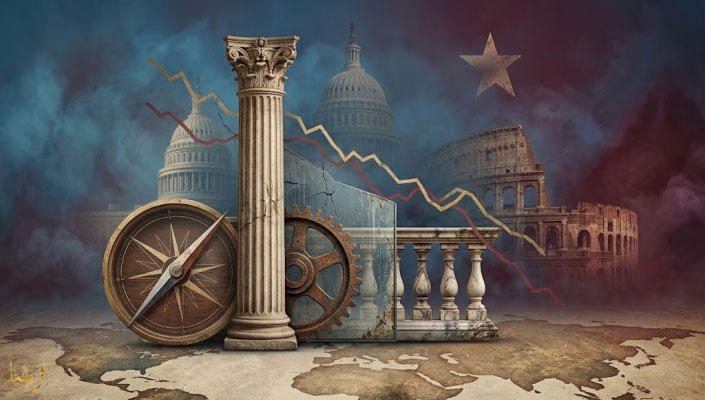
Afrasianet - The United States is losing some of its features that made it look "exceptional" compared to other Western countries, and is approaching, in a number of economic and political aspects, Italy's model.
In an analysis article published in the Financial Times, Vorohar bases her comparison on three main axes: the decline of the fight against corruption, the rise of populism, and worrying shifts in the labor market, especially for young people.
The United States and Italy are witnessing, to varying degrees, a decline in anti-corruption efforts, based on international indicators that see the two countries weakening some oversight and accountability mechanisms.
She believes that this path coincides with a democratic decline, as studies and research institutions have included the two countries among Western countries that have witnessed a significant decline in democracy indicators in recent years.
Shifting the perception to corruption
According to Vorohar, the problem lies not only in the existence of corruption, but also in the shift in the perception of it among citizens, so that it becomes a familiar thing that is seen as a reality that the average individual cannot change.
Citing a Gallup poll, the percentage of Americans who believe corruption in government is rampant has risen from 60 percent in 2006 to 89 percent today, reflecting growing pessimism about the economic and political system, especially among younger generations.
The labor market is one of the most striking similarities between the United States and Italy, with young Americans facing much higher unemployment rates than older workers, while the Italian economy suffers from a sharper gap in this area.
The author explains the problem not only by age, but also by social and economic background, where a person is born and the family to which he belongs, has become more influential in his or her future chances, which makes the United States, according to her analysis, closer to the patterns of "old Europe" in terms of weak social mobility.
Contrary to expectations that the technology will automatically give an automatic advantage to young people, Vorohhar adds that the rise of artificial intelligence may temporarily increase this gap, as older workers often have professional and sectoral experience that helps them benefit from AI tools, while new entrants to the labor market may face greater risks.

Attorney General in Southern New York after announcing corruption charges against U.S. Senator Robert Menendez (French)
More populism and political polarization
The author cites estimates by the U.S. Census Bureau that suggest that graduates of majors with more exposure to AI may face fewer opportunities to get their first jobs and lower incomes than their counterparts in sectors less exposed to technology.
The accumulation of these economic and social pressures could fuel further populism and political polarization, as declining youth opportunities and rising inequality could deepen generational divisions and between moderates and more extreme currents.
In this context, the author recalls the experience of Italy, which has gone through repeated cycles of economic and political crises, before recently witnessing an improvement in some indicators of exports and employment.
The United States is beginning to face challenges that have traditionally been attributed to less economically and politically successful European countries, warning that continued imbalances in the U.S. political economy could lead to a vicious cycle: slower growth, declining opportunities for young people and lower-income groups, and rising populism and polarization, which in turn weakens the regime's ability to address its core problems.
In this regard, American writer Thomas Friedman said that America is on the verge of explosion due to the policies of the current administration led by President Donald Trump in several areas, the most important of which is the immigration file, which has become at the forefront against the background of tension in the city of Minneapolis in the state of Minnesota due to the practices of the employees of the concerned departments.
A Minneapolis native, grew up and is still associated with it, Friedman spoke on a special podcast on the New York Times website about what was happening in the city, which was rocked by violence over the weekend and put President Trump's anti-irregular immigration policy into focus.
Tensions peaked in the city when Customs and Border Protection (CBP) employee Alex Pretty, 37, a nurse, shot and killed him, just two weeks after René Goode, a 37-year-old mother of three, was killed by an Immigration and Customs Enforcement officer in the same city.
Friedman said that for health reasons he was unable to go to his hometown to witness what was going on there, and that he was watching the situation from afar with a mixture of pride and pain, pride in the way Minneapolis residents came together to defend themselves against arbitrary arrest from their homes or on the streets simply because their appearance suggested they were immigrants.
At the same time, he said, he feels real pain that the city, its economy and its community are being attacked by the federal government, in the midst of what he called a "street war" in Minnesota led by "the worst people in the Trump administration, like Stephen Miller, Homeland Security Secretary Kristi Noem, and President Trump himself."
In Friedman's view, these officials were not trying to solve a problem, they were trying to exploit a problem to sow discord among Americans, and they were using violence to boost their political standing.
Potential disaster
Regarding the political context of what is happening in Minneapolis, Friedman said that this year will be very important for America and that he cannot imagine what Trump would do if the Republicans continued to control all the reins of power (the White House ,the Supreme Court, the Senate and the House of Representatives). He added that if Trump became unconcerned about the fate of the next election and was completely free, it would be a disaster for America.
Regarding the repercussions of the events in Minneapolis, a New York Times poll conducted in cooperation with the Siena Institute showed that a majority of Americans strongly disapprove of the way ICE employees work, while a number of President Trump's advisers expressed concern about the escalation of events in Minneapolis.
Friedman hinted at a split within the current administration on immigration even before protester Bertie was killed last Saturday, so it is not surprising, in his view, that President Trump is changing his stance and backing away from his hardline statements about the Minneapolis events.
In the author's view, the migration crisis has been on the rise since President Trump's first term (2017-2021) and that a national consensus on immigration cannot be achieved if people feel that the country's borders are open.
The author, who is leaning towards the Democratic Party, acknowledged that the recent Democratic administration made a grave mistake in dealing with the border file, perhaps because people feel that their societies are changing faster than they can understand culturally, and they feel a loss of control, so they came out and re-elected Donald Trump.
Radical Handling of the Immigration File
Trump had a chance to radically address immigration when he controlled the House and Senate, the White House, and the Supreme Court, as he could pass any legislation he wanted to control the border and create a legal path for hard-working immigrants who contribute to the development of their communities, both financially and culturally.
Friedman added that President Trump did not do this in his first term because he wanted to exploit the immigration crisis to stir up division and because he always seeks to win elections by division rather than consensus, thus endangering American democracy.
On the impact of America's image and global standing on immigration and other issues (Greenland, tariffs, etc.) Friedman said that if America's flame is extinguished, the flame of the whole world will be extinguished, and if selfishness prevails in America, selfishness will prevail in the rest of the world.
Friedman explained that America is currently going through a transition from a country with a white majority to a country with a majority of minorities, and he described this stage as difficult and painful for some Americans after their sense of belonging, cultural norms, and job security was shaken.
Compounded by the emergence of Donald Trump with an agenda of building a wall to tackle not only immigrants but also the winds of change blowing the country.
Fading Institutions
Friedman expressed concern that the nation's institutions would fade and said that President Trump made a "real farce" when he appointed people at the head of some of the key institutions (the Department of Health and Human Services, the FBI, the Department of Homeland Security) who were not qualified for those positions, and that puts those institutions at risk, and will be difficult to restore if they collapse.
Friedman also expressed concern about what he said is a difficult technological, social and cultural transition for the country, exacerbated by the digital revolution, an industry that benefits from anger and division among Americans and exacerbates tensions.
In the author's view, this situation was exacerbated when Donald Trump entered the scene and made it politically permissible and profitable to say and do anything, which no American president has ever done.
To overcome this situation, Friedman called for two things: first, to ensure the resilience of U.S. institutions, which makes the 2026 midterm elections so important, and second, the country's need to calm the situation and put things back on track.
________________
Source: The New York Times - Financial.

