

Washington's declaration alone is not enough to prove that a binding agreement has come into force.
Afrasianet - U.S. President Donald Trump has announced an agreement to stop targeting energy facilities in the Russia-Ukraine war, presenting the move as an immediate truce that could open a window for de-escalation. But the announcement, which did not include details on the scope of the deal or its implementation mechanisms, came without immediate confirmation from Moscow or Kyiv, keeping the initiative between the prospect of establishing a limited truce and fears that it could turn into a political declaration that would not withstand the continuation of the confrontation.
Trump said on Sunday that the ceasefire on energy facilities would take effect from now, without clarifying whether it would cover all types of energy infrastructure, refineries and oil and gas facilities, or also power plants and distribution networks. The White House did not provide further details about the president's announcement, and there was no immediate confirmation from the Russian and Ukrainian governments.
The announcement comes at a time of escalating disputes between Trump and Ukrainian President Volodymyr Zelensky over the targeting of Russian oil facilities, after the US president called on Kyiv to stop these strikes and blamed it for the rise in diesel prices in the United States. In contrast, Zelensky insists that the cessation of attacks must be mutual, and be accompanied by effective guarantees that prevent Russia from continuing to hit Ukrainian infrastructure.
Zelenskyy stressed on Sunday that Ukraine is ready to stop targeting Russian oil refineries if Moscow stops its attacks on Ukrainian energy facilities. He said de-escalation cannot be based on a unilateral commitment, but rather needs reciprocal steps and real guarantees.
Ukraine's position reflects a difference in the nature of the targets targeted by both sides. Kyiv says striking Russian refineries and oil facilities limits revenues that fund the war, while Russian attacks are focusing on Ukrainian electricity and gas facilities, affecting basic services and energy supplies to the population.
The dispute is not limited to the principle of cessation of attacks, but also extends to the definition of the facilities covered by the truce, how to verify compliance with them, and who monitors violations. Without clear agreement on these issues, the parties may find room to interpret the commitments differently, allowing strikes to continue under different military or technical classifications.
The lack of Russian and Ukrainian confirmation adds to the uncertainty surrounding the initiative. Washington's announcement alone is not enough to prove that a binding agreement has come into effect, especially as both sides continue to use long-range strikes to target the adversary's infrastructure.
The new initiative faces further test due to an earlier experiment in September. On September 14, Trump announced that Russia and Ukraine had agreed to refrain from striking energy facilities, but Moscow and Kyiv did not confirm at the time that there was a mutual agreement, and the attacks continued after the announcement.
The next day, the Kremlin welcomed the idea of a truce, but also linked the stability of energy markets to ensuring the security of commercial navigation and lifting sanctions on Russia. In return, Zelensky stressed the need to stop all attacks on energy facilities, not just stop Ukrainian strikes on Russian refineries.
Past experience reveals that the dispute is not just about declaring a truce, but also about its political and economic terms. Moscow wants to ease restrictions affecting its exports, while Kyiv fears that stopping the targeting of Russian oil facilities without corresponding guarantees will reduce its ability to respond, while its electrical grid remains vulnerable to attacks.
Therefore, the repetition of the US announcement does not mean that the initiative is doomed to failure, but it does make the actual test linked to what Moscow and Kyiv will announce in the coming hours and days, and whether they will identify a clear mechanism for stopping the strikes and verifying compliance.
Trump's move cannot be separated from the pressures his administration is facing due to rising fuel prices. High diesel prices have become a political burden for the Republican Party ahead of November's midterm elections, as the White House seeks to mitigate the impact of the energy crisis on consumers.
On Friday, Trump announced an agreement with Russian President Vladimir Putin to make quantities of Russian diesel available to global markets in conjunction with a temporary easing of some restrictions. He presented the move as a way to increase supplies and push for lower prices, while Zelensky criticized the deal, saying it gives Moscow additional resources to finance its war. Analysts have questioned that the quantities offered will be enough to bring about a sustained drop in fuel prices.
These developments raise questions about the overlap of the diplomatic track with the U.S. economic calculations. Trump is pressuring Kyiv to stop striking Russian refineries, while seeking to increase diesel supplies and lower prices domestically. But this coincidence alone does not prove that the truce declaration is an electoral maneuver; judging by this requires knowing the details of the agreement and the extent of the parties' commitment to it.
Rising energy prices are not only linked to Russian and Ukrainian strikes, but are also affected by the wider war in the Middle East and disruptions to supplies and sea lanes. Thus, stopping targeting facilities may limit additional risks to markets, but it alone does not guarantee a decline in prices or address all the reasons for their rise.
The significance of the announcement is that it raises the possibility of detaching energy facilities from the arena of mutual targeting, which could reduce harm to civilians and ease some of the pressure on markets. However, the success of this step requires clarity of commitments, mutual implementation, and a mechanism through which liability can be determined in the event of a breach.
If the truce remains within the scope of an uncertain U.S. declaration by both sides, it could become a new stop in a series of initiatives that have so far failed to stop the war. Tying it to fuel prices could also widen the rift with Kyiv if it feels Washington is demanding that it restrict its ability to respond without guaranteeing the protection of its facilities.
Ultimately, calling the initiative an "energy truce" is not enough to judge it as a serious step toward peace, nor is its political timing enough to prove that it is a Trump maneuver. The criterion is whether Russia and Ukraine will effectively stop attacks on energy facilities, and whether the commitment will withstand the first field test. Only then can we know whether the initiative is the beginning of de-escalation or a new declaration that precedes the facts
Oil refinery attacks escalate tensions between Trump, Zelenskyy, Europe backs Ukraine's president
In this context, Axios quoted White House officials as saying that US President Donald Trump is very angry and feels that Ukrainian President Volodymyr Zelensky takes American support for granted, noting that Ukrainian attacks on Russian oil refineries are hurting Zelensky's relationship with Trump more than Moscow's damage to it.
Ukrainian President Volodymyr Zelenskyy announced that Russian strikes targeted several power plants in Ukraine on Sunday, after US President Donald Trump announced that the two sides had agreed to stop exchanging targeting energy infrastructure.
Zelenskyy wrote in a social media post that a drone hit a power plant in Kyiv, causing a power outage in the capital.
Zelenskyy pointed to the targeting of the CHP-5 power plant in Kharkiv in eastern Ukraine, stressing that Ukrainian airspace witnessed the intensive flight of Russian Shahed drones throughout the day.
Axios quoted a U.S. official as saying that envoys Steve Witkoff andJared Kushner told the Ukrainians, during a meeting in Miami, that the U.S. is a strong partner providing Kyiv with ammunition and intelligence, and stressed the need to avoid steps that harm U.S. consumers.
Axios also reported that Witkov and Kushner suspended their planned visit to Moscow pending Ukraine and Europe's position on a unified proposal by Russian President Vladimir Putin.
Axios also quoted a Ukrainian official as saying that Witkov and Kushner had threatened to halt intelligence sharing if Kyiv continued to ignore Trump's demands.
On the other hand, a US official denied the validity of the threat to stop the exchange of intelligence, stressing that US support continues with weapons and information.
Commenting on the proposals, a Ukrainian official explained that the "refinery for refinery" proposal is flawed, explaining that Ukraine has one refinery that Russia has targeted several times and is not fully operational, while Russia has an extensive network of oil refineries.
A White House official said that if the attacks on oil refineries stopped, the next step could be to reach an agreement to stop targeting power plants and power grids.
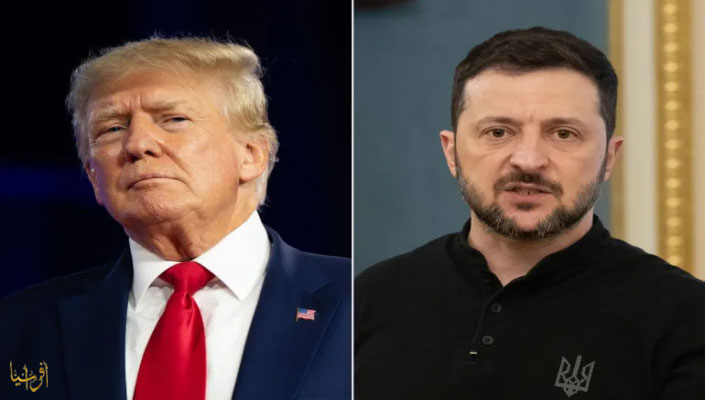
Zelensky (right) announced that a Russian drone targeted a power plant in Kyiv after Trump announced a halt to targeting energy infrastructure (agencies)
Trump Announces Halt to Attacks on Energy Sector
US President Donald Trump announced on Sunday that an agreement had been reached to cease the energy sector as part of the war between Russia and Ukraine, adding: "As of now, there is a ceasefire in the energy sector in the war between Russia and Ukraine, and both sides have agreed to that. Do not violate it."
Zelensky: The news is new to me
Commenting on Trump's remarks, Axios quoted Ukrainian President Volodymyr Zelensky as saying that the US president's announcement of a ceasefire was new news for him, adding that if Washington has negotiated a truce with Moscow in the energy sector, Kyiv is ready to accept it.
Trump on Saturday criticized Zelensky for launching attacks on Russian oil refineries, a day after the United States temporarily lifted sanctions on Russian fuel, aimed at depriving Moscow of the revenue needed to fund its war.
Trump told reporters at the White House: "I think it's time for Ukraine to get a new president."
In response, Zelensky said that the choice of a leader of the country is up to the Ukrainians, noting that Putin also wants to change Ukraine's leadership.
He added that it is easy to blame Ukraine for the rise in fuel prices, when everyone in the world is aware that prices are rising because of the war in the Middle East.
European support for Zelensky
German Foreign Minister Johann Fadiful reiterated Berlin's support for Ukrainian President Volodymyr Zelenskyy, following US President Donald Trump's call for his removal, and urged Fadiful to exert more pressure on Russia to resume peace talks.
Vadiful said Germany remained supportive of Ukraine and its government, stressing that it "fully supports the president as he performs his difficult tasks."
Fadiful's remarks, made during a leadership meeting of the conservative Christian Democratic Union (CDU) led by Chancellor Friedrich Merz, underscore the growing rift between Berlin and Washington.
Berlin, Europe's largest donor to Ukraine, has also confirmed that it will maintain sanctions on Russia, despite Trump's announcement that his administration would temporarily lift U.S. sanctions on Russian fuel.
Vadiful, who met his Russian counterpart Sergei Lavrov on the sidelines of the U.N. General Assembly in New York last month, said "consistency and clarity" were necessary to support Ukraine and push Moscow to negotiate.
"We don't need to ease the pressure, we need more pressure on Putin to get him ready to negotiate. That's what the current moment requires, and that's what the government is defending," he said.
A spokesman for British Prime Minister Andy Burnham said the latter had spoken with Zelensky and told him that London would continue to tighten its sanctions on Russia.
European Commission President Ursula von der Leyen on Sunday expressed support for the Ukrainian president following sharp criticism from his U.S. counterpart.
In a post on the X platform following a conversation with Zelensky, von der Leyen said she "fully supports President Zelenskyy's call for a ceasefire that would protect global food supplies and energy infrastructure in both Ukraine and Russia."
The Diesel Deal: A Temporary Solution to a Deeper Crisis in the U.S. Diesel Market
On October 9, the U.S. Department of the Treasury, through the Office of Foreign Assets Control (OFAC), issued General License No. 135, authorizing transactions related to the sale, delivery, unloading, and import of Russian-origin diesel, including its import into the United States, until April 7, 2027.
The license coincided with US President Donald Trump's announcement of an agreement with his Russian counterpart Vladimir Putin to make 300,000 tons of Russian diesel available immediately, then 500,000 tons in November, and 1 million tons later, in addition to the quantities linked to the capacity of Russian refineries.
However, the U.S. license does not specify a quantity or delivery schedule for shipments, but rather legally authorizes transactions that were prohibited under the sanctions regulations. It also excludes any withdrawals from the accounts of the Russian Central Bank, the National Wealth Fund, or the Russian Ministry of Finance with U.S. financial institutions.
In the economic window, Russia appears to be seeking to organize supplies in batches so as not to affect the needs of its domestic market, at a time when refineries and supply chains are under pressure.
High production and lower inventory
Data from the U.S. Energy Information Administration (EIA) do not point to weak refinery operations as a cause of pressure in the diesel market. U.S. "distillate" production, a category that includes diesel and heating oil, averaged 5.1 million barrels per day (bpd) between January and August, the highest level for the same period since 2019.
U.S. refineries were operating at 97% in the week ended Sept. 11, according to the administration's data.
But since February, U.S. net distillate exports have remained near or above their five-year highs. As net exports increased, inventories fell. In the week ending September 11, distillate inventories were 15.8 million barrels, or 13%, below their seasonal average for 2021-2025.

High production and exports do not guarantee domestic abundance in a market linked to global demand
The Energy Information Administration confirmed continued pressure in its October 5 update. Distillate fuel inventories in the week ending September 25 were 13% lower than the average for the previous five years, compared to 7% for gasoline inventories, while jet fuel inventories were 3% higher than average.
Why isn't it enough to run the refineries?
The U.S. Energy Information Administration says the price of distillate, which is often sold as diesel, is determined not only by the cost of crude oil, but also by its components, refining margins, distribution cost, taxes and retail margins.
According to the administration, higher diesel refining margins, above the rise in the price of crude oil, contributed to the rise in the price paid by consumers. On September 14, the average retail price of diesel in the United States was $6.29 per gallon, the highest nominal level in the administration's chain since it began publication in 1994, and the highest level since 2022 after accounting for inflation.
The report explains that diesel is not limited to private vehicles, but after being refined from crude oil, it enters the operation of trucks, trains, ships, agricultural machinery, factories and construction sites.
The EIA says the rising price of diesel could drive up the cost of road and rail transportation of goods, and the fuel has important seasonal uses in agriculture and home heating in northeastern America.
Global Market
The U.S. Energy Information Administration (EIA) attributes the global supply of distillate fuel to a decline in refining activity in Russia, China, and the Middle East. According to the administration, the decline in production outside the United States has led to higher international prices, increased the cost of importing diesel to the United States, and increased foreign demand for its exports.
In an Oct. 5 update, the administration said that distillate supplies in the U.S. have become tight due to rising exports to tight markets, along with the rising cost of supplies in import regions such as the U.S. East Coast.
In its monthly report for September, the International Energy Agency (IEA) said refining margins in the Atlantic basin hit record highs in August, driven by diesel margins, while higher shipping costs weighed on refining profitability in Singapore.
In its September forecast, the EIA also assumed that global distillate production would remain below the previous year's level over the following months, which it said could support continued high U.S. net exports, low inventories and high prices.
What can Russia add?
Oil and energy expert Mustafa Al-Bazarkan believes that the Russian quantities announced by Trump remain limited compared to the global consumption of diesel, so it is likely that their price impact will be limited and temporary.
The market is not only affected by additional shipments, but also by the level of inventories and the ability of refineries to produce derivatives, he said. He added that Russia will give priority to meeting the needs of its domestic market in light of the pressures on the refining sector.
The expert limited the longer-term treatment of the diesel crisis to easing tensions that disrupt production and exports, increasing refining capacity in producing countries, and increasing the capacity of existing refineries or building new ones.
Winter Test
Distillate fuel inventories are even more important ahead of the heating season, with the U.S. Energy Information Administration predicting that household spending on heating oil as the main heating fuel will rise by about 21% in the winter of 2026-2027 compared to the previous winter.
The administration attributes the increase to higher crude oil and distillate prices globally. Heating oil is mainly used in northeastern America, while the EIA links the decline in pre-winter distillate inventories to higher import costs and increased demand for U.S. exports.
The U.S. license itself does not provide an estimate of how much Russian diesel may arrive or when it will arrive. In contrast, the EIA links the path of diesel prices to crude cost, refining, distribution and tax margins, and to the status of inventories and import and export flows.
Axios: Zelensky's Ignoring Washington's Demands Paves the Way for the Diesel Agreement with Moscow
In this regard, the American website "Axios" reported that Ukrainian President Volodymyr Zelenskyy's ignoring "repeated US requests" to stop attacks on Russian oil refineries contributed to President Donald Trump's conclusion of a deal on diesel fuel with his Russian counterpart Vladimir Putin.
On Saturday, the website quoted a US official familiar with the file as saying that the US administration acted after Kyiv ignored its requests, and that Trump decided to take a new step represented in concluding an agreement with Russia on diesel fuel.
"Zelensky is misreading the situation, and by continuing to hit refineries, he is undermining the goodwill credit he has earned with Trump over the past six months," the official said.
He pointed out that Trump asked Ukraine to "stop its attacks on Russian refineries unilaterally," and that he "does not consider attacks on refineries to be equal to Russian attacks on Ukraine's power grid."
For his part, Zelensky described the agreement as "unfair and unfair" in a statement to Axios after the signing of the diesel deal, calling it "an unfair gift to Putin."
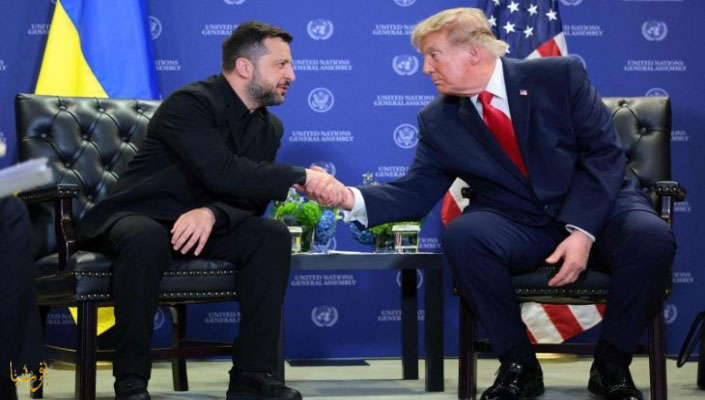
Trump and Zelenskyy on the sidelines of the NATO summit in Ankara on July 8 (AP)
Trump: It's time for Ukraine to have a new president
In turn, US President Donald Trump has said that it is time for Ukraine to have a new president.
Trump's comments came in the wake of Ukrainian anger following the US president's announcement that he had reached an agreement with his Russian counterpart Vladimir Putin to supply millions of tons of Russian diesel to US and global markets, in an attempt to reduce fuel prices that have risen sharply due to the war on Iran.
The deal, which comes weeks before the midterm elections, has angered Ukraine.
President Volodymyr Zelensky described the deal as a "birthday present for Putin," arguing that diesel revenues would give Russia additional resources to continue the war.
US President Donald Trump on Saturday renewed his call for the selection of a new leadership in Ukraine, after criticism he directed at his Ukrainian counterpart Volodymyr Zelensky for targeting Russian oil refineries and causing the prolongation of the war, while the Ukrainian president attacked the US administration's decision to lift the ban on Russian diesel imports.
Trump said elections should be held in Ukraine and that Zelensky could have reached an agreement on several occasions, adding that the Ukrainian president did not want to reach an agreement despite several opportunities to do so.
Speaking about a phone call he had with his Russian counterpart Vladimir Putin on Friday, he added: "Putin very much wants to reach a settlement."
Speaking to reporters hours earlier, Trump said: "We told him (Zelensky): You can do whatever you want against Russia, but don't hit the oil refineries, because this is a problem that causes problems globally. But he wants to cause problems for the world, so he goes and targets diesel. He has to stop doing that completely."
Trump accused Zelensky of not wanting to end the Russia-Ukraine war, adding: "I think it's time for Ukraine to have a new president."
"I advise the Ukrainians to find a new leader who can reach an agreement, because he could have made a lot of agreements, but for some reason, he doesn't do it at all," he said.
Trump noted that the Russia-Ukraine war should not have started in the first place, adding, "You have lost 30 percent of your country, and more than a million people have been killed. In total, more than two million people have lost their lives on both sides."
Russia's chief negotiator Kirill Dmitriev immediately welcomed the US president's call for a new president to replace Zelensky, calling his remarks "pivotal and historic".
Dmitriev, the Kremlin's special envoy for economic cooperation, said in a post on the X platform : "President Trump joins many who believe that Ukraine needs leadership that is really focused on peace, not on Zelensky's policy of war. These are pivotal and historic statements."
For his part, Ukrainian Foreign Minister Andriy Sepeha said President Zelensky had the support of the people "who alone have the right to decide their own future."
"Thanksgiving"
Moscow has intensified its bombardment of Ukraine in recent months, while U.S.-led efforts to broker an end to the more than four-and-a-half-year war remain stalling.
Russia's defence ministry said it had bombed a data processing centre in Kyiv early Saturday morning, as well as a cargo ship transporting military supplies to the Ukrainian port of Odesa.
The facility in Kyiv is used by the Armed Forces of Ukraine to collect, process and store intelligence information, the ministry said in a statement.
The Ukrainian president considered the Russian strikes as Moscow's way to "thank" Washington for the agreement on diesel.
Trump announced an agreement, following a phone call with his Russian counterpart Vladimir Putin, that Moscow would release large quantities of diesel to the U.S. and global markets in exchange for some sanctions relief, which the Europeans saw as support for Moscow to finance the war.
"This is certainly not fair, it is certainly a shame on the part of our partners, and in my opinion it is a weak decision," Zelensky told reporters on Friday.
"Different signals"
Gasoline and diesel prices in the United States have risen since late February, when the United States and Israel began a war on Iran.
In announcing the agreement, Trump wrote on his platform Truth Social in capital letters that diesel prices would "drop at record rates and quickly." "I want to thank President Putin," he later told reporters.
In a Facebook post, Zelensky called for the agreement to be reversed. "Russia's choice is war. It will only be ready to end it when it feels its ability to prolong the war is being reversed," he said.
"Unfortunately, the signals that Russia received yesterday were very different, signals suggesting that it could simply continue the attacks. That has to be corrected."
Putin's ideas and suggestions
Meanwhile, U.S., Ukrainian and European officials met in Miami, as part of renewed diplomatic efforts to end the war.
U.S. envoy Steve Whitkov wrote on the X platform after the meeting that "constructive discussions addressed possible ways to de-escalate, end the war with Russia before winter arrives, and advance efforts to achieve a lasting and stable peace."
Witkov explained that the meeting included "3 European countries , the European Commission , Ukraine and NATO."
The Kremlin announced that Trump presented Putin with his ideas on how to de-escalate during a phone call between them.
The Kremlin said Putin had received the proposals "with understanding" without revealing their details or clarifying the Russian president's response to them.
Russia, which launched its offensive on Ukraine in February 2022, controls about a fifth of Ukraine's territory.
________________
Source: Agencies

