
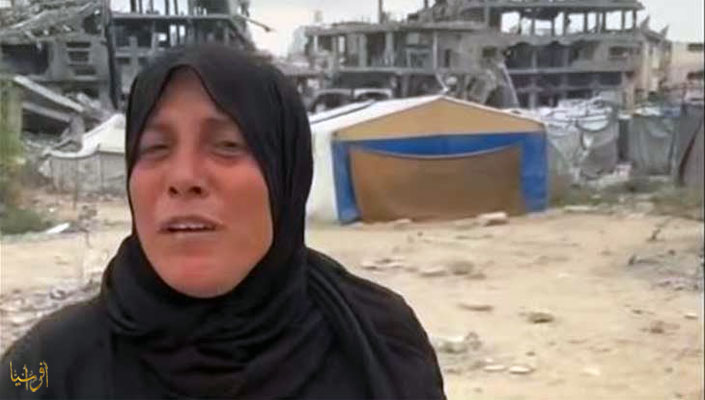
Afrasianet - Maryam Mashtawi - In the Shujaiya area, a woman in black clothes stands between tents and houses whose entrails are exposed to the sky. She reaches for the lens and says that she wants to dig a hole and live in it.
I read her phrase a second time, as if the first reading had a mistake that could be corrected. A hole! This is how the name of the house became in the mouth of a woman who was tired of looking for a place to put her body, without being haunted by fear.
In the photos, published by TRT Arabi, the Palestinian woman says that her tent has been destroyed. She points to her surroundings, and talks about the bed and utensils that fell on her, and about the yellow line that has become next to her. Then she asks to sit in a safe place. All this distance between human beings and their rights is shortened by tired knees, outstretched hands, and a small word that the world cannot me: Sit me down.
I think of the act of sitting, which we practice inattentively. We pull a chair to the table, we throw it on a sofa, we grumble about a cramped seat on a train. For these ordinary movements A hidden history of tranquility. We know that the earth will remain under our feet, that the roof will not turn over against us, and that the night, when it enters, will find us a place to rest.
I don't know her name, nor how many times she picked up her things and walked. I don't know who she was waiting for, who she lost, and what door was her door before all the sides became ways to leave. I only know what the picture gives: a woman crying out for help, and desolation behind her shoulders. Perhaps respecting her pain begins here, when you refrain from inventing a biography of her, and listening to what she actually says.
She says she's tired. How short this word seems to be. We use it after a long day's work, and we find water, a pillow, and maybe a hand asking for us. As for her tiredness, he stands with her in the open. She can't take it off at the threshold, and she has no threshold. The path continues inside her feet even when she stops, and leaving is still possible at any moment, as if it were a time she can't apologize for.
Behind them were buildings that stood painfully still. Openings were windows, and layers that could have separated a kitchen from a bedroom. I meditate on them and think about details that images of destruction don't keep: the placement of a nail with a picture attached to it, the footprint of a hand near the power switch, the measurement of a child on a wall, when the house falls, the little clues that a whole life was here are scattered with it.
Then we get the mention of the cemetery. A woman searches among the dead for a place where she can live. In this coup, something wounds the language itself. The words we have learned to signify things lose their limits. The grave becomes a possibility of shelter, the tent becomes a distant dream, and sitting is a hope raised in front of a camera. What is left of the meaning of survival if the survivor spends his day looking for a land on which he can stay?
I am afraid, as I write, that rhetoric will give it a cover of words, and then leave it in the cold. It is easy to make a moving picture out of its brokenness, and to close the essay with a beautiful rhythm. But after the last point, it will still need a place. The metaphor will not support its back, and it will not come back with an eloquent sentence about the danger. It is the responsibility of the writer here to keep the request clear, and not to replace her admiration for it with her ability to describe it.
I don't want to ask her to stand firm. This woman has the right to be tired, to be upset, to say that she can no longer bear it. We are sometimes used to elevate the afflicted to the status of heroes, and then leave them there deprived of their human weakness. We love the image of them standing, and we forget that standing for a long time hurts, and that courage does not give the body other bones, nor does it eliminate its need for sleep.
The line she refers to is not just a color in a distant explanation. At her feet, it becomes a question of the direction in which she can go, and where she may place a bed. Maps, when read from a safe height, hide these details. But they are read on the ground with people's bodies, with a hesitating step, a bag lifted again, and a woman asking where she is going after the sides are narrowed down.
There is a great distance between seeing the tragedy and allowing it to change our perspective. The woman passes by a lit screen, surrounded by like, comment and share buttons. With a single touch, we can leave the scene. She cannot leave her day in the same way. She will continue to seek shelter after we move on to another news, and perhaps after we turn off our phones and go to sleep.
That's why I go back to hers. You don't make a statement, you don't ask us to interpret the world. They're stretched out enough for us to understand. I want this woman to close a door of her own free will, a bed that she doesn't panic, and a morning that doesn't start asking about a new destination of displacement. I want the word home to regain its meaning in her mouth, and for the hole to become just a hole, not the last thing her exhausted imagination can suggest for dwelling.
When you say, "Sit me down," something in this world should stop circulating. It should make room for it, here, among the living. Where the tired person has the right to rest without fear.
To move with joy
On a street in Salé, a man in his sixties walks by on a pair of wheels. His light dress accompanies the movement of his body, and his white beard makes the scene resemble a childhood that was late to return to its owner, and then finally found him. He leans slightly, balances his step, and moves on. I contemplate him and smile. There is something beautiful about keeping a date with joy, and not tearing the date sheet whenever the years add a number to one's life.
How much we are distressed by ourselves when we give each stage of life a list that befits it. The young have to play, the young have adventure, and those who have grown old have a sobriety that should not be tampered with by the air. We distribute the roles early, and we watch each other as we perform them. If one of us deviates from the text, we hasten to remind him of his age, as if the years are a violation he has committed, and he has to spend the rest of his life apologizing for it.
That's why I loved the scene. A man who makes a place on the street for his desires, and carries his age lightly with him. He didn't leave his white beard at home to look smaller, and he didn't need to disguise himself for his years in order to experience the pleasure of movement. He crosses as he is, in his dress and features, while the small wheels open up another possibility for the evening, and perhaps the allure of the picture lies in this quiet reconciliation between the past and what is still possible.
I imagine childhood sitting somewhere inside of us, waiting for us to finish our busyness. We promise her every time we'll come back, then we close the door and go out to work, duties, and what needs to be done. The distance between us and her grows so much that we forget the things that lit up our eyes: a bicycle, a color, a melody, or a jog for no reason. When she suddenly knocks, we ask her with painful seriousness what she wants from people who have grown up and have to act wisely.
But sometimes the wisdom may be in opening the door. To sit down at the piano for the first time, or to learn a dance, or to hold a drawing brush without waiting for a painting worth hanging on. How many desires we have spoiled in order to master, and how many from the beginning we buried them because we were ashamed of the confusion of beginners. We want to get there before we walk, and to ensure that others like it before we allow ourselves to try.
The man takes me back to the pleasure of the experience itself, to that moment when one is preoccupied with what one is doing, forgetting what it looks like. Perhaps we miss this brief absence from people's eyes. We miss to laugh at our stumbles, to try again, to have a hobby that we do not ask for a return or a certificate of success. Something we do because the time we spend is closer to us, because we come out of it and have regained some of our attention to life.
I think of those who postpone their desires until after the end of their responsibilities. When the children grow up, when the work becomes lighter, when the conditions are right. As the years pass, and new responsibilities come that take the place of the old, while the desire remains at the threshold, we may need to give it an hour of a normal day, and accept that the beginning may be modest, confused, but it is ours, because the time we dedicate to what we love becomes part of our lives, and has a place among all our other appointments.
In the lightness of this passerby, I see what security can offer the soul: a space that goes beyond the means of survival, and allows for play, curiosity and adventure. Here the woman of courage returns to me, and the meaning of her request is complete in my mind, behind the safe place where she hopes for a life worth living, with her little days and her desires that she has not found time to say. I leave the man his open path, and I wish her a land to be reassured by, so that the question will one day become: what should I like to do, after the fear is gone?
________________
Maryam Mashtawi - Lebanese Writer

