
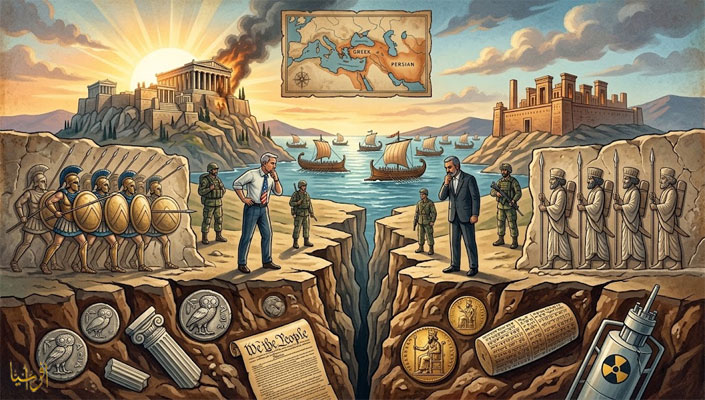
Rubio's rhetoric does not use history to explain politics, but rather to produce an imagined historical narrative of its own, starting with a geopolitical rivalry with Iran in the present, and then returning to the past.
Afrasianet - Laila Nicola - In his speech in Athens on October 7, 2026, U.S. Secretary of State Marco Rubio recalled scenes from the Greco-Persian Wars, talking about the arrival of Xerxes' armies in Athens in 480 B.C. and the burning of the Acropolis, linking them to the war on Iran and the threats facing the United States and the West today, suggesting that the current confrontation with Iran is only a new chapter in an older civilizational confrontation between Athens and Persia.
After listening to the speech and this connection between ancient history and the wars of the present, two basic observations can be recorded:
First: A speech similar to the Israeli right.
In this historical metaphor, Rubio seems closer to the rhetoric of Benjamin Netanyahu and the Israeli right than to the usual American political tradition.
In form, American politicians have long been known for their historical metaphors, usually invoking American independence, the Constitution, the Civil War, or World War II in their speeches. But what is striking is that their primary reference remains American history itself and American national memory, and Rubio has turned to a history that predates the birth of the United States by more than 2,000 years, and has made it a framework for interpreting a contemporary conflict.
Rubio's way of reading and politicizing history is similar to that of Netanyahu and the Israeli right. In Netanyahu's speeches, the right, and the Israelis, the ancient biblical kingdoms, the Babylonian captivity, the wars against the Romans, and ancient empires are frequently referenced, and linked to Israel's modern adversaries.
Rubio thus adopted almost the same logic, evoking centuries-separated figures, events, and empires and treating them as part of a single conflict that continues over time: Xerxes is a precursor to understanding contemporary Iran, and ancient Athens has become a direct political and civilizational ancestor of the United States.
Second: The Issue of Identity Spanning History
This type of discourse is based on a problematic theoretical premise: the existence of a fixed historical identity that transcends centuries and preserves its content despite the change of states, societies, political systems, and cultures.
Rubio's narrative posits a single, contiguous "West" stretching from Athens to Washington, and a single, contiguous "Persia" stretching from the Achaemenids to the Islamic Republic. But this continuity is not so much a historical fact as an imagined ideological construct.
Present-day Iran is not the Achaemenid Empire, and it is not a political continuation of it in the sense that the current state is a legal or institutional extension of the old state.
Between the ancient Persian Empire and the modern state of Iran, different empires, dynasties, religions, and political systems have successed, and borders, societies, and identities have changed many times. The same is true of the United States, which is not a continuation of ancient Athens, nor is it a direct political heir to it.
History does not define fixed civilizational or political entities that pass through centuries, retaining the same meaning and identity. Essentially, identity is not an essence that passes through time without change, but rather a historical construct that is formed, changed, and constantly interrupted and redefined.
In addition, the claim that there is a fixed and pure Western identity is incorrect, because political thought is formed primarily through the cross-pollination of civilizations and their conflicts. Western political thought has been inspired by many aspects of the Greek heritage, as well as by the Roman, Christian, and modern European heritage, but it has also been inspired by the Persian cultural heritage itself.
Since the Renaissance, Western thinkers have not only invoked the Persian legacy as a historical adversary, but also as a source of political ideas and models. Cyropaedia has occupied an important place in Western political thought, particularly through Xenophon's Cyropaedia, which for centuries remains one of the most influential political texts in modern Europe.
Some American historical studies have also shown references to the knowledge of Cyrus as a model of good governance and religious tolerance.
The above means that the relationship between the Greek and Persian worlds has historically not been a relationship of constant conflict, as the civilizational discourse of Rubio and Netanyahu assumes, but also included paths of mutual influence and the transfer of ideas and political models.
Thus, it can be said that Rubio's rhetoric does not use history to explain politics, but rather uses politics to produce its own imagined historical narrative, starting with a geopolitical rivalry with Iran in the present, and then returning to the past in search of a precedent that gives this rivalry a civilizational and moral meaning.
From the perspective of international relations, the danger of this type of narrative is that it moves the conflict from the level of interests to the level of identity. When the confrontation with Iran is interpreted through the nuclear program, regional balances, or national security, it remains a manageable, negotiated, and resolvable political conflict.
When presented as a new chapter in a civilizational confrontation that began with Athens and Persia, it turns into an existential conflict in which compromises become more difficult, because the adversary is no longer a strategic competitor but is redefined as the "civilized other."
________________
Laila Nicola - Lebanese writer.

________________

