
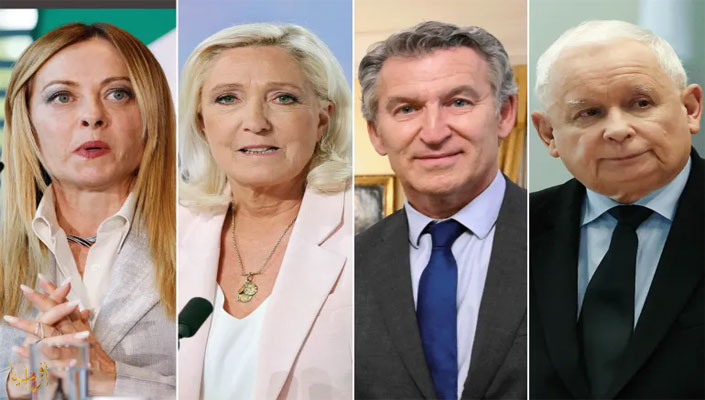
4 faces whose upcoming election results may determine the balance of power within the European Union and the path of the rise of the right on the continent.
Afrasianet - Saja Yasser - In one year, four of the EU's top 5 countries will go to the polls: Spain first, then France , Poland and Italy. In the four countries, the nationalist or far-right stands on the threshold of power, or already holds it and waits for it to be consolidated.
The Financial Times describes the scene as a "super-election cycle" that Europe has not seen as dense as it has been in a generation, not only because of the proximity of the dates, but because the elections are coming in the wake of similar trends: the erosion of old party loyalties, the widening of the right, and the collapse of the barriers that separated the conservative center from the far-right alliance.
Natalie Tucci, a professor at the School of Advanced International Studies at Johns Hopkins University in Bologna, writes in an op-ed for the British newspaper The Guardian that Europe has so far been relatively immune to the all-out political coup that a single US presidential election could bring.
The multiplicity of governments and their different orientations would dispel the impact of any single wave. But this balance could be broken if several major capitals tilted in the same direction at the same time.
Accumulation of fund results
The rise of the right is not new to Europe. The Guardian points out that nationalist and far-right parties have been in governments and coalitions for years, and that the right and center-right are now able to form a majority within the European Parliament on some issues, especially migration and climate. But this shift has remained geographically and politically uneven, and has so far not produced a unified coup d'état in the path of the Union.
What's new this time is the possibility of wins accumulating rather than dispersing.
If the leader of the far-right National Rally party, Marine Le Pen, reaches the French presidency, and Italian Prime Minister Giorgia Meloni confirms her rule in Italy in a more right-wing coalition, the Law and Justice party returns to power in Poland, and the Popular Party and Vox coalition government is formed in Spain, Europe will not face four separate national transformations, but rather a political bloc capable of changing the balance of the union from within.
These governments, along with smaller allies, may not have a majority to lead the bloc, but they can form a resilient minority that will curb any new push for defence, energy, finance and technology integration, Tucci says in the Guardian.
Speaking to the Financial Times, she also said that a meeting of the nationalist right in power within the four countries could mean "the end of the European Union as we have come to know it."
Spain (November 29)
Spain opens this session on November 29, after Spanish Prime Minister Pedro Sánchez called for early elections following a parliamentary crisis that toppled a package of housing reforms that was relied upon.
According to the Financial Times, the polls give the conservative Popular Party and its potential partner Vox a clear majority, which could end eight years of socialist rule and open the door for the far-right to enter the central government in Madrid. The PP itself has not closed the door to an alliance with Vox, and it already rules with it in a number of regional administrations.
France (April-May 2027)
Then comes France, whose presidential elections in April and May 2027 are described by the Financial Times as potentially the most influential of the entire cycle. The presidential election is followed by parliamentary elections in the summer.
Marine Le Pen is clearly leading the race, while her traditional opponents appear to be divided and unable to build a counter-momentum.
Despite years of trying to "cleanse" the image of the National Rally, Le Pen still has a confrontational agenda with the European Union: she wants to reduce France's contribution to the bloc's budget by about 11 billion euros, withdraw from the common European asylum policy, and give French law priority over EU legislation.
Le Pen's victory will differ in weight from Meloni's: France's president has a mandate and powers that make his voice decisive within the European Council, which includes the leaders of the 27 countries and sets the EU's strategic direction, and could transform the bloc's second-largest power from a pillar of his project into an opposition force at its heart.
Poland (Fall 2027)
In Poland, the PiS party that ruled the country between 2015 and 2023 may return, but the scene is no longer about it alone.
The Financial Times says the party has split and lost votes to forces to its right, led by the Confederation and the Polish Crown Confederation. However, the four right-wing parties gather about 47 percent of support in a recent poll, leaving the possibility of a return to power in next fall's elections.
The newspaper observes a phenomenon that is repeated in other countries: the extreme right is no longer only pressuring the center, but also the traditional and nationalist right itself, pushing it to harden its positions so that its voters do not lose to more radical competitors.

Italian Prime Minister Giorgia Meloni during a European summit in Croatia (French)
Italy (before December 2027)
Italy is different; it is already ruled by the right. But the Guardian and the Financial Times are asking whether Giorgia Meloni will remain the pragmatic approach she took in Brussels if the political environment around her changes.
Meloni has so far adhered to European fiscal rules, cooperated with the commission, and supported Ukraine. But the Financial Times says she is facing pressure from forces to her right, and in the upcoming election she may have to include the National Future party, led by pro-Russian former general Roberto Vanacci, into its coalition.
The Guardian's Natalie Tucci argues that Meloni's relative moderation was partly linked to her presence among more centrist European leaders. If some of these are replaced by leaders who are more ideologically closer to her, her calculus may also change.
They are not one front
This does not mean that the European right is a cohesive bloc, as its positions differ on several issues, foremost of which is the relationship with Russia and Ukraine, and its parties are distributed among 3 blocs within the European Parliament.
However, the Financial Times observes an intersection between them in critiquing liberalism and globalization, exploiting successive crises, raising the slogan "Priority of our people" over migrants and cross-border institutions, as well as the stance on supporting Ukraine, and employing the digital space and its algorithms that promote provocative rhetoric.
Marc Leonard, director of the European Council on Foreign Relations, told the newspaper that these parties are watching each other and learning from their successes, from slogans to campaigns to the use of new media. This learning becomes more dangerous, Tucci reads, if enough of them reach power at the same time.
Ukraine may be the first to pay the price, as the Financial Times notes that Le Pen wants to halt most bilateral aid to Kyiv, questions sanctions on Russia, and rejects Ukraine's accession to the bloc, at a time when analysts speak of growing political and popular fatigue from her support.
________________
Source: The Guardian + Financial Times

