
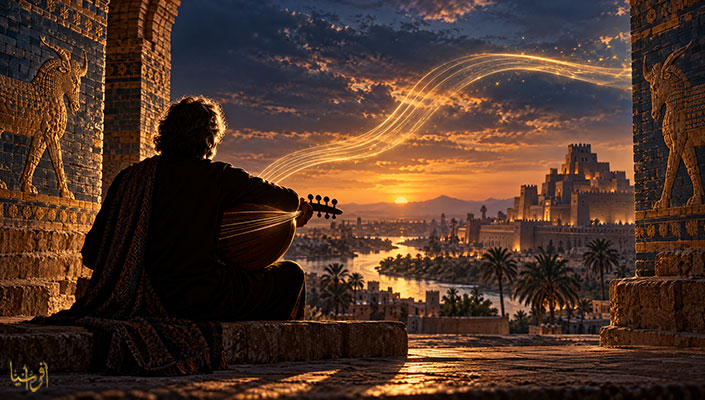
Afrasianet - Zahi Wehbe - From Babylon, where the first writing was born, and where it stands today in Mesopotamia, to Amshit, Beirut, the south and Palestine, we say to you: Your voice is still a promise from the storm, in the heart of the storm, and a victory over the storm.
To Marcel Khalifa, in Babylon...
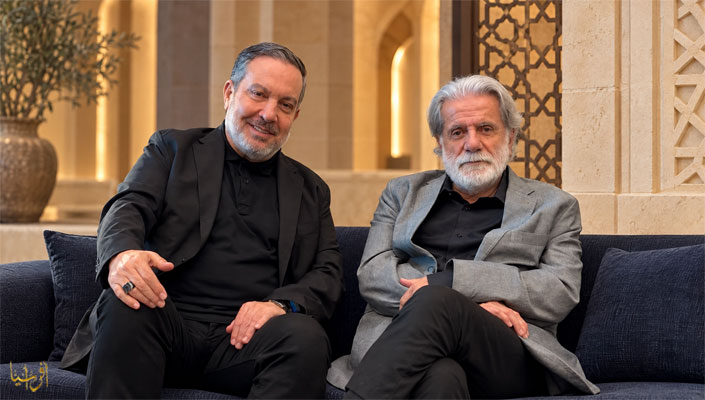
Zahi with resistance artist Marcel Khalifa
In the mythical city, between the Ishtar Gate and its gardens hanging in memory, you stand on the land of Mesopotamia, returning to the fountain of the first story. Here, where civilization breathes from its eternal soil, the "Festival of Babylon" celebrates you, the lover who carried his songs in a passport that transcends borders, through the cities as the storm crosses its promises.
A journey that spanned 50 years that began when you left war-torn Lebanon with Mahmoud Darwish's Diwan and "Promises of the Storm", the first partnership with a poet you had not yet met, and then your meeting with him became a lifelong partnership and a story of creativity.
For half a century, those words have still resonated in the throats of Arabs. Your melodies enriched life, gave the soul reasons to hold on to hope. You were the familiar chases, refusing to rest on the finished product, because, in your eyes, that is a premature death.
I founded the band Al-Mayadeen, and you sang for the homeland, the people, love and freedom. I sang for my village of Ainatha, and the people of a border town rejoiced in your song and considered it a participation in their daily struggle with the occupation and deprivation. You traveled the world with your lute, victorious for the land and for man, rejecting injustice wherever it was.
Your journey was not easy. You banned your concerts in many capitals, your tapes were confiscated, your voice was combed. But you didn't kneel. You were singing in besieged cities, in camps, in forgotten villages, everywhere you raised the banner of freedom. Your music was not a luxury, it was an act of resistance.
And your voice, Marcel, was a help to us in the darkness of the shelters and the trembling of the trenches. It pierced the darkness and reached the weary hearts and restored their pulse. It was a witness to the love stories that blossomed among the rubble, to the moments of hugs that defied death, to the tears of parting that shed silently, and to the farewells of the comrades who had gone and left an unfinished song in their throats.
You sang to them all, giving love a longer life than war, giving separation an unbreakable dignity, and giving martyrdom an unfathomable voice.
It is not only your voice that remains. But with it the voices of all of us: the voices of those who loved us, those who left us, and those who died muttering one of your songs. Your music has become a collective memory, which an Arab generation cannot forget, nor abandon.
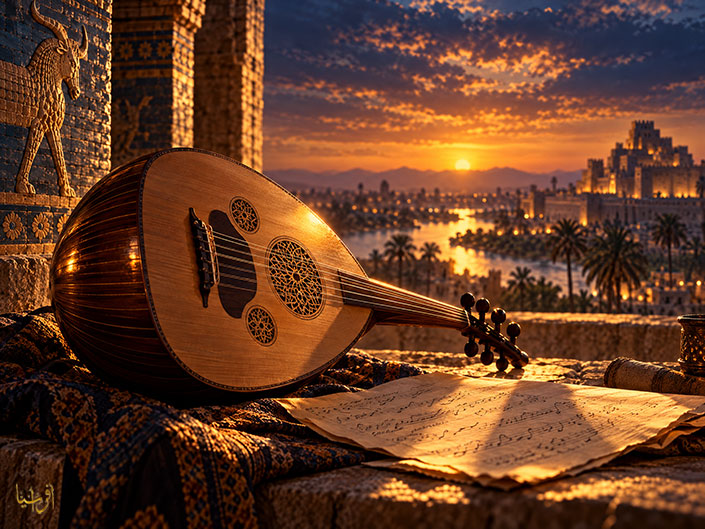
And your music alone, far from words and poems, has another conversation. There, where poetry is silenced and the lute remains, so that it seems to the listener that he is not listening to a composer and a composer, but to a lover who knows how to speak. In your pure music, along with revolution and violence, there is magic and seduction, so that sometimes she seems like a female who is seductive and pampered, who reaches out her hand and leads you wherever she wants, and then takes a step back to leave you longing and lust.
At the same time, it is like a wave that retreats from the shore to leave it longing, and then returns to it and embraces it. It has an endless dance, it has an uncompromising sadness, and it has joy that is afraid to escape. That is why your music seduces as you love, and love as you resist.
Before you sang, I had given the oud a place that it had never known before. I made it speak alone, not as a voice or a servant of the word, but as a voice that stood on its own, carrying joy, sadness, anger and nostalgia in tones that rise to the level of poetry. In doing so, I prepared for the oud its throne, which was almost forgotten in the rush of modern instruments.
There is another side of your genius, which many may not know: you are an excellent prose, you write Arabic with clarity and grace, and your prose prowess is revealed in the texts you publish on social media, texts that carry the experience of the lover, the wisdom of old age, and the wonder of the child. These texts are collected in a book, as they deserve to be read in the light of a multi-source and multi-directional experience.
You also have the eye of a skilled sniper, who knows how to capture the most beautiful things in texts to sing them. If we compare the sung poems with their origins, we will see that you take from them the jewel of its crown, leave to the page what completes its beauty, and take for the voice what immortalizes it.
Even though you sang in Arabic, your music transcended language. In Paris, Madrid, São Paulo and elsewhere, and in every city you set foot in, people found in your oud another language that they understood with their hearts. You became the ambassador of Arab joy and sorrow to the world, and those who did not understand our words understood our tunes.
Your bias towards Palestine, South Lebanon, the poor, the lovers and the dreamers, is first and foremost a bias towards man. To man in the face of oppression, to dream in the face of destruction, and to life in the face of death.
I was a young boy in southern Lebanon, listening to your songs under the roar of planes and the sound of cannons, and I loved your music and your warm voice. I never imagined that one day you would compose some of my poems, that we would become friends on trips and evenings, that your friendship would be an added human value, and that your company would be a spiritual and intellectual pleasure. And that we would meet together under the skies of Iraq, in ancient Babylon, this is a new opportunity for more love and beauty.
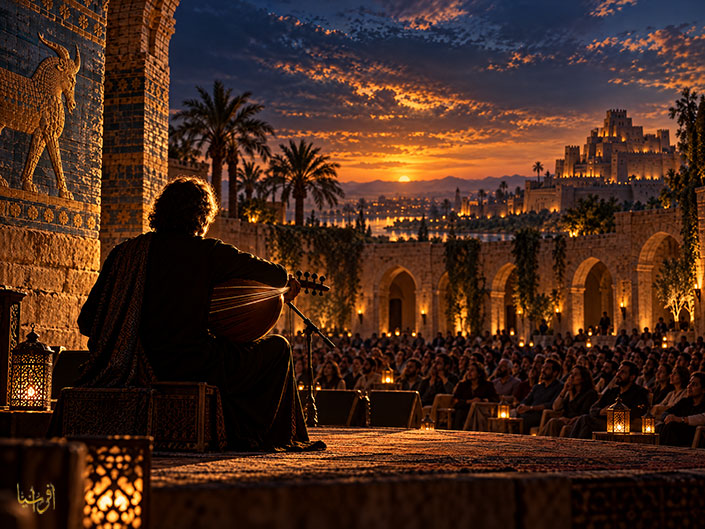
Marcel, you are today in Babylon, where the first writing was born. And here is the lute returning to its original cradle. In Babylon, where the first letters were painted on clay, your art finds its fullest meaning: for the word to return to its source, and for the voice to return to a land that knew that art alone is what remains after the demise of kingdoms. Here, in a land that has known the storm since the dawn of history, the tribute comes as the culmination of a march that has chosen to endure, and to a lute that refuses to die.
After a journey of nearly half a century, "Promises from the Storm" feels as fresh as if it was written this morning, because the circumstances are the same, and because your steadfast voice finds its echo in every Arab throat that seeks joy behind the eyelids of frightened eyes.
From Babylon, where the first writing was born, and where it stands today in the land of Mesopotamia, to Amshit, Beirut, the south, and Palestine, we say to you: Your voice is still a promise from the storm, in the heart of the storm, and a victory over the storm.
Fifty years later, the storm is still reborn, and the promise remains: that the voice will remain free, that the lute will remain steadfast, and that the free word will remain a pulse in the heart of every lover, in the heart of every fighter and in the heart of every human being.
________________
(*) Delivered at a ceremony honoring the artist Marcel Khalifa at the "Babylon Festival of World Cultures" in Iraq.

