
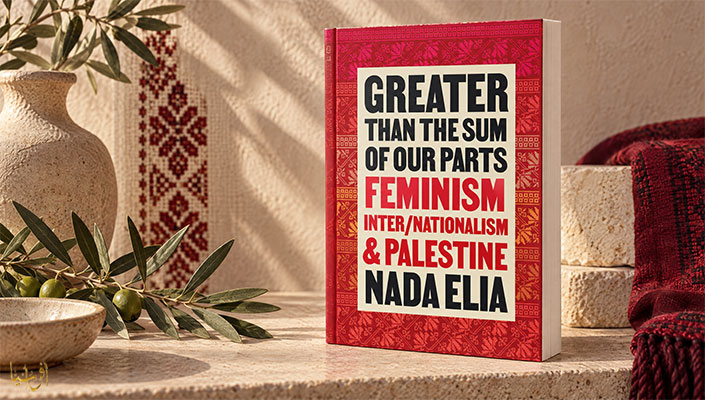
Afrasianet - Subhi Hadidi - Palestinian academic and feminist Nada Elia is a professor of cultural and ethnic studies at Western Washington University, and the author of groundbreaking work in his field, Deep Bridges, published in English in 2023 under the title "Greater Than the Sum of Our Parts: Feminism, Nationalism/International, and Palestine," Pluto Publications. Several chapters of the acclaimed volume, The Argument for Sanctions on Israel, 2020, are also signed by Haymarket. Within a broader framework, Elia has co-edited Critical Ethnic Studies: A Reader, another book closer to a practical guide that equips women activists of color with tools to fight against violence, and a third, Palestine: A Socialist Introduction.
Her most recent book, published by Verso Publications in London, is titled "Palestinian: A Century of Palestinian Feminism," and Elia wanted to use the Arabic word Falastiniyyat In the English title, for reasons that are not hidden and are not at all strange to her constant tendency to read the Palestinian affairs from a national depth rooted in conscience and history. As for the word "feminists" in the title, it refers to the diversity of feminists FeminismsWomen are not feminists, and this choice has special intellectual, political, and cultural connotations, which are also not hidden.
In order not to cause any level of intentional fallacies about feminism, in all its different currents and its tendency to limit it to women's liberation in particular, Elia hastens from the first lines of her book to define what she means in a number of decisive terms, foremost of which is the meaning of the Nakba: she does not see it as "a frozen moment in time, which occurred on May 15, 1948, but rather as the beginning of the Nakba, to emphasize that the displacement, stripping, theft of land, massacres, and other crimes that characterized the establishment of Israel in 1948 are still ongoing." Referring to the current Israeli war on the Gaza Strip after October 7, 2023, Elia writes about "an accelerated and intensive genocide, because the Israeli genocide against the Palestinian people has been going on since 1948."
She continues to use the term "Third World," or rather "Third World feminism," not because the term folded with the folding of the Soviet Union, the socialist camp, or even the Non-Aligned Movement, but because today it refers to Western feminist currents that embrace a gender analysis that gives importance to the effects of racism, colonialism, and neocolonialism, without neglecting collective empowerment, group organizing, and not limiting it to individual women's rights files.
In a way of vital organic overlap, Elia resorts to expressions such as the "cosmic north," to refer to a feminism that incorporates generalized Western ideologies, regardless of ethnic identity or geographical distribution, or "feminism," when talking about currents deeply rooted in the cultures of indigenous peoples, strongly linked to the national land and local heritage.
Palestinian feminism, among these and many other considerations, is highly complex and complex, although its major pillars can be summed up in the following formula: Women have always been, and remain so, at the heart of "some of the highest transformative efforts and initiatives in our people's quest for justice, i.e., our resistance first to imperialism, then to settler colonialism and apartheid," writes Elijah.
On the contrary, she has high intellectual and moral courage when the prevailing currents in the West in general and the United States in particular are aligned around this central axis: Zionism and the occupying state, not the Palestinian man, are the oppressors of Palestinian women, and here the focus of Palestinian feminist struggles must be formed, which does not in any way nullify the various fields of human rights struggles related to the relationship between women and men in Palestinian societies.
The eight chapters in her book, except for the introduction and the epilogue, cover feminist struggles The Palestinian era, starting with the emergence of the personal politician (the macro level, as she puts it), under the British Mandate and the 191848 years, then the development of manjat, during the Nakba, where childhood issues were present through Hind al-Husseini and "Dar al-Child"; the birth of support groups, support and cultural preservation, with Samiha Khalil, and the revival of the family; raising the voice and normalizing the anti-colonial discourse, in the years 1967-1980, and in the presence of Jean Makdisi and Camille Odeh.
There is the era of the Renaissance and the "Women's Uprising" during the First Intifada, the 108793 years, with Sarida Hussein, Zuhaira Kamal, and Naela Ayish; navigating through problematic political and social lines, the years 1993-20000, where the Oslo years, with Maha Abu Dayyeh and Rita Jaqman and the Institute for Women's Studies at Birzeit University.
Chapter 7 deals with the crucial question: Who is feminist, and who are women? The answers are proposed by the concluding chapter eight, in a panoramic and polemical manner, the paragraphs of which are not at all embarrassed to emphasize a tone of high militant resistance.
Palestine is a feminist issue,’ insists every chapter in [Nadine] Nassan's [Elias's] book, recalling that historical pledge in the document of the collective Palestinian feminist movement, March 2021; which is inherently inseparable from the struggle of Palestinian women in the face of Zionist, colonial, and imperialist feminisms, which are allied or sometimes identical with hollow, orientalist, or reductionist Western feminisms.
It is no wonder that Elias looks forward, in the final lines, to that dream of Palestinian women celebrating the liberation of the homeland: 'From the river to the sea, and from the water to the water!'.
________________

