
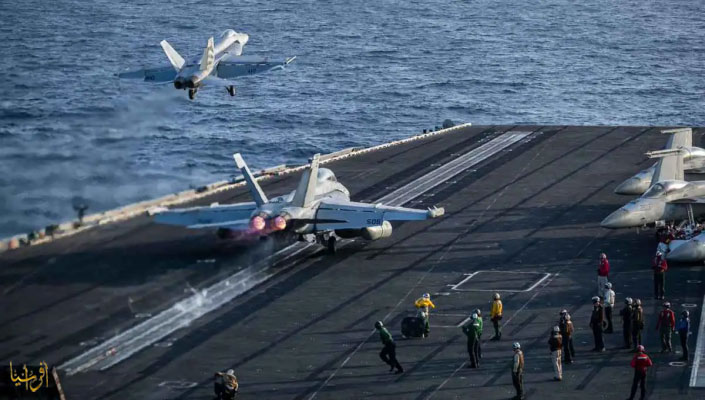
US aircraft carrier near Strait of Hormuz
Afrasianet - Nafija Sabah Albuafra Al-Kuwari - The question in the Middle East is no longer whether the United States can maintain its presence and influence, but whether the model by which it has managed the region's security since the end of the 1991 Gulf War is still viable.
The equation, which was based on U.S. military superiority that ensures the security of allies, deters adversaries, and gives Washington a broad ability to influence the direction of crises and settlements, today faces a different regional and international environment than the one in which it was formed.
U.S. allies are more inclined to diversify their international partnerships, and its adversaries have shown greater resilience to military and economic pressures. At the same time, U.S. resources are no longer as devoted to the Middle East, as international competition and strategic commitments expand.
In this context, the challenge is not the choice between staying or withdrawing, but how to reframe the role itself, from a model based on hegemony and direct military presence to one that relies on collective defense, burden-sharing, and a flexible military presence.
However, this transition does not happen simply by reducing or redeploying troops, as reducing the military presence without building security alternatives could create a strategic vacuum, while continuing the previous model increases costs without ensuring more stable political outcomes. The central question arises: What conditions make this transition possible without weakening deterrence or creating a new security vacuum?
"The essence of the transformation is not the reduction of the U.S. military presence per se, but rather the gradual redistribution of security responsibility, as the capabilities of the region's countries in the areas of air defense, maritime security, early warning, operational coordination, and crisis management develop, the more it becomes possible to reduce the U.S. presence without weakening deterrence or creating a security vacuum"
________________
The Dilemma of Continuing with the Old Approach
The fundamental dilemma is that the strategy that has given the United States broad ability to manage regional balances over the past decades has become more costly and less able to produce stable political outcomes.
U.S. military power has proven capable of inflicting significant damage on its adversaries, but it has not always been able to convert military superiority into sustainable settlements. The two direct confrontations with Iran, in June 2025 and February 2026, reveal part of this problem, as they have damaged Iran's military structure, without ending its ability to respond or closing escalation paths, while the second confrontation ended in a fragile truce reached in Islamabad.
The predicament of the existing approach is manifested in three interrelated paradoxes: the first is that some military assets to enhance the security of regional countries have become, in moments of escalation, part of the targeting calculations, which raises the question of the relationship between military protection and security exposure. The second paradox relates to the cost of deterrence itself, as the continuation of rounds of escalation imposes a high consumption of ammunition and defense systems, and makes maintaining military readiness more expensive and complicated.
The third paradox is the gap between the American commitment to Israel's security and Washington's ability to influence its military and political choices, and the wider this gap, the more the United States will be required to bear the consequences of policies that do not fully control its course, weakening its ability to combine the functions of a security guarantor and a political actor.
This problem becomes more apparent with the change in the international and domestic environment of the United States, as the United States no longer moves in a unipolar system, and the appetite within the United States to engage in long wars has declined, at a time when strategic priorities are distributed between Europe and the Indo-Pacific region. Therefore, continuing with tools that have been designed for a different phase may not reflect strategic stability as much as it reveals a growing gap between the means used and the environment in which they operate.
Strategic Options for Washington
In light of these shifts, three main paths can be envisaged for the United States, each with its own cost and limits, the first of which is based on an attempt to renew the hegemonic model by strengthening military deployment and expanding the scope of pressure, giving Washington greater ability to directly intervene and influence adversaries' calculations.
This option may provide greater flexibility in crisis management, but it raises the cost of commitment and increases the likelihood of recurring confrontations, without ensuring that military superiority translates into sustainable political stability.
This problem is even more important in light of the recent U.S. trend toward strengthening a military presence in the region as tensions escalate. Such moves underscore that military power remains a central tool in crisis management, while at the same time revealing the difficulty of moving from one based on a direct U.S. presence to one that gives regional partners greater responsibility for their own security. The more crises require a reintensification of U.S. deployment, the more difficult it becomes to build a security model based on burden-sharing and less reliance on direct intervention.
The second path is broad retreat, by reducing the military presence to its lowest levels and only intervening when vital U.S. interests are under direct threat. However, this option carries various risks: a rapid withdrawal could lead to a security vacuum, spur arms races, and prompt some partners to seek alternative arrangements and guarantees that may not necessarily be in line with U.S. interests.
Between these two tracks, a third formula emerges based on a more balanced security partnership, combining a less intensive and more flexible military presence, greater regional defense capabilities, and political mechanisms capable of managing the competition and containing the escalation before it turns into an open confrontation. This option means that the United States retains an influential role, but by empowering partners and sharing the burden, rather than shouldering the bulk of it alone.
From this perspective, the strengthening of the US military presence at the current stage reveals a broader paradox in US policy: on the one hand, Washington seeks to push its partners to take greater responsibility for their own security, but on the other hand, it returns to intensifying its direct presence as the threat level increases. The problem is not this reinforcement per se, but rather its transformation into a recurring pattern that makes regional security linked to the continued US ability to intervene directly.
The third formula is therefore not achieved simply by easing the military presence, but rather requires building a regional capacity capable of taking on a greater part of the responsibility for deterrence, defense, and crisis management. Hence, the question moves from the trade-off between the size of the U.S. presence to the more important question: What conditions make the shift toward collective defense viable and sustainable?
"The transition from hegemony to partnership does not begin with the withdrawal of troops, but with a redefinition of the American role in the Middle East, as it is not a question of leaving or staying in the region, but of moving from a model in which Washington bears the greatest burden in managing regional security to one based on the distribution of responsibility and the empowerment of partners"
________________
Conditions for Realistic Transformation
The first condition begins with a redefinition of U.S. interest in the Middle East, so that instead of trying to influence overall political balances and outcomes, the strategy can focus on a specific set of measurable interests, foremost among which are protecting freedom of navigation, preventing nuclear proliferation, counterterrorism, and maintaining the stability of energy markets. This requires accepting greater autonomy for partners, including making decisions that do not always align with U.S. preferences, without interpreting this as a departure from the coalition system.
The second condition is to build a collective defense in which the region has a key role in its formulation and management, and what is meant here is not the immediate establishment of a broad military alliance, but rather the development of a gradual structure that begins with the linking of early warning systems, air defense, and maritime security, and then expands to training, joint planning, defense manufacturing, and the distribution of strategic stockpiles. In this formula, the U.S. role shifts from bearing the primary defense burden to empowering partners through intelligence, technology, training, and armament.
The success of this structure requires greater clarity in the rules for the use of military installations in the region, so that the relationship between the host country and the United States is based on consultation and risk-sharing, with the territory of host countries not being used for offensive operations without their consent. Collective defense loses part of its logic if the tools of protection become a source of exposing partners to conflicts in which they were not involved.
The third condition is that the reduction of the military presence should be gradual and conditional on the growth of local capabilities, for the problem is not only the size of the forces, but the nature and function of their deployment. It is possible to move from a heavy reliance on fixed and large bases to a more flexible model based on distributed and periodic deployment and a naval presence, while maintaining a limited number of fortified posts and capable of responding quickly, thus reducing the presence as a result of the increased capacity of partners, rather than a step before building that capability.
The fourth condition is to build a more comprehensive regional diplomatic path, as collective security cannot be based on deterrence alone, because a security system that excludes the main regional powers will remain vulnerable to reproducing the polarization it seeks to contain, hence the need for a permanent framework for security dialogue, which includes, in addition to Arab states, Iran and Turkey, and begins with practical negotiable files, such as military lines of communication, maritime security, mechanisms to prevent miscalculations, and arrangements related to nuclear control.
This does not mean ending differences or assuming that it is possible to build full trust between the parties, but rather managing the competition so that every political dispute does not turn into a military crisis, as it requires supporting regional mediations rather than monopolizing the negotiation process, and accepting the contribution of other international powers when such a contribution is able to de-escalate and enhance the chances of a settlement.
The fifth condition is the creation of a credible political horizon for the Palestinian issue, while strengthening the ability of the United States to influence Israeli policies within regional arrangements. Security cooperation is not only based on common interests, but also requires a degree of political and popular acceptance, which is difficult to achieve in light of the continuing tension in Gaza and the West Bank, or in the absence of a clear political track that guarantees Palestinian rights.
If Washington seeks to expand regional cooperation, its influence over Israel should be coupled with its ability to ensure compliance with agreements and limit policies that impose increasing political and security burdens on its regional partners, otherwise the chances of building a broad and sustainable regional security system will remain limited.
Added to these conditions is an equally important internal American dimension, which is institutional continuity: any long-term strategy that requires a degree of consensus within Congress and U.S. institutions limits sharp fluctuations between administrations.
"U.S. military power has proven capable of inflicting significant damage on its adversaries, but it has not always been able to convert military superiority into sustainable settlements. The direct confrontations with Iran, in June 2025 and February 2026, reveal part of this problem, as they have damaged Iran's military structure, without ending its ability to respond or closing escalation paths"
________________
Redeploy within a graded path
The success of the transformation in the US strategy depends not only on the availability of the previous conditions, but also on the sequence of its implementation, as military redeployment should come within a gradual path that begins with reducing the level of threat, strengthening confidence-building mechanisms, and developing regional defense capabilities, ensuring that the construction of the security alternative precedes any significant reduction in the US presence.
An early drawdown, before partners are fully ready, could create a security gap and be interpreted as a decline in U.S. commitment, leading adversaries to test the limits of new arrangements and allies to seek additional security assurances. Conversely, continuing the current pattern of deployment without increasing the ability of countries in the region to assume greater defense responsibilities would entrench dependence on the United States and limit the chances of developing a more effective regional security system.
The more the capabilities of the countries of the region in the fields of air defense, maritime security, early warning, operational coordination, and crisis management develop, the more it becomes possible to reduce the U.S. presence without weakening deterrence or creating a security vacuum.
From Area Management to Redistribution of Responsibility
The transition from hegemony to partnership does not begin with the withdrawal of troops, but with a redefinition of the U.S. role in the Middle East, not of leaving or staying in the region, but of moving from a model in which Washington bears the brunt of managing regional security to one based on the division of responsibility, the empowerment of partners, and the linking of military power to diplomatic tracks capable of reducing the need to use it.
This shift requires more specific U.S. objectives, a more accountable regional defense architecture, a gradual military redeployment, a non-exclusionary security dialogue, a credible political path to the Palestinian cause, and institutional continuity within the United States that ensures that regional politics does not become hostage to periodic changes in administrations.
More importantly, the success of this approach depends on rethinking the concept of influence itself: in a more pluralistic regional environment, influence is no longer measured only by the size of deployed forces or the ability to impose results, but also by the ability to build consensus, distribute burdens, contain competition, and prevent crises from turning into open confrontations.
The question that will determine the future of the U.S. role in the Middle East is no longer how Washington maintains the hegemony it held after 1991. Rather, how does it reshape its influence in a region that no longer accepts that its security is managed by the same logic that has governed the past three decades?
________________
Nafija Sabah Albuafra Al-Kuwari - Assistant Professor in the Department of International Affairs at Qatar University.

