

Afrasianet - Haidar Al Mohsen - In the hour of trouble, how many hands stretch out to you at the same time, but you only sanctify one, the one that has remained with you.
Years ago, I was afflicted by an illness that kept me isolated from others and the world for a long time, and none of my library's treasures have found me except the articles of Ali Jawad al-Taher, not the story, not the novel, or the books of ancient history and geography.
Of course, I forgot everything related to this subject, and I did not return to my teacher's works after the misery of those days was over. But in a later time, as I was writing an article for this newspaper "My Brother Abdullah", I was listening to the echo of the pure voice in my ears, after it had melted into me and became a few of me, and I completed the writing without having to go back to the source.
The article flourishes and becomes a piece of art when the smell of tenderness radiates in it, moving our blood so that it jumps out of its place and changes for the better, or the text is cold and lukewarm and exhausts us from boredom and kills us with boredom. Rhythm is required and necessary, and the bell of the word is with Silence, stillness or the hustle and bustle that follows is required and necessary, and random work concludes with random literature that resembles random construction, no organization, no geometry, no order, and no sense of emptiness, the system has leaked out of a hidden hole in the place, and the leakage continued until the end.

Although all arts yearn to imitate music, the art of the essay is closer to the spirit of melody, the clarity of the letter and the splendor of meaning result in the navigation of speech, and some think that the invention of intensity in style and the condescendence of the reader guarantee the appreciation of critics. It is not in their mind that difficult speech is like hard water, and clarity, simplicity, and bell are the qualities of sweet and sweet speech.
There are those who resort to blind discourse that does not find its way to the readers, as if it were a mathematical equation in engineering, or it comes up with topics that deceive you at first, so that you count death in which there is life, and this leaves a void in your heart, which is immediately canceled by moments of reflection.
In Phaedrus's dialogue, Plato speaks of the "organic unity" of literary discourse, which is supposed to be formed as a living creature with no complete structure, and there is no vacuum or fragmentation in the text, but rather the units of the essay, if they are numerous, "can – in solidarity – simply form the whole."
"It is easier to write ten pages of a novel than to write these two pages. I have rewritten this dreaded text at least five times, and in the process, I have been editing it one after the other until I finally completed it as I agreed... But its mediocrity is bloody." The author of these moving phrases, Dostoevsky, in one of his letters to his brother, openly declares the difficulty of writing a literary essay.
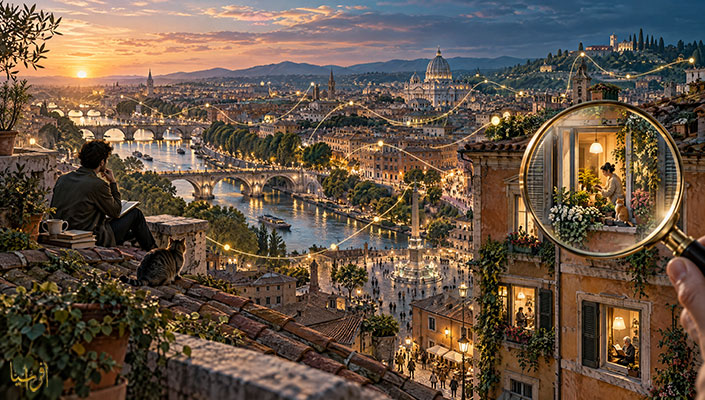
The most important conditions for this art are that the essayist must be talented and aware of the history of the culture and arts of his people. The essay touches people's lives directly, enters into their secrets, and foresees the world far, near and near. This art gives its desiree the festival of the city to live around it every day, inside and outside its homes. All things have become his property as long as he has written about it and fixed it on paper: glass, buildings, streets, and the river with its banks, as if it were Tomorrow is a palm tree that interacts with the wind and the sun, rotates with the movement in the city, and is affected by what is happening.
He is also a cartographer of the world that is unparalleled, he can make a map of the scale of 1:100,000, 1:50,000, or 1:5000, which includes all the dimensions of the visible world and the human conscience, and he can depict himself, others, the human race, as well as the rest of the creatures on earth, in a symbolic painting and in the dimensions he wants, and he can also examine everything presented with a microscope.
The article makes you a monument, or digs a hole for you, or neither of these or that, which is the most general type of what we read in newspapers and books about this art, because the author has not made an effort to raise it above their heads, and does not descend without it, so that he gets lost in the crisis of their grunts, and if he continues to fall in this way, it may happen that he will be trampled by his heels, and the writer would prefer to die rather than be crammed in this place, an example of failure, helplessness, and corruption of taste.
It is known about this art that it lives on the press, which in turn feeds on reality, and does not take anything from the imagination. While the specialist in the literary article likes to talk about things that seem unnecessary, and from which the practical benefit has disappeared, leaving him to live a naked life in them, what he calls its poetic criticism, reveals it to the reader in touching images. It is the way of the one who lives all his life, and he acquires things that are not sold.
Feminization, remembrance, and the preference of the male over the female are not absent from our thinking in this country, even if the thinker is a writer, a scientist, and a great human being. It is narrated that my pure teacher preferred the name "article" to mention the "article", and if he liked the way it was written and presented, he said that it was an article, otherwise it would be in the feminine form. For me, I prefer her to call it feminine because she resembles Eve, gentle and light on the heart, and easy to reach on the surface, but impossible for the helpless.
The article is written as if the narrator is singing, combining the two most precious things in existence: beautiful music and lingering wisdom.
________________

