
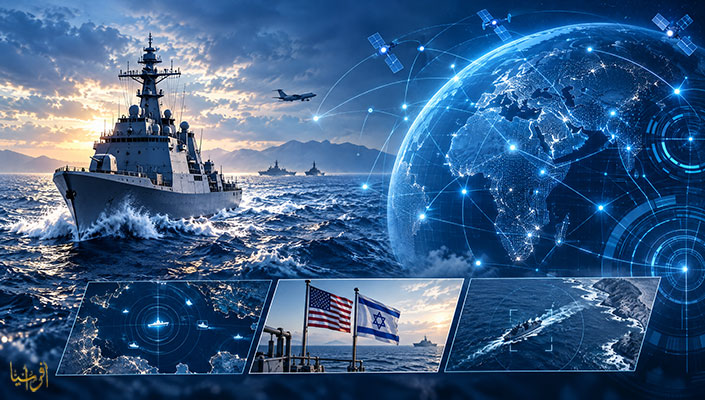
The writer stressed that America has no choice but to achieve a crushing victory over Iran or others, or to admit defeat and bear the repercussions.
Afrasianet - Dagher Monqez - After every major technological revolution, a major war breaks out and its effects extend to the entire world and create a new international order.
The current U.S.-Iran war appears to belong to this pattern, coming in the wake of the Fourth Industrial Revolution , which began in 2016 according to Klaus Schwab's classification.
More than one political theory has discussed how power shifts in the aftermath of major wars, and the consequent shaking of the world order and its replacement by a new order commensurate with the balance of power that results from those wars.
The current war is no exception, as the conditions of Thucydides' trap apply to all of them, which foreshadows a major shift in the structure of the existing international order , which was produced by the conditions after the second Gulf War in 1991, which coincided with the fall of the Soviet Union, and produced a unipolar world in which America was not only the superpower, but also the dominant power that imposed its conditions and guarded the new order that reflected that hegemony.
This article discusses the potential repercussions of the war now going on between the United States and its regional allies on the one hand, and Iran and its regional and international allies (China and Russia) on the other.
"The period between the end of World War I and the outbreak of World War II saw a scientific revolution that produced radar, jet engines, and nuclear fission. The defeat of Germany and the Axis powers led to profound changes in the world order"
________________
Back to history
The Agricultural Revolution represented the first epoch of human technological development; before agriculture, hunter-gatherer man did not have anything worth defending or conquering (no fixed land and no grain stores).
With the beginnings of agricultural settlement in Mesopotamia, the concepts of property and abundance emerged, and with them emerged the concept of the outsider/invader as opposed to the owner and defender of the land.
In other words, it was the agricultural revolution that created the concept of war itself, so it is not strange that the first war in human history was documented on the land of Sumer, between the Sumerian cities of Lagash and Uma, due to an agricultural border dispute over an irrigation canal and agricultural land called "Guitina", according to what was recorded on "Obelisk of the Eagles".
When the first scientific and industrial revolution began in the 17th century with the works of Galileo and Newton, it was coincided with the Thirty Years' War in Europe (1618-1648), which was ostensibly religious but in reality an economic and political dispute over property rights to lands that were semi-independent religiously and politically, which threatened the balance of power on which the small German principalities and neighboring countries depended.
That war ended the Habsburgs' imperial religious hegemony and established the very concept of "national sovereignty" that remains the basis of the international order today.
With the development of the First Industrial Revolution and the resulting invention of the steam engine, machine, and electricity in the 18th and 19th centuries, the Napoleonic Wars broke out, and then World War I , which was decided by the Axis control of 70% of the world's oil resources.
The period between the end of World War I and the outbreak of World War II witnessed a scientific revolution that produced radar, jet engines, and nuclear fission. The defeat of Germany and the Axis powers led to profound changes in the world order, represented by the entrenchment of two world poles (the Soviet Union and the United States) that governed the world.
Desert Storm
The 1980s witnessed the so-called Third Technological Revolution (or the First Digital Revolution), with its era of the personal computer, accessible programming, lasers, mobile phones, the Internet, and GPS technology, and paved the way for the era of cyberspace and digitalization.
These enormous technological advances coincided with Saddam Hussein's invasion of Kuwait in August 1990, threatening the world's energy backbone and fuel tank (the Persian Gulf) in a way that the superpower could not allow.
The great and accelerated rise of the United States in all fields at the time was a prelude to the era of unipolarity, and American strategists recognized this fact, which President George H.W. Bush clearly expressed in a speech to a joint session of Congress a week after the invasion of Kuwait, stating that from these turbulent times a new world order could be born.
Therefore, the Desert Storm, which began in early 1991, came to liberate Kuwait first, and to push the world order towards new horizons that would strengthen American hegemony over it second.
The 1991 war was marked by two things that make it a document on the transition from one world order to another. First, it was the first real embodiment of electronic warfare; the Second Gulf War was described as the first actual application of the so-called "revolution in military affairs," a term coined specifically to describe how digital technology changed the nature of war itself.
"Instead of working through the multilateral international frameworks that have long defended the importance of its existence, the United States is increasingly acting outside institutional constraints, justifying its actions as an "enhanced hegemon" and superior capabilities, rather than collective legitimacy"
________________
The second is that it is the only war, out of all the wars fought after the Vietnam War, that arguably represented a clear military, political and diplomatic victory for America, in a way that greatly increased its power on the international stage and confirmed its position as the world's policeman.
Within this historical context of U.S. hegemony, America and its allies invaded Iraq in 2003, after the Third Technological Revolution (or the first digital) had developed and matured to a greater degree, making digitization the control of the war.
Precision munitions have become the norm rather than the exception, and the rules of engagement and the art of warfare have changed in a way that has greatly diminished the importance of ground forces (infantry and armor) and given superiority to air and missile forces.
The reconnaissance and digital targeting systems enabled the U.S. military to carry out the "shock and terror" campaign that toppled Saddam's regime at the lowest cost and in the fastest time.
These wars once again enshrined American military and political hegemony, so that the United States no longer cared about the rules and institutions it had formulated after World War II.
Rather than working through the international multilateral frameworks that have long championed the importance of its existence, the United States is increasingly acting outside institutional constraints, justifying its actions as an "enhanced hegemon" and superior capabilities, rather than collective legitimacy.

The U.S.-Iran War in 2026
The past decade has witnessed a second digital revolution, of which artificial intelligence has been the most prominent product. The most important feature of this revolution that we are living in today is the shift from simple digitization (the Third Industrial Revolution) to innovation based on the synthesis and synthesis of several technologies (the Fourth Industrial Revolution).
While the third revolution asked: "How do we digitize information?" The fourth revolution asks: "What happens when digital information merges with other things?" To summarize the repercussions of this new digital revolution, which began in 2016 according to the German economist Klaus Schwab, four characteristics of the current war can be distinguished from the reference war of 1991:
First: From centralization to decentralization in war management:
The 1991 war was a clear central U.S. leadership, on a single geographical theater (Iraq), and with a unified coalition under a single military command.
The 2026 war is more intertwined and fragmented: multiple simultaneous fronts (Iran, Iraq, Kurdistan, Saudi Arabia, the UAE, Kuwait, Cyprus, and the Indian Ocean), and non-state actors (Hezbollah, Houthis, the Popular Mobilization Forces, and Iraqi factions) that move almost independently of central orders; operators receive "commander's intent" rather than detailed orders, and can move forward even in the absence of direct communications or coordination controls.
This means that network efficiency and decision-making speed generate a disproportionate advantage. Advances in mobile communications have also provided the IRGC with communication capabilities that were not available in the 1991 war, but have allowed it to direct Iranian missiles and drones that have targeted the Persian Gulf states.
In addition, the Chinese satellite network is used for communications, missile guidance and drones (Azad, Small Wars Magazine, 2026). In short, advances in communications technology have given Iran advantages that were not possible in 1991.
"The Iranian side benefited from this lesson of the U.S. military's use of its sophisticated technological capabilities that produced precision-guided munitions, and confronted them in a manner based on exhausting the enemy to the maximum extent using as many cheap combat methods as possible"
________________
Second, from conventional warfare to hybrid warfare:
Hybrid warfare here refers to the fusion of different types of warfare, including conventional capabilities, irregular tactics and formations, acts of terrorism with their indiscriminate violence and coercion, and criminal anarchy.
Although all countries involved in the war have used some form of hybrid warfare, Iran has been able to mix a wide range of them, including disinformation campaigns, social media manipulation, cyberattacks, and the use of proxies and irregular forces.
Their use of hybrid warfare was not limited to the strategic and tactical levels, but they were able to manufacture hybrid weapons (drones and missiles) that combine traditional manufacturing techniques with modern digital technology.
This is precisely what is embodied in Iran's AI-guided drones: a conventional physical object based on conventional flight engines, combined with digital intelligence (self-guidance without a signal) into a single tool of war.
Iran has also been able to combine traditional Russian ballistic missiles with digital missile guidance technology. The 2026 war has been hybrid from the moment it erupted, while the 1991 war was actually the closest to a "purely conventional warfare" model.
Third, from high resolution to high density:
The U.S.-Israeli side is still relying mainly on making the greatest possible impact through both targeted and parallel precision strikes targeting nuclear headquarters, commanders, facilities, and security headquarters.
This is an extension of the doctrine of "impact-based operations" that was first followed in the 1991 war, when the precision of the US Air Force, along with the Iraqi army's central command style based on its previous military experience, made it possible to strike more than one Iraqi target at the same time to paralyze the Iraqi command and control system and have a significant physical and psychological impact.
The Iranian side has learned the lesson of using the U.S. military's sophisticated technological capabilities to produce precision-guided munitions, countering them in a manner that maximizes the enemy's fatigue by using as many cheap combat methods as possible.
This method was clearly demonstrated in forcing U.S. and Israeli air defenses to deplete their expensive resources ( Patriot and Thad) in countering cheap weapons, by saturating with missiles and drones (numerical density instead of precision). Thus, the war became the arena for an asymmetrical conflict between two simultaneous patterns: U.S. precision versus Iranian intensity and saturation.
Fourth, from the monopoly of technology to its spread:
This may be the most important factor, not only because it has given Iranian forces a great ability to counter U.S. technological superiority, but also because it signals a new era in military confrontations, unlike in the 1991 war.
In that war, America had a complete monopoly on sophisticated technology, such as the GPS system, stealth technology, precision-guided munitions, and long-range Tomahawk cruise missiles.
In the 2026 war, the spread of revolutionary digital technologies around the world, through open sources, not exclusively, has enabled individuals and countries to invent lethal weapons at the lowest cost and in the shortest possible time, which has come to be known as the "democratization of technology ."
Although Iran has used many sophisticated military technologies from China, Russia, and North Korea, it is the availability of publicly available positioning technologies that enable Shahed, for example, to navigate aerial navigation and hit their targets with precision.
"The United States has one of two ways to restore confidence in its global role: either to resolve the military and strategic victory over Iran in a clear and unambiguous manner, which requires either toppling the regime or accepting it on terms similar to Japan's surrender after World War II, or seeking a new war as important and large as the Iraq War in 1991 and achieving a decisive victory in it"
________________
Towards a New World Order
It is clear, then, that the current U.S.-Iran war is one of the types of wars that inaugurates a new era of conflict between states. Thus, based on the historical pattern we have referred to above, it is expected to change the nature of the existing world order and establish a new world based on a different power equation.
Although it is difficult to accurately predict the outcome of this war and the shape of the world order that will emerge from it, in light of the many possibilities of its consequences and the uncertainty of who will ultimately win strategically, it is certain that the foundations of the old world order are gradually dissolving and that it is going through a phase of liquidity that is waiting to be reshaped.
It will take time for the broader world order to absorb all of this, but the Middle East itself has already been transformed.
This analysis is undoubtedly in favor of a shift toward a multipolar system, but it is not the only possible scenario: America could also emerge from this war, through a decisive settlement or escalation, in a more established position, no less.
Some analysts believe that a clear U.S. victory could re-establish U.S. prestige globally, boost allies' confidence in its security umbrella, and give it an opportunity to redesign regional arrangements to serve its interests, while putting renewed pressure on China and Russia to curb their expansion.
Even in this scenario, unipolarity remains relative, not absolute, but it remains a systemic possibility that cannot be completely ruled out as long as the war continues without a final resolution.
Perhaps the shaking of the confidence of the world in general, and the Gulf countries in particular, in the ability of the American pole to protect them has become a new dilemma facing America and affecting the formation of the new order.
The United States has one of two ways to restore confidence in its global role: either to resolve the military and strategic victory over Iran in a clear and unambiguous way, which requires either toppling the regime or accepting it on terms similar to Japan's surrender after World War II, or seeking a new war as important and as large as the Iraq War of 1991 and achieving a decisive victory in it.
There is, of course, a third way: America accepts its defeat and reaps the major consequences of it, the least of which is to accept a world in which China is a great power that influences large parts of it and shares the global decision with America.
________________
Dagher Monqez - He has served as an advisor to the Prime Minister and is currently the Middle East and North Africa Regional Director at Gallup International and the World Public Opinion Research Organization. A former general in the Iraqi Army, he received his master's and doctorate in public administration from the University of Baghdad in 1996, and his certificate from the Iraqi Staff College in 1991. He studied at the Colleges of Staff and National Defense in Iraq, and at the universities of Baghdad and Basra for primary and graduate studies, and lectured at major universities and scientific research centers such as Harvard, Princeton, Maryland, and King's College London, and at the Council on Foreign Relations of the United States and the European Union. He has published 10 books, as well as articles in Arabic and English.

