

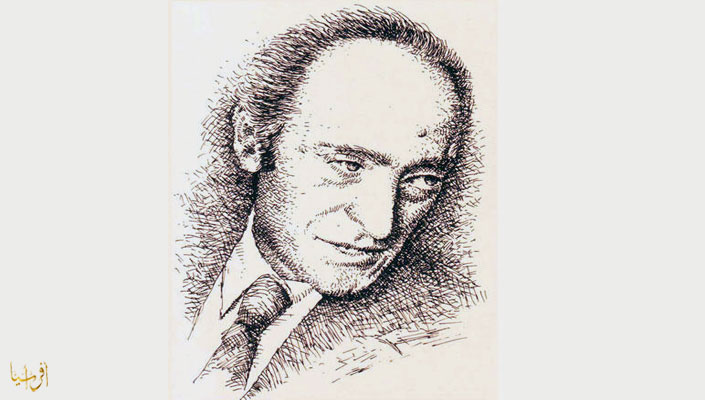
Afrasianet - Ibrahim Mishara - Khalil Hawi (1919/1982) is one of the important poetic voices on the map of modern poetry, and one of the prominent founders of modernist poetry, and perhaps the only poet among his contemporaries who are called the great poets of modernity who ended tragically, he preferred to end his life himself instead of waiting for death to come, and many critics and historians of the poet's life link the Israeli invasion of Lebanon in 1982 to the end of the poet, it is known that the poet committed suicide with his own rifle, when Israeli tanks entered Beirut.
The nationalist poet could not bear the scene, and the shock was so severe for him, so he blew his head off with a bullet from his rifle and drowned in his blood, and he was a little over sixty. The late Egyptian storyteller Youssef al-Sharoni says that "each of us is born as the heroes of popular biographies and ends up as the heroes of Greek tragedy", and if this is true of a critical intellectual or a great modernist poet, it is largely true of the poet Khalil Hawi, who began his life as Abu Zaid al-Hilali and ended as Oedipus, or Prometheus, defeated by the fragmented and divided Arab reality and mired in internal strife on ethnic or sectarian lines, and he is the nationalist poet who engaged in an endeavor.
Evangelizing the lights, progress and modernity, that is, towards a promising and bright Arab future in which the Arabs reach their promising tomorrow with the prosperous past, the era of the Rashid, for example, Arab unity is more than a necessity in an era in which the colonial powers have conspired to divide the Arab countries for an easy summit since the fall of the Ottoman Caliphate and the Sykes-Picot Agreement, which led to the division of the legacy of the sick man between the two colonial powers, France and Britain.
Khalil Hawi was enthusiastic about all the liberation movements in the Arab world to get rid of Western hegemony in all its forms, whether it is a mandate, protection or colonialism, as the complete independence of every Arab country is a necessary condition for achieving Arab unity and initiating the national progressive development project by engaging in the consolidation of modern scientific culture and the modernization of social and economic structures and individual freedoms, such as civil society, equality, and women's freedom.
In his poetic beginnings, we find many modernist poems that accompanied this endeavor and heralded the new era that the poet hopes for, as represented by his legacy of modernist poets such as Al-Bayati, Nazik Al-Malaika, Salah Abdel Sabour, Ahmed Abdel Moati Hijazi, Al-Sayyab, Adonis, Nizar Kabbani and others.
The struggle against dispossession and enslavement and the resistance to conditions that work against the human will for liberation and progress, whether foreign in the form of a colonial power, or local in the form of authoritarian governments, reactionary forces, or unfavorable social and economic conditions, is a necessary condition for entering the new era like the rising societies, which the poet preached in his early poetic writings.
In the life of the poet himself, it is appropriate to take a model, as the poet who learned a formal education relatively late, after engaging in the practical life of craftsmanship under the oppression of circumstances, then insisting on learning and adopting the causes of modern culture and developing and refining the mind, until he made remarkable progress and continued his higher studies in the West itself, and in the most prestigious universities in England, and crowned this scientific path with a higher degree with mastery of English and playing from the source of Western culture, and this stage allowed the poet to come into contact with Western culture, especially the production of the great modernist poets in the West since Baudelaire, passing through Eliot, Ezra Pound and Walt Whitman, and then what it represents from his Salafi Arab culture since the dawn of ancient poetry and the poems of Al-Muhlhal, passing through the stallions of Umayyad and Abbasid poetry, and ending with the poets of revival such as Ismail Sabri and Baroudi, then Hafez and Shawki.
Since his stay in England and when he returned to Lebanon and worked as a teacher at the university, the poet has kept pace with the battle of new poetry between the supporters of the modern poem and the supporters of the classical poem (the vertical poem), and this cultural battle was one of the most fierce literary battles that reached the level of satire and obscenity at times, as in Hijazi's response to Akkad, for example, and the poet was not known to participate in these battles, as his psychological structure kept him away from quarrels and quarrels in the quarrel and ferocity in them, or from being aggressive in responses. He was a critical intellectual and a modernist poet who tended to isolate and introvert himself in a form close to the ivory tower, or cultural elitism, limiting his attention to academic work, and the publication of pamphlets or poetry collections, without this implying condescension or contempt for people, and he is a poet who knew a harsh childhood and a bitter struggle in life, but his psychological structure is especially based on extreme sensitivity, delicate self, and a critical attitude towards thought and life together, which necessitated him to take a distance from others to issue a correct position away from populism, intestinalism and dependency with a representation of human issues in justice, liberation, equality and progress.
The shock was as harsh for the poet as it was for other poets, intellectuals and militants following the defeat of June 1967, during which the national dreams collapsed, the enthusiasm faded, and the promising pink horizon became a gray present, as Israel occupied the Golan Heights and Sinai in the blink of an eye, and the anarchy faded in the face of the speed of the Zionist initiative, and Israel was not thrown into the sea, but Israel increased the area of the occupied territory, destroyed the Egyptian army's equipment and paralyzed its air force, and it was a truly undeniable defeat whose repercussions we are still living today. This defeat was echoed in the poems of the poet Khalil Hawi, and this defeat was expressed in sad poetic words of a bitterly dark tone, reflecting the horror of the disaster and the magnitude of the defeat in the poems "Wounded Thunder" and "From the Hell of Comedy".
This shock – the defeat of June – was the decisive in the series of Arab disappointments and setbacks, and it was not the first since the fall of Baghdad at the hands of the Mongols, the Nakba of Andalusia, and the defeat of 1948, but it was the defeat that delivered the poet to greater isolation and introversion, until the entry of Israeli tanks into Beirut in 1982 was the drop that overflowed the cup.
The poet Khalil Hawi also knew the disappointment in love, as his love for the Iraqi storyteller Daisy Al-Amir did not culminate in meeting and forming a family bond based on love, understanding and integration, and the messages exchanged between them reveal honest effervescent feelings and a special look at love, marriage and family, and the separation between the poet and the storyteller was an additional reason for the poet's increased isolation, introversion, and surrender to his inner roots, and Muhammad Jaber Al-Ansari dealt with the poet's life, existential and intellectual concerns and his end Tragically, as the Lebanese poet Jumana Haddad discussed in her book "Death Will Come and Your Eyes Will Have You", the poet's life and his tragic end, and a selection of his poems that reveal a special vision of the world, a desperate despair of life and a desire to leave with death, but the most important thing the poet touched on was the poet's illness and his personal secrecy about him and the family's secrecy If this health factor is added to the emotional factor (the end of his romantic relationship) and the deteriorating political factor of the Arab reality, we realize the extent of the wound and the impossibility of being innocent of it except in the absence of a great poet like him who is committed to the national cause, without crude demagoguery or false populism.
This is due to his psychological structure, intellectual structure, and special existential tendency, which pushes him to unity, contemplation, and unity with nature in a form closer to Sufism, expressing this in a symbolic language according to a deep philosophical perspective, which complicates his follow-up and understanding of his poetic contents to non-specialists and those who are experienced in symbolic poetry, for whom the poem is not formed from saying what has been said and ruminating on the previous poetic themes, but rather the poem is a reconstruction from the fragments of the self itself, and from the wreckage of the world according to a special poetic dictionary, it is a self that gropes its way on a Diogenesian approach, rising above the wreckage of the world, its whims, its selfishness, and its materialism, which has increased its ugliness and cacophony of its people and things, and the poet's motto is always the honesty of life and art together.
"I don't know why all those who knew Khalil Hawi and loved him as a poet and a human being, feel that this man will continue to grow with the days and will become more and more one of the most powerful, fertile and original melodies in the Lebanese contribution to Arabic poetry, and perhaps the act of his poetry in the Lebanese and Arab heritage and according to Khalil's dream was like the work of the era of the immortal German symphonies in establishing real civilizational foundations for its nation," he said.
In the poem "The Sailor and the Dervish" from the Diwan "The River of Ashes" (1957), which is a prophetic and visionary poem in protest against the unstable reality that will increase in misery, fragmentation and successive defeats, the poet will only get rid of its bitterness and wounds by absence, i.e., by the voluntary death that the poet sought at the end of his sorrows during the Israeli invasion of Lebanon in 1982.
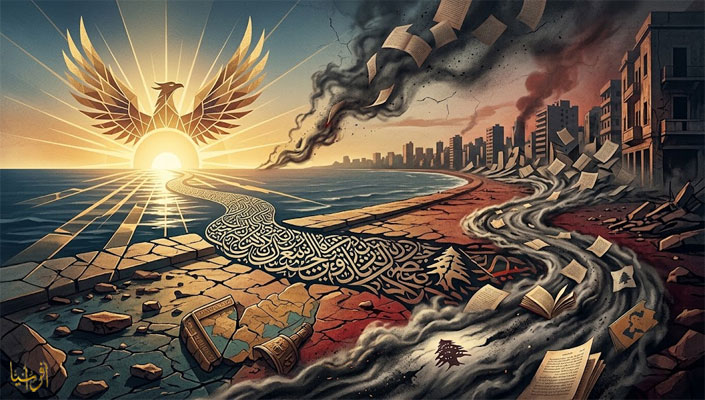
This poem is a protest against the self that does not rise from its ashes, a cry in the face of the knight who does not rise from its repression, and a protest against the thought that does not gather its diaspora and rebuild the Arab man and the world, benefiting from the lessons of history, like societies The Modern Riser.
A dream represented by the poet with a blooming spring through which water flows in the spring of the Arab map – and water is the symbol of life and the person of existence – but the river turned to ashes and swept the poet away in the end:
Leave me to the sea, to the wind, to die.
Spreading blue shrouds for the drowning
A sailor died in his eyes the beacons of the road
That light in his eyes is dead.
Neither heroism saves him nor humiliates prayer
If that poetic voice disappears amid the noise of the rebellious voices and the cries and anxieties of political brokers, crisis merchants, and profiteers over the defeats of the Arab nation at the height of its crisis, and the godfathers of strife, whether ethnic or sectarian, and during the cultural and intellectual reaction and the real civilizational catastrophe, Khalil Hawi will remain a distinctive poetic voice who committed to the causes of his nation without a crude ideology and dreamed of renaissance, justice, liberation and progress.
________________

