
Afrasianet - Marwa Salah Metwally - The name of the American rapper Maclemore was recently mentioned, after his participation in the British singer Ed Sheeran's artistic tour in the United States of America was canceled, and the reason for the ban and cancellation was that he sang for Palestine, raised his voice loudly and chanted freedom for Palestine.
Such an artist of course leads one to get close to this artist with a sound moral and humanitarian attitude, and arouses curiosity and a desire to discover his artistic world in general, and what he has done for Palestine in particular. Every word of truth that is said in recognition of the Palestinian right, and in condemnation of Israeli crimes and American support for them, represents more than a political position, and gives us some hope in the humanity of this world, and that there are those whose feelings have not yet dulled, and who can feel the horror of what they see of the open crimes of genocide being committed in full view of the whole world, especially when this word comes from the heart of the United States of America, the greatest supporter of the Zionist entity, and when its author boldly declares it knowing that he will inevitably suffer some losses, it is true that he lives in the land of freedom and will not be harmed by life-threatening harm, but he will be under the influence of money, politics and Zionist pressure in one way or another.
When this word is uttered by an artist, it is not only an expression of an individual position, but also an expression of many voices that possess awareness and a just human sense. It also stimulates the feelings of those who are unconscious, or who are absent from the truth, and awaken the conscience of those who close their eyes to it and confront themselves. Of course, words and voices do not have the power to stop the killing machine and liberate the earth, but they have the ability to remain a witness to the great crime and the tragedy of the age, denouncing it, raising the stolen land flag in the face of the thief, and drawing the faces of the victims to chase the murderer.
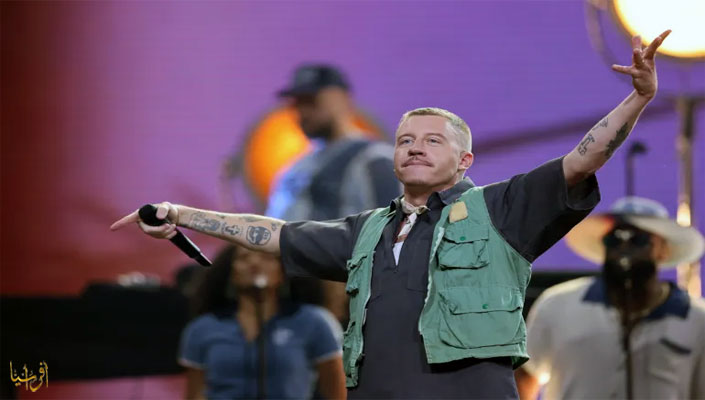
American rapper Macklemore
Rap and the Art of Protest
Born in 1983, and his real name is Benjamin Hammond Hagerty, he started his singing career in 2000, and specialized in the art of rap, which undoubtedly has a wide audience around the world, although this art was initially associated with specific neighborhoods and certain local cultures, and then it became one of the most widespread and influential forms of musical expression in the world, perhaps to a greater extent in the younger age groups of teenagers and young adults. The art of rap was also able to cross borders and move to other cultures and languages, with all its singing, appearance, personality, performance style, body movement, and everything that characterizes rappers.
Rap art does not depend on the power of sound and the beauty of singing and music, as much as it depends on On the idea and turning ordinary speech into an artistic material, carrying feelings, attitudes, and questions, as well as rebellion, revolution, and protest, is an art that proves its existence away from the usual arts, and has also made its way away from official channels and traditional paths.
In the time of communication, there is no longer any obstacle to this art and its spread is no longer difficult, and it has become heard by millions all over the world, especially with the interaction of rap songs with many topics, such as societal problems, political issues, wars, poverty, migration, discrimination, and identity, as well as some personal topics such as success, ambition, overcoming difficulties, and getting up again after falling and failing, it is an art that opens up to the whole of life and can address large segments of the audience, you may not find what you are looking for and need in other arts, and rap art has its aesthetics that its fans and listeners undoubtedly taste.
Macklemore is one of the most important rap stars in the world, as he has so far achieved distinguished successes during his artistic career, and his songs and albums topped the Billboard list more than once, and he also won a Grammy Award in 2014, and he was able to introduce his songs into the pop space as well, and address other audiences outside the rap circle, where he can mix rap with some melodic lines, and other colors of singing such as the voice of the choir and the collective performance, the colors of church singing at times, and some musical elements derived from pop, rock, and show songs, and sometimes he tends to turn some of his song clips into what looks like huge collective anthems, where the regular rhythm, the enthusiastic performance, and the necessary easy to memorize and perform, which the audience can repeat.
What is striking about Macklemore's performance is his presence on the stage and his ability to lead and influence large audiences, as well as his ability to speak, when he reads a statement or speaks to the audience before singing. He is good at theatrical delivery, the flow of the voice, and the control of its pitches, so he knows when to raise and lower the volume, when to speed up, slow down and stop, and how to make loud climaxes and excite the audience greatly, as if he were leading a demonstration and managing its collective chants, and his ability to write and express himself in an art that relies on words is not hidden more than He relies on music, and his pronunciation and the integrity of his letters are observed, more than is typical of rap artists in general.
Gaza and the Impact of the Tragedy
Since 2023, with the beginning of the genocidal war in the Gaza Strip, Macklemore has participated in many demonstrations, protests, signatures, and appeals, calling for an end to this genocide, and he has delivered many statements and lengthy speeches, and clearly denounced all the horrific massacres and massacres carried out by Israel, and all the horrific crimes it commits against the Palestinian people and humanity as a whole. In 2024, he released the first version of the song "Hind Hall", as a loud cry of protest that resounded the truth to be heard in the whole world, and donated the proceeds of the song to UNRWA.
McLemore was banned from participating in concerts and music festivals, in Las Vegas and elsewhere, but this was no reason to back down from his stated ethical stance, and he released the second version of the song "Hall of India", which was not just a rework of the work, but a new construction around the same idea, more expansive, comprehensive and diverse, and he also donated the proceeds to UNRWA.
Macklemore composed the song "Hind Hall" in both versions, inspired by the Palestinian cause and the tragedy of Gaza in particular, and the horrific war of genocide it was subjected to, which is considered one of the most horrible wars of genocide in the history of mankind. This artist could not surpass the name of the Palestinian martyred child Hind Rajab, who struck the human feeling with a violent shock and unforgettable pain, and confronted the conscience of the world with her slaughtered voice.
Hind is only a child martyr among thousands of children of the martyrs of Palestine, and in mentioning her name is a tribute to all the martyrs of Palestine who fell victim to the criminality of the Zionist entity. The hall is the Hamilton Hall at Columbia University, which the protesters supporting the Palestinian cause and human justice changed its name to Hind Hall.
The first version of the song was released in the first half of 2024, and it was A relatively short song that lasts less than three minutes, and talks about the protests for Palestine and the student sit-ins in American universities. He then asks questions about these protesters and the threat they pose to institutions, is the state afraid of them or what they are demonstrating for?
Macklemore evokes the history of protest rap and its traditions in the face of power, and mentions one of his former stars and a number of his songs that include strong protest words, in what is considered an insult to the police. McLemore then expands on the Palestinian issue and its situation in the midst of all the political issues and global interests surrounding it, and the obscuration of information and images of truth in the time of communication, we hear the word "Nakba" in the song, when Macklemore says that the Nakba is not over, and he also talks about Israel's destruction of every mosque in Gaza, and every place of study and education, and of course the mention of free Palestine is repeated in the song. In terms of music, Macklemore combined a melodic line sequentially with the rhythm of rap, which gave the work a more expansive artistic dimension and more attractive to the audience outside the circle of rap enthusiasts, and the most beautiful thing is that this melodic line was derived from an Arabic melody, which is "Ana Lahbibi" sung by Mrs. Fairuz from the melodies of the Rahbani brothers.
Almost six months after the release of the first version of the song "Hind Hall", Macklemore released the second version, which was more mature and complete, this time longer than five minutes. Macklemore collaborated with some rap stars of Palestinian origin, and also used a choir of Palestinian children, as well as a church choir. He added the full syllables in Arabic in his song, not just single words, as the basic requirement in the song is repeated in the same sense in English and Arabic.
The chant "From the river to the sea... Palestine will become free" The lyrics of the song vary between mentioning the tragedy of Gaza and the war of genocide, the history of Zionist crimes and massacres, as he mentions "Nakba, Sabra, Shatila, Rafah," and attacking the authority in the United States of America that supports the Zionist entity.
The performance also varies between the traditional rap style and the approach to the normal lyrical style, which made the song more accessible to different tastes, not to mention its contact with the general human feeling. The Arabic melody derived from The song of Mrs. Fairuz, and we listen to the Arabic singing in the voice of the children, who say: "In our lives, we are free.
The light shines and we are free. In our lives, we are free. If we are buried, we will return to bloom," and we also listen to the sound of the oud in a wonderful accompaniment to the singing in the last part of the song. We really stop in front of some wonderful meanings and expressions in this song, such as his saying that he sees God in the eyes of the refugees, and his talk about the inevitable return to Palestine no matter how long it takes, and about the key that every Palestinian refugee holds, the key to ownership of the home, the land and the homeland.
________________

