
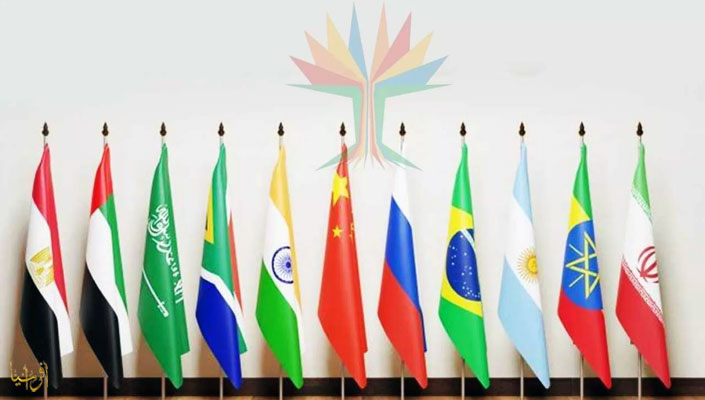
Afrasianet - In a world of rapid geopolitical and economic transformations, the BRICS group has emerged as one of the most prominent international groupings reshaping the global balance of power.
The birth of the idea and its origin
The BRICS has its roots in 2001, when British economist Jim O'Neill, chief economist at Goldman Sachs, coined the term "BRIC" in a widely publicized paper. The term was just an economic forecast that monitored the rise of four ambitious emerging economies — Russia, China, India, and Brazil—and their ability to lead the global economy by 2050.
By 2006, the idea had gone beyond investment studies to enter the political realm, as the foreign ministers of the four countries met on the sidelines of the United Nations General Assembly in New York, announcing the launch of joint coordination between them.
South Africa joined the group in 2011, and later turned into a broader grouping with new countries joining from the beginning of 2024: Egypt, the United Arab Emirates, Iran, Ethiopia, and Indonesia.
Historical Milestones and Expansion (2009 - 2026)
In 2009, the Russian city of Yekaterinburg witnessed the first official summit of the group, where the leaders of the four countries met to discuss ways to improve global economic conditions and reform international financial institutions, especially the International Monetary Fund and the World Bank.
2014 was a turning point, with the Fortaleza summit in Brazil establishing a $100 billion New Development Bank, reflecting the group's quest to build its own financial institutions away from Western domination.
In 2024, the Russian city of Kazan hosted a historic BRICS summit, the first after the expansion of the group and the accession of new countries.
The summit witnessed the participation of the leaders of the new member states, and discussed ways to enhance economic and financial cooperation, develop mechanisms for the payment of national currencies, reform the global governance system, and discuss current regional and international issues.
Mounting economic weight
The BRICS has enormous economic potential that puts it ahead of the G7. The group includes the world's largest emerging economies, accounts for a large proportion of global GDP, accounts for more than 40% of the world's population, and contributes about one-third of global trade.
It accounts for about one-third of global trade and controls nearly 45% of the world's oil reserves. This superiority reflects a shift in the economic center of gravity towards the Global South.
Outperform the Group of Seven
In recent years, the BRICS has surpassed the G7 in several indicators, most notably GDP on a purchasing power parity basis, as the member countries together produce more than the major industrialized countries combined.
According to the International Monetary Fund, the BRICS share of global GDP on a purchasing power parity basis will be about 35% in 2025, compared to about 30% for the G7.
Strategic Directions
BRICS seeks to strengthen cooperation in multiple areas, including the development of settlements in national currencies, reducing dependence on the dollar, promoting mutual investments, technological partnership, and establishing alternative financial institutions, such as the New Development Bank.
BRICS leaders adopt final statement. Warning of nuclear dangers, rejection of unilateral trade restrictions
At the last meeting. Indian Prime Minister Narendra Modi announced that BRICS leaders adopted a joint statement at the conclusion of the 18th summit held in New Delhi, noting that the declaration includes clear directions for the group's work paths.
The following are the highlights of the final statement:
• BRICS member states have expressed concern over the escalating risks of nuclear threat and conflict.
• States stressed the need to encourage continued discussions to find practical solutions in the area of cross-border payments between the States of the Group.
• Member States expressed grave concern over the increasing unilateral tariff and non-tariff measures that distort global trade.
• BRICS countries express concern about the growing risks of nuclear threats and call for strengthening the nuclear non-proliferation regime.
• BRICS countries express concern over the situation in the Gaza Strip and discuss attempts to politicize humanitarian aid to the Palestinians.
• BRICS summit participants stress the growing role of the New Development Bank.
• BRICS describes the Global South as the driving force for change.
• BRICS summit participants express their thanks to Russia for hosting the meeting of the New Development Bank in Moscow in 2026.
• BRICS leaders stress the need to strengthen energy security.
• BRICS leaders affirm their commitment to Syria's sovereignty and territorial integrity.
• The BRICS countries reject any unilateral measures aimed at changing the legal and historical status of Jerusalem.
• BRICS leaders renew their commitment to combat all manifestations of terrorism.
• The BRICS countries call on Israel to abide by the terms agreed with Lebanon and withdraw its forces from all Lebanese territory.
• The BRICS group expresses concern over the risk of the spread of terrorism in Sudan and calls for an immediate ceasefire in the country.
Putin calls for Security Council enlargement, WTO reform and end Western dictatorship
Russian President Vladimir Putin called for the expansion of the UN Security Council to include the countries of the Global South, stressing the need to reform the International Monetary Fund, the World Bank and the World Trade Organization.
In his speech at the 18th BRICS Summit in New Delhi, the Russian President stressed that the member countries of the BRICS group continue to strengthen cooperation in all key areas, noting that the BRICS partnership is based on the principles of equality and good neighborliness.
The following are the most prominent statements of the Russian president:
• Putin: BRICS member states continue to strengthen cooperation in all key areas.
• Putin: The BRICS partnership is based on the principles of equality and good neighborliness.
• Putin: A growing number of countries around the world are declaring their readiness to defend their national interests.
• Putin: The world is undergoing radical transformations, and the human lifestyle, the quality of the environment and medicine are changing.
• Putin: The unipolar system of international relations is a thing of the past.
• Putin: We call for the involvement of more countries in ensuring peace and stability on the international stage.
• Putin: We call for the expansion of the membership of the UN Security Council to include the countries of the Global South.
• Putin: It's time to reform the IMF, the World Bank and the World Trade Organization.
• Putin: Business activity in the world today is increasingly shifting towards emerging markets.
• Putin: The entire system of international relations has failed due to the actions of a number of countries that seek to provoke conflicts and create new tensions.
In addition to Putin, Indian Prime Minister Narendra Modi, Chinese President Xi Jinping, Iranian President Masoud Bezshkian, South African President Cyril Ramaphosa, Egyptian President Abdel Fattah al-Sisi, Indonesian President Prabowo Subianto, Ethiopian Prime Minister Abiy Ahmed, Abu Dhabi Crown Prince Khalid bin Mohammed Al Nahyan and a number of international leaders and officials participated in the summit.
The two-day BRICS summit will discuss strengthening economic and financial cooperation among member countries, developing mechanisms for paying national currencies, expanding the New Development Bank, and reforming the global governance system, in addition to current international and regional issues, most notably tensions in the Middle East and the continued closure of the Strait of Hormuz.
Egypt reveals its ambition in the BRICS. Sisi looks forward to leading the BRICS in the future
On the other hand, Egyptian President Abdel Fattah El-Sisi called on the BRICS countries to transform their capabilities and capabilities into practical projects and programs, stressing the importance of the grouping's role in facing economic and development challenges and enhancing cooperation.
In his speech during the closed session of the BRICS Heads of State and Government Summit in New Delhi, El-Sisi said that the current developments in the Middle East and their effects on the global economy, trade, energy and supply chains confirm the close interdependence between security and development.
The Egyptian President stressed that his country, by virtue of its strategic location and pivotal role in the global trade movement, is aware of the importance of maintaining the stability and freedom of international navigation, calling for the use of the capabilities of the BRICS countries to establish specific projects and programs that support the sustainable development goals, diversify sources of growth, enhance productivity and reduce development and technological gaps.
In the financial file, El-Sisi expressed Egypt's appreciation for the efforts aimed at reforming the international financial architecture and developing innovative and accessible financing tools, in addition to strengthening the role of the "New Development Bank", which helps member countries face debt challenges and fiscal space constraints and meet their financing needs.
The New Development Bank was established in 2015 at the initiative of the BRICS founding countries, with the aim of financing infrastructure and sustainable development projects in the BRICS countries and other emerging and developing economies, while the bank is currently working on preparing its general strategy for the period from 2027 to 2031.
The Egyptian president also stressed the need to enhance food, water and energy security, in light of the high costs of food and energy and supply chain disruptions, stressing the importance of adopting an integrated approach that takes into account the interdependence between these files.
El-Sisi pointed out that Egypt will continue to work on developing a grain and logistics center to support food security and enhance the country's position as a regional hub for trade and logistics, at a time when Cairo seeks to expand cooperation with BRICS countries in the fields of agriculture, energy, industry, infrastructure and technology.
These priorities intersect with the BRICS' growing economic agenda, as the BRICS summit in New Delhi will discuss strengthening trade, investment, supply chains, food security and energy, as well as developing mechanisms for cross-border payments and reducing the cost of transactions between member states.
El-Sisi also stressed the importance of developing countries having access to climate finance and supporting a just and realistic transition to low-emission economies, taking into account the different circumstances, burdens and development needs between countries.
He said that Egypt views the BRICS as a promising opportunity and an effective framework to build practical partnerships and develop a more balanced international economic system, stressing Cairo's readiness to continue contributing to supporting joint projects and benefiting from its strategic location in promoting trade, investment and linking Africa, Europe and Asia.
El-Sisi announced Egypt's aspiration to assume the presidency of the BRICS in the near future, stressing his country's commitment to work with member states to develop cooperation in various fields and translate common capabilities into concrete partnerships that support development and common interests.
Sisi's participation in the 18th BRICS summit comes at a time when the BRICS seeks to expand its role in the global economy and strengthen the presence of the countries of the South in international governance institutions. Together, member states represent about half of the world's population and about 40% of the global economy according to the PPP criterion.
________________

