
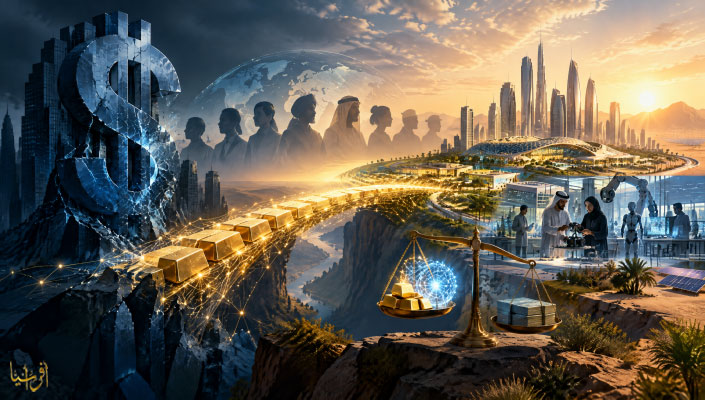
This attempt to break away from the dollar did not happen in a vacuum, but rather a direct and inevitable result of successive US policies that damaged the reliability of its currency
From BRICS to Gold.. A Disengagement Journey That Redraws the Balance of Economic Power
Afrasianet - Mustafa Youssef - The international arena is currently witnessing rapid geostrategic and economic transformations, which clearly indicate a clear decline in the level of global confidence in the United States of America, whether economically, militarily, strategically or politically.
This decline is not just a temporary fluctuation in the balance of power, but a structural rift that heralds the beginning of the end of an era that has lasted for decades.
The most striking milestone in this landscape is the frantic global rush towards gold as a safe haven for sovereignty, and the gradual and deliberate evasion of the US dollar, whether as a store of value, a strategic reserve currency, or an inevitable intermediary in global trade.
Central banks, major investors, and decision-making centers around the world are gradually moving away from the American umbrella, driven by an obsession with protecting their independence from the vicissitudes and moods of politics in Washington.
"To understand the magnitude and consequences of this shift, we must look at the movement of history with awareness. What the dollar is witnessing today is very similar to what the pound sterling was subjected to before World War II and before the signing of the Bretton Woods Agreement in 1944"
________________
BRICS. From Economic Romance to Critical Realism
In this complex context, the BRICS is emerging as a spearhead in engineering the alternative financial system. These countries have moved beyond dreamy economic romance to adopt rigid monetary and technical realism.
Together, which accounts for nearly 40% of the world's GDP and is the world's largest heavyweight in manufacturing and raw materials, the group is no longer merely denouncing Western hegemony, but is taking practical steps to disengage.
Core and institutional countries such as India, for example, are highly pragmatic in their efforts to protect their strategic autonomy within the bloc; they refuse to replace the dominance of the dollar with the dominance of the Chinese yuan, preferring instead to promote the use of their digital currencies, such as the digital rupee (e-rupee), to enhance the balance of intra-euro trade.
Bypassing the SWIFT system. Establishing an alternative digital infrastructure
It is no longer just political intentions, but has translated into a technological institutionalization that goes beyond traditional Western-controlled financial networks. Since the Rio de Janeiro summit in 2025, the results of the exchange have been accumulating and efforts have been integrated towards building a leading digital infrastructure that is gaining new spaces every day.
Bookbooks distributed directly between the central banks of the BRICS countries are now being linked intensively, bypassing the Western SWIFT network and the third intermediary that has always forcibly converted all transactions back to the US dollar. This profound technological transformation not only provides independence and confidentiality, but also achieves huge financial savings of more than 70% of the cost of transactions, reducing their execution time from several hours or days to a few seconds.
Rather than pursuing a single currency such as the euro – which runs into technical hurdles and the complexities of sovereign budget deficits – the BRICS countries have cleverly chosen to build a digital platform that is encrypted and linked to their central banks to facilitate such exchange and avoid punitive fees.
"Rather than risking sovereign and private wealth in markets threatened by financial deflation and declining reliability, our investment strategy should focus on a higher and more sustainable goal: bringing in knowledge and transferring technology"
________________
The weapon of sanctions and the burden of debt. Factors of expulsion that are not mistaken by the eye
This attempt to break away from the dollar did not happen in a vacuum, but rather a direct and inevitable result of successive US policies that have damaged the credibility of its currency.
The extreme extravagance by successive US administrations, whether under Biden or Trump, in using sanctions and asset freezes as a geopolitical weapon, has caused real concern among many governments around the world.
In addition, the U.S. debt burden — which has exceeded $40 trillion in fiscal deficits — has become a specter that threatens global financial stability, prompting countries to seriously seek alternatives that protect their wealth from a potential collapse.
The high cost of transactions through U.S. institutions and banks, which monopolize from the SWIFT system, has added a substantial economic reason to accelerate this financial migration.
History repeats itself. The dollar is no exception
To understand the magnitude and consequences of this transformation, we must look at the movement of history with awareness. What the dollar is witnessing today is very similar to what the pound sterling was exposed to before World War II and before the signing of the Bretton Woods Agreement in 1944.
At that time, the pound was completely dominant in global trade, before its influence eroded and lost its position in favor of the dollar. In the short term, the dollar will retain its current importance and reference, but it will undoubtedly witness a gradual decline in its dominance, turning over time into just one of many other options in the basket of international transactions, and will not remain the only reference, especially with countries that produce basic commodities and raw materials such as oil and gas.
Arab Capital & Investments
With this careful reading of the global landscape and erosion of confidence, investors and economic policymakers in our countries should pay attention to these shifts. The uncalculated rush to inject investments, buy bonds, and accumulate traditional assets within the United States at this point is a risk to think about.
The U.S. economic and political environment is suffering from cracks that make it unwise to rely on it as a single basket of investments, the system is changing, and the rules of the game are being rewritten away from Wall Street.
However, with a purely pragmatic view, we must exclude the high-tech, artificial intelligence, and technical innovation sectors within America, which still retain their luster and strategic necessity, and represent the locomotive that currently drives the human future.
"The real and smart investment today lies in linking any outflow of our capital with strict requirements that force international companies, both technical and industrial, to open regional branches, establish joint ventures, and build real R&D centers within our countries"
________________
Localization of knowledge. Creating the future with local hands
Rather than risking sovereign and private wealth in markets threatened by financial deflation and declining reliability, our investment strategy should focus on a higher and more sustainable goal: bringing know-how and technology transfer to the heart of our nations.
The real and smart investment today lies in linking any outflow of our capital to strict requirements that force international companies, both technical and industrial, to open regional branches, establish joint ventures, and build real R&D centers within our countries.
We must go from being mere consumers of technology and financiers of the West's deficits to actual partners in production. Building our own capacities, localizing advanced industries, and strengthening digital infrastructure is the only shield that will protect our economies in a multipolar world that is now taking shape so harshly.
The question that cannot be postponed
The picture has become clear to those who have the vision, because the world does not wait for those who are late in reading. The financial system that ruled the last century is quietly cracking before our eyes, and as the major and rising powers race to consolidate their positions in the alternative system, the most serious question remains for policymakers in our Arab world: will we be content with the position of a bystander watching the redistribution of global wealth and influence, or will we act today – before tomorrow – to turn our surplus money into solid knowledge and a national industry capable of withstanding in a multipolar world?
History does not give a second chance to those who are late for the moment, and the lesson of the decline of the pound remains: real economic power is not bought by bonds, but by knowledge, production, and independence.
Those who have the courage to ask this question honestly today are the same ones who will have the steering wheel tomorrow to guide the right answer.
________________
Mustafa Youssef - Political economy researcher, Director of the International Center for Studies.

