
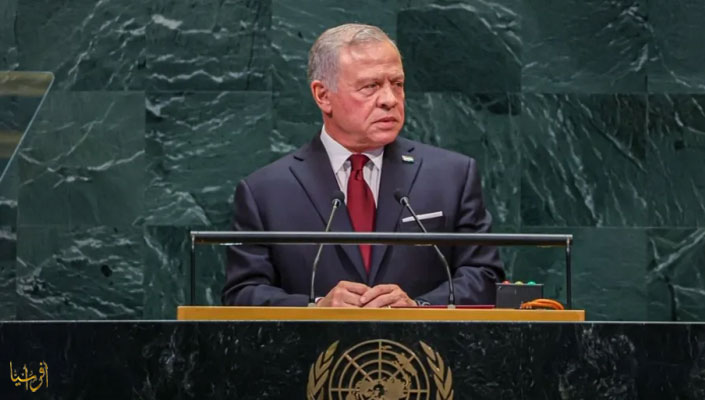
Afrasianet - Alaa Naji - His Majesty King Abdullah's address to the United Nations General Assembly was not a traditional diplomatic speech, nor was it simply a repetition of Jordan's well-known positions on the Palestinian issue and the region's crises. At its core, it was a very clear political message to a world accustomed to managing crises rather than ending them: Watch out before what you ignore today becomes a reality that cannot be changed tomorrow.
From the very first sentence, the king chose to put his finger on one of the most serious problems of our time: the world is no longer suffering from a lack of information, but a crisis in the ability to maintain attention.
Herein lies the paradox on which the king built his speech: crises do not disappear when they recede from the world's screens, and victims do not stop suffering when the cameras are turned off.
Indeed, what the world is losing interest in may be what is being hidden into a bigger crisis.
The King Turns the Equation: What We Ignore Today Makes the World of Tomorrow
The choice of "attention" as an entry point for the discourse was not a rhetorical elaboration.
The king transformed a concept that seemed social and technical into a political one, when he asserted that the world's attention has become a geopolitical resource, and that what the international community chooses to focus on determines the conflicts that receive diplomacy and political pressure, and those that are left to their fate.
The message is straightforward: the international community cannot claim to be surprised by the crises that are worsening before it, if it has chosen not to see them earlier.
Economic crises, food insecurity, conflict, and climate change have not suddenly emerged, as has the Palestinian issue, which the king has warned the world about the dangers of being left unresolved for decades.
But instead of addressing the root of the problem, the international community has chosen, according to the king's reading, to manage and contain the conflict.
The result is that the "temporary" has become permanent, and the exception has become the rule.
Gaza.. King rejects gray language
On the Palestinian issue, the king's speech seemed more direct than traditional diplomatic language.
Instead of merely expressing concern or calling for restraint, His Majesty demanded that things be given their names.
In Gaza, the rhetoric said it was no longer possible to treat what was happening as mere "temporary military measures" or side effects of the war.
The king described what is happening as an attempt to erase the Palestinian presence and impose a new reality in Gaza.
This particular phrase carries great political significance because it moves the discourse from describing the results of the war to talking about the nature of the course that is taking place on the ground.
In the West Bank, the speech was more detailed, linking settlements, land confiscation, settler violence and Palestinian displacement, stressing that what is happening is not a separate set of incidents, but rather interrelated practices.
In other words, the king's reading is based on the fact that Gaza and the West Bank are not two separate files, but two connected tracks within a single Palestinian reality.
The most dangerous thing in the speech. Talking about the next day
Perhaps the most dangerous message of the king's speech lies not only in describing the current situation, but also in warning of what it may result.
The king has warned that continued imposition of facts on the ground threatens not only the Palestinians, but also weakens the idea of a viable Palestinian state, and raises even greater questions about the international community's ability to protect international law when its violations have been ignored for years.
Here, the issue goes beyond the borders of Palestine to reach the international system itself.
If international resolutions become incapable of making a real impact, and if repeated violations become commonplace, the question that the rhetoric raises goes beyond the current conflict: what is the value of international law if it is not applicable?
Jordan sets its red lines
But the point most relevant to Jordan came when His Majesty moved from characterizing regional risks to defining what that means for the kingdom.
The message was explicit:
Any threat to Jordan's northern border or to water security is a threat to Jordan's national security.
The king did not stop at this description, but followed it up by affirming that Jordan would not turn his back on him, and that he would protect its security, waters, and the interests of its people.
This is not fleeting diplomatic language.
With the king talking about developments in southern Syria, Israeli incursions and the imposition of new realities on the ground, Jordan's message is clearer: Jordan is following what is happening around its borders, and it is aware that some regional developments may turn from external events to issues that directly affect national security.
This is where one of the most striking shifts in the rhetoric emerges: Jordan is not only warning of the region's repercussions, but is also defining in advance what it considers to be a direct violation of its interests.
Jordanian diplomacy is not a space for concessions
It is striking that the king was keen, at the same time, to clarify the nature of Jordanian policy.
Jordan is committed to diplomacy, committed to a just peace, supports the Palestinian people and UNRWA, and upholds the Hashemite Custodianship of Islamic and Christian holy sites in Jerusalem.
But the king put a seminal sentence in this context:
"Our commitment to diplomacy is above our commitment to human values, and no one should take it for granted, or misjudge it as weakness."
This is one of the most explicit messages in the speech about how Jordan's role is understood.
Diplomacy, according to this proposition, is not synonymous with silence, and being open to dialogue does not mean abandoning interests, and adhering to peace does not mean accepting the fait accompli.
Jordan does not want to be merely a recipient of the region's repercussions
On the other hand, the speech tried to present a different picture of Jordan in the midst of a region burdened with wars.
The kingdom, as the king has shown, is not working on a single track.
It confronts terrorism and drug trafficking, develops its defense capabilities, supports humanitarian causes, protects holy sites, and at the same time seeks to strengthen its trade, industrial and technological links.
This message is important because it conveys Jordan's image from a country that deals with the crises around it to a country that is trying to create its own space in the midst of these crises.
Jordan, according to the rhetoric, cannot choose the timing of the crises around it, but it can choose how to deal with them.
The final message: The world is in a test, not a shortage of tools
Ultimately, His Majesty's speech can be summed up in one question: Is the problem that the world doesn't have the tools, or does it not use them when they should be used?
The king clearly pointed to the existence of political, economic and diplomatic tools, including sanctions, asset freezes, embargoes and diplomatic isolation, but questioned why decisions on Israel had become what he described as "ink on paper."
Hence, the essence of the discourse becomes not only to demand that the world take action towards Gaza or the West Bank, but also to hold accountable a whole set of standards that govern international handling of crises.
Justice, according to the message of the speech, cannot be seasonal, the law cannot be applicable in one crisis and not applicable in another, and principles are not supposed to change with the changing level of attention of the world.
Jordan says: We will protect our interests and we will not get used to the danger
In conclusion, His Majesty's speech set three parallel messages to the international community.
First, the Palestinian cause cannot be buried under crisis management, and what is happening in Gaza and the West Bank needs to be addressed politically at the root of the conflict.
Second, Jordan will not treat threats to its borders or water security as details of the regional landscape.
Third, and broader, the world cannot demand stability while allowing the accumulation of crises and abuses that produce further instability.
Perhaps the strongest part of the king's speech is that he did not only ask what the world was doing, but also posed a more disturbing question:
What if the real danger is not what we see today, but what we choose not to see?
That is the gist of the message.
Gaza is not a crisis that ends with the end of media coverage, the West Bank is not a separate file, Jordan's security is not a regional detail, and Jordanian diplomacy is not a sign of decline.
In a world where priorities are changing rapidly, Jordan is clearly saying: there are issues that should not be held hostage to temporary attention, there are interests that cannot be postponed, and there are limits when dangers approach them silence itself becomes a decision.
______________

