
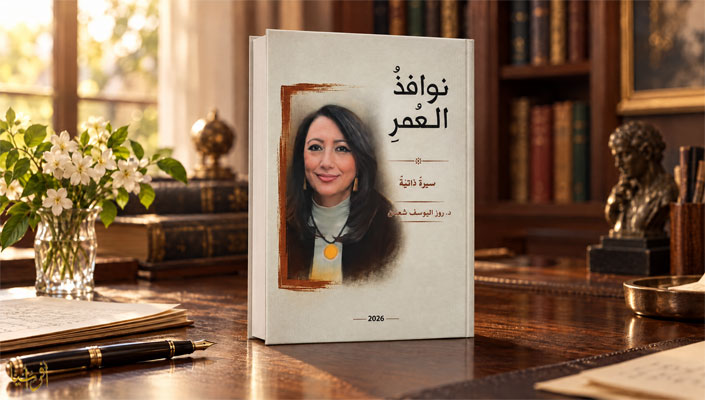
Afrasianet - Jamil Salhout - I have read the book "Windows of Age: An Autobiography" by the writer Dr. Rose Al-Youssef Shaaban, a daughter of the Galilee village of Tur'an, which lies between Nazareth and Tiberias. This fictionalized biography drew me into the debate between "biography and fiction," for every biography is a novel in some way, and every novel—including a realistic one—indulges deeply in the world of imagination. Writing a biography is often more difficult than writing a novel because it relies on true information, whereas a novel can drift into fiction.
It is worth recalling here that biographical literature has been known among Arabs for hundreds of years, with one of the most famous Palestinian women to write her autobiography in the modern era being the late poet Fadwa Tuqan.
Dr. Rose Al-Youssef Shaaban's personal, novelistic biography—recently published by Dar Al-Huda - Abd Zahalka and spanning 220 large-format pages—is written in a beautiful, literary language and a compelling style that captivates the reader, compelling them to finish it in a single sitting.
Roots and Upbringing
Writer Shaaban discusses her personal life, prefacing it with accounts of her family roots. Her maternal grandfather was a martyr in the Battle of Al-Shajara in 1948, and her mother left the eighth preparatory grade to complete her education at the Teachers' College in Jaffa. Her father hailed from a well-known family with a prominent social standing. He was well-off, generous, and giving to his family and others. Rose had the fortune of being her parents' firstborn, earning a special place in their hearts—especially her father, Yousef Sabbah, and her mother, who admired Rose Al-Youssef, the mother of Egyptian writer Ihsan Abdel Quddous and editor-in-chief of the magazine bearing her name. Thus, she named her "Rose," and since her father's name was "Youssef," she became "Rose Al-Youssef"! This Rose was blessed by God with striking beauty and intelligence, making her beloved by her parents, extended family, and everyone who knew her.
Distinguished among her generation for her alertness and intelligence, Rose excelled in school from a young age, ranking among the top students in her class. This made her a source of pride for her father, who closely followed her education, constantly encouraged her, and provided all her needs for success. It was at school that her literary talent began to bloom; she wrote poetry at an early age, encouraged by her teachers. This literary talent later drove her to study Arabic literature at university, defying her father's wish for her to study medicine—though he ultimately agreed and supported her throughout her life. He was proud of her, taking her along to family and village celebrations, and even allowing her to sit in his diwan (reception hall) to express her opinion in resolving family disputes, which forged in her a strong, leadership-oriented personality.
The Conscious Father
In her memoirs, Rose speaks with high credibility and sincere affection about her late father, who gave her special care and understood her desires and hobbies. He respected her affiliation with the Democratic Front for Peace and Equality (Jabha) list in the local council elections and did not object when she participated in a demonstration contrary to his political views.
During her university studies at a book fair in her village of Tur'an, Rose met Abdul Majeed Mahmoud Shaaban, a displaced person from the destroyed village of Hittin and a building engineering graduate from Kharkov University in the Soviet Union. He served as the secretary of the Communist Party (Rakah) in the town. They shared mutual admiration and married with a dowry of just one shekel upfront and one shekel deferred—a testament to her father's deep awareness and respect for his daughter's choice.
Rose and Folk Heritage
As a child, young woman, and cherished daughter, Rose participated in her family's and village's events and seasons. She took part in the olive harvest and harvesting grains on the threshing floors using iron sleds pulled by cattle, donkeys, or mules.
She also took part in weddings through traditional dabke dances, songs, and folk chants. She enriched her biography by incorporating lyrics and traditional wedding cheers (muhajat) heard at these events. Furthermore, she touched upon various traditional Palestinian dishes and tabun bread.
Notably, the author did not limit her autobiography to personal and family life; the book is brimming with social life, customs, and traditions that prevailed—and still prevail—though some have faded due to education and modern development.
Teacher in Umm al-Rashrash (Eilat)
After earning her Bachelor’s degree from the University of Haifa, Rose worked as an Arabic language teacher in a Jewish school in Eilat (Umm al-Rashrash). She faced many challenges, most notably that Jewish students initially struggled to accept learning Arabic and having an Arab teacher. However, through her sheer willpower and strong personality, she overcame this obstacle—especially after transferring to another school in the city in her second year.
She did not escape racial discrimination, though. After working for two years, the school principal informed her that her financial allowances and free housing—normally given to teachers because Eilat was a development zone—were being cut. The officials' pretext was that these benefits were reserved for those who had served in the military, effectively excluding Arabs without stating it directly. However, the municipality rejected this policy and provided Rose with an apartment to live in. While in Eilat, Rose gave birth to her firstborn, Hisham.
In 1991, Rose gave birth to her daughter, Rawan. Five years later, she took a one-year unpaid leave from her job in Eilat, requested a transfer to the Northern District, and successfully returned to teach at her village school in Tur'an. She also worked as a district guide for alternative teaching methods in the North and coordinator of the five-year plan.
Principal Rose
Rose’s ambitions did not stop there. She applied for and won the principal position at the Reineh school (9 km from Tur’an), a challenging school facing many problems at the time. Through her competence, patience, and administrative expertise, she overcame these difficulties, winning the admiration of the town's residents and education officials. After a few years, she returned to manage her hometown school in Tur'an until her early retirement at the start of the 2023–2024 academic year, dedicating herself to completing her cultural project in writing poetry, children's stories, and novels, as well as focusing on her home and family.
Doctor of Letters
Ambitious and persevering, Rose continued her higher education, earning a Master’s degree, and later in 2018, she earned her Ph.D. in Arabic Language. At that time, she deeply missed her late father, who had passed away in 2002, wishing he could see her attain the highest academic degrees.
Rose the Writer
Dr. Rose loves her Arabic language to the point of adoration and possesses genuine literary talent. She wrote her first poems as a child and never forgets her mother's role in encouraging her to read and self-educate. Today, she continues her creative journey in poetry, short stories, and novels. Although she was a dedicated and successful teacher, guide, and school principal, she ultimately finds her true self in her literary pursuits.
A Role Model
This engaging biography serves as a model for a hardworking woman who built herself through her own capabilities, initial support from her parents, and later support from her husband. Dr. Rose Al-Youssef Shaaban stands as a role model for current and future generations. She pursued the subject she loved (Arabic language) despite her father's wishes for her to study medicine, married the man she loved, worked far from home, started a family, proved her administrative brilliance as a principal, and never stopped climbing the academic ladder until she achieved her doctorate.
Amidst her busy life as a teacher, principal, wife, and mother, she never compromised her literary ambitions. She continues to write poetry, short stories, novels, letters, and academic research—including her book on the art of the novel by the prominent writer Mahmoud Shuqair—while remaining an active cultural figure participating in literary lectures and seminars at the height of her vitality.
It is worth noting that this brief overview is no substitute for reading the full biography.
________________

