
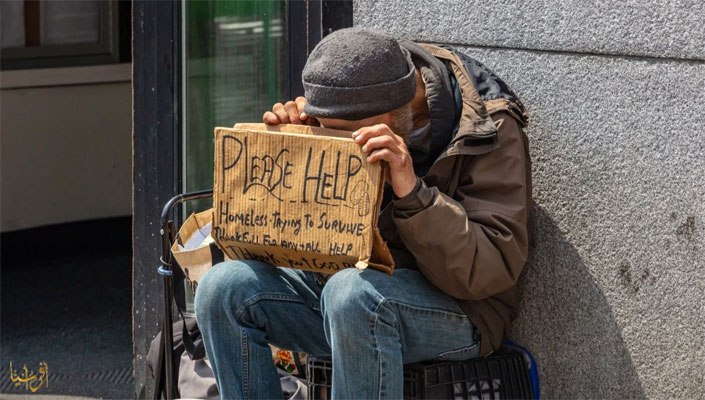
President Donald Trump has said that "the American dream is back," but residents of rural Arizona don't believe it.
Afrasianet - Yvonne Wingate Sanchez - The Atlantic magazine publishes an article on the worsening crisis of high prices, hunger and food insecurity in the United States, specifically in the state of Arizona, in light of US President Donald Trump's economic policies and cuts in government food aid, highlighting the widening gap between Trump's promises to improve living conditions and the economic reality facing Americans.
The following is the text of the article:
While walking around Arizona last week, I saw a nearly mile line of cars on a high desert road, and I was surprised that all these people were waiting in line for food, after the benefits of the Supplemental Nutrition Assistance Program for U.S. citizens were recently curtailed.
I met Candy Soto, a retiree who used to work as a clerk for the court, who used to donate regularly to the local food bank in her area, but now she is a beneficiary of other people's donations. "The price of canned vegetables was going up almost every time I went to the store, and after checking the prices, I might buy some cheap fish fillets or canned meat, but beef or poultry was out of my pocket," she said, as she prepared to fill a bag with items her family could no longer afford.
For Ms. Soto, it wasn't meant to be that way. When she voted for Donald Trump two years ago, she counted on him to deliver on his promise to "make America affordable again," after the painful spikes in inflation under Joe Biden.
She wonders what kind of life Trump and his family are living, because she sees no signs of the booming economy he's talking about. Her husband had to stop working after a neck injury and surgery, and then they discovered that their modest retirement income made them ineligible for public assistance.
Meanwhile, fuel and grocery prices have soared, and conditions worsened several months ago to the point that Soto, 66, had to get past any feeling of fatigue or shame, and drive 20 miles to get to a food bank, even though it's very difficult for the elderly.
In neighboring Yavapai County, Trump won 66 percent of the vote en route to winning Arizona two years ago. In 2016, he held one last campaign rally here before Election Day. Trump is counting on this area to help limit his Republican Party's projected defeat next month, according to polls, and is scheduled to hold a rally on Wednesday in the town of Bullhead, about 200 miles to the northwest. But the president's grip on power seems to be loosening, and the economic situation explains why.
The impact of rising prices has been particularly severe in Arizona. Since the summer of 2025, changes to the food stamp program have affected nearly half a million of the state's residents, on the back of amendments to Trump's tax code that limits aid and punishes states that make mistakes when granting it. The law is still being implemented gradually, with Arizona one of the first states to implement these amendments.
Almost everyone I spoke to in the region last month, including Trump supporters, said they were worse off than they were before the 2024 election. Arizona's unemployment rate was 3.8% in August 2024, while it rose to 4.9% in August of this year, according to federal data.
Many of those I spoke to in the county reported that they were working, but their salaries had not kept up with the rising prices of fuel and food. Most also expressed anger at Trump's decisions to wage war and spend hundreds of millions of dollars on decorating a capital they would never see. They did not believe his claim that their lives had improved since he took office.
Many said they were disappointed with Congress and the political parties, expressed dismay at what they saw as rampant corruption in government and big business, and denounced billionaires exploiting their suffering.
People have told me that they are worried about many things, including future job opportunities, providing healthy meals for their children, keeping their small businesses running, and the costs of repairing their cars. Trump has said that "the American dream is back," but that doesn't apply to the people I spoke to in Yavabay County.
Victoria Dombrowski lost $800 a month in food stamps after state officials, who run the program, took drastic measures to comply with the new eligibility requirements imposed by the Republican Party's "Big One Bill Bill."
Dombrowski, a full-time mother of two young children, said she completed the renewal paperwork and reached the end of the process, interviewing an employee in charge of following up on her financial situation. But even after waiting for days and asking for help from a nonprofit, she couldn't reach out to EESA staff, so she gave up.
Victoria's husband works in a car parts store, but his income is not enough to support the family, sometimes forcing her to get free lunch boxes. But the food, she said, was often expired, or the items on display were sugary sweets that didn't provide her children with the nutrition they needed, while her fridge was empty.
Victoria once prided herself on preparing nutritious homemade food for her family, such as meatloaf and potatoes. But since the loss of food assistance, she has had no choice but to serve cheap, microwave-heated meals. Like others, she has begun bartering for services.
Across Arizona, food banks are in growing need. They served an average of 626,881 people per month in 2024, while about 786,366 Arizonans used food banks each month this year, according to the Arizona Food Banks Network.
Wages are not rising as fast as expenses, and more residents continue to lose food stamps due to changes in laws.
The Prescott Community Food Bank recently received a call on behalf of 17 community veterans who had "no food at all," according to Jim Phelps, the organization's executive director.
Workers also carried out an emergency delivery one night, carrying a Tesla with two loads of food to distribute to those in need, including Ron Brannon, who was waiting for something to eat.
Brannon is a veteran, and he has a disability. He told me that if he manages his food assistance well, he may be able to make it enough until the 10th of every month. His monthly aid has recently been reduced to $60, and when his balance is zero, at 68, he has no choice but to endure hunger.
Sam Risk, a 32-year-old former military police officer, was holding her baby while waiting in line to get food distributed by the community food bank.
Since February, she said she has been trying to get answers from state officials about the status of her application for temporary financial assistance for low-income families. Her family lost about $780 in monthly food benefits over the summer because she didn't meet the required eligibility papers. To make ends meet, she works as a dog groomer, while her partner works in various jobs.
Outside a popular restaurant in the Prescott Valley, where federal officials have carried out immigration enforcement operations this summer, I met a woman who refused to give me her full name, fearing that her situation would draw attention to her situation.
The woman complained about high food prices and labor shortages, which put pressure on the family business. Her husband recently left, and she is just trying to get through each day, between running her house and supervising the staff.
Many Republicans I spoke to say they support these crackdowns on immigration, despite the pain and fear they have caused to many people in their community.
Don Zimmerman, a cosmetologist who owns a studio in Meyer, Arizona, said Trump, whom she voted for in 2024, "does a lot."
But she added that as costs spiraled out of control, people were "panicking", noting that the prices of products had risen dramatically, that her customers were buying less, and that the number of people coming to get their hair done had decreased.
Zimmerman is reluctant to raise prices because her clients are older or on fixed incomes. She did not participate in the primary, but she plans to vote next month, without being committed to supporting Republicans. "It's hard right now, because there's a lot of deception," she said.
________________

