
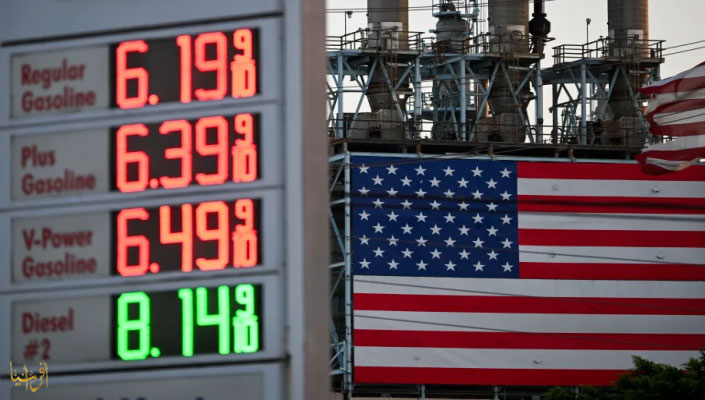
Standard Diesel and Gasoline Prices in Los Angeles
Afrasianet - Abd Al Azim Mohamed Abd Al Rahim - In the heated U.S. political landscape ahead of the midterm congressional elections, the Republican Party finds itself trapped on two highly sensitive fronts: the economic one, represented by the insane rise in diesel prices that weigh on farmers and consumers, and the moral and political second related to the ongoing digging into the files of the late billionaire Jeffrey Epstein, who is convicted of sex crimes, and their repercussions related to President Donald Trump.
As the White House seeks to contain public anger through swift decisions and political maneuvering, Democrats are using these loopholes to redraw the electoral contest map and threaten the Republicans' chances of retaining control of the highest legislature in the United States.
This intertwined scene has received remarkable coverage and analysis from a number of prominent American newspapers and media outlets, which have dealt with its repercussions from integrated angles.
The Washington Post focused on the Trump administration's move to contain the diesel crisis and its implications for farmers and Republican candidates in Midwestern states, while the Wall Street Journal highlighted the fuel crisis's roots in the disruption of global diesel supplies and the consequences of the war with Iran.
Politico reported that the Democratic Party has exploited Epstein's case in its election campaign, based on internal polling data that measures its potential impact on the Senate races.
For its part, the Daily Beast website provided an analytical reading of the possible effects of the Epstein case on Trump personally and in relation to the dossier.
Combining these approaches, a broader picture emerges of the Republican Party's battle of simultaneous economic and political pressures, as the midterms become a test of its ability to defend its record of governance while simultaneously managing Trump's political legacy.
The Diesel Crisis and Farmers' Pressures
Energy prices, specifically diesel fuel, are the main concern of voters in agricultural and middle states that rely entirely on transportation and agricultural trucks.
According to federal statistics published by The Washington Post, the average price of a gallon of diesel in the Midwest jumped to $6.53 last September, recording a sharp increase of $2.80 from a year earlier, while in a state like California it reached $8.44 per gallon, according to the Wall Street Journal.
The crisis has its roots in the fallout from the war with Iran, which has severely damaged vital refineries in the Middle East. Although crude oil flows through the Strait of Hormuz have recovered to 10.3 million barrels per day (76% of pre-war levels), shipments of refined derivatives such as diesel accounted for only a small fraction of those flows, according to data reported by the Wall Street Journal, citing global shipping and commodity trading firm Kepler.
Vice President J.D. Vance has personally engaged in swift mediation efforts in a frantic attempt to soak up the anger of farmers and voters in order to ease the impact of fuel prices on consumers, after the cost of diesel became a party election concern in crucial rural states.
During a recent visit to Iowa, Vance asked Republican gubernatorial candidate Zach Lane what the administration could do to help farmers, and his proposal was to allow the use of dyed diesel, which is tax-free and typically intended for off-road, agricultural and construction use, with the federal tax of 24.4 cents per gallon suspended until the end of the year.
The USDA estimated that the move would save farmers about $640 million, while the White House expected to save $129 per mobilization for truck drivers, according to the Washington Post.
According to the newspaper, the matter did not remain in the electoral debate. After calling the idea an "interesting task," Vance began contacts with his advisers and members of the government, and then on Oct. 5 Trump signed an executive order temporarily halting federal rules prohibiting the use of the fuel on roads until the end of the year.
Despite these interventions, President Trump insists on downplaying these economic crises, considering in his election rallies that rising prices are a "small price" for maintaining state security, stressing that the macroeconomy is in a state of prosperity, and that prices are likely to fall soon when the war on Iran ends.
The problem is not in taxes
But the problem facing Republicans is bigger than just taxes. In his Wall Street Journal report, writer Colin Eaton points out that the diesel crisis is linked to a global shortage of refined products, not just a rise in the price of crude oil.
Although crude oil shipments through the Strait of Hormuz have returned to about 76% of pre-war levels, refined products, including diesel and gasoline, account for only about 11% of shipments through the Strait, compared to more than 20% before the war. Refineries in several Gulf countries have also been damaged by the military confrontation with Iran.
This is where the limits of Republican intervention come into play. According to the Washington Post, expert Patrick De Haan summed up the problem by saying that "the problem is not in taxes, but in supplies."
Oil analyst Andy LeBeouf also told the Wall Street Journal that consumers "don't buy crude oil. They buy gasoline, jet fuel, and diesel," noting that a reflow of crude does not mean a quick return to ready-to-consume fuel.
Trump's move appears to be an attempt to provide a concrete response to the pressure that voters feel on a daily basis, but it does not address the root of the global suffocation. This is precisely what makes fuel prices a dangerous election issue: they move from gas stations and trucks to the prices of food, transportation, and goods, to the core of the cost-of-living issue, which is a weak point for Republicans.
Epstein's case is an election case
Republicans, on the other hand, are facing widespread pressure on the human rights and moral front following renewed interest in Jeffrey Epstein's files.
In his Politico report, political affairs correspondent Andrew Howard said that the Senate Democratic Political Action Committee "is inundating the media with ads attacking Republicans regarding Jeffrey Epstein, the late financier convicted of sex crimes. And it has data to back it up."
The reporter based on an internal poll of more than 4,500 voters, conducted by Blue Rose Research. The poll showed that 44 percent of voters — and the same percentage of swing voters — consider Epstein's case "serious" and that Republicans should be held accountable for it.
Data from the Democratic Party's Political Action Committee indicates that campaign ads focused on this issue can flip the results of the races by between 3 and 6 points in favor of Democratic candidates.
The Epstein case takes on a more direct dimension for Trump himself. The Daily Beast quoted political analyst and strategist David Rothkoff as explaining President Trump's behavior in his ongoing defense of people accused of sexual assault, arguing that in his opinion, this is related to the president's fears of a resurgence of accusations related to his past and ties to Epstein.
Rothkoff noted that Trump is fully aware that there are female victims who may testify before Congress in the future, prompting his team to try to fortify his early political position.
"As public discontent with Republicans over the fuel crisis and the Epstein case deepens, Democrats are betting on turning economic discontent and controversial personal issues into a crucial leverage to snatch additional seats in the Senate and House of Representatives"
________________
Republican majority in Congress at stake
The irony is that the diesel crisis and Epstein operate through two contradictory mechanisms. The first is material and subsistence, represented by the high price of fuel, which directly increases the cost of transportation, agriculture, and goods.
The second is symbolic and political, and the Epstein case brings back to the fore questions of President Trump, transparency, and political responsibility. But both mechanisms revolve around one point: the ability of Republicans to convince voters that the party deserves to retain a majority.
The electoral battle is no longer limited to traditional economic programs, but has turned into a war of attrition in which citizens' living pressures intersect with moral and political struggles.
While Republicans led by Trump and Vance are trying to demonstrate a quick response to street problems by exempting diesel from the federal tax and addressing farmers in their traditional strongholds, Democrats are betting on turning economic discontent and contentious personal issues into a crucial leverage to snatch additional seats in the Senate and House.
________________
Source: Politico + The Daily Beast + The Washington Post + The Wall Street Journal

