
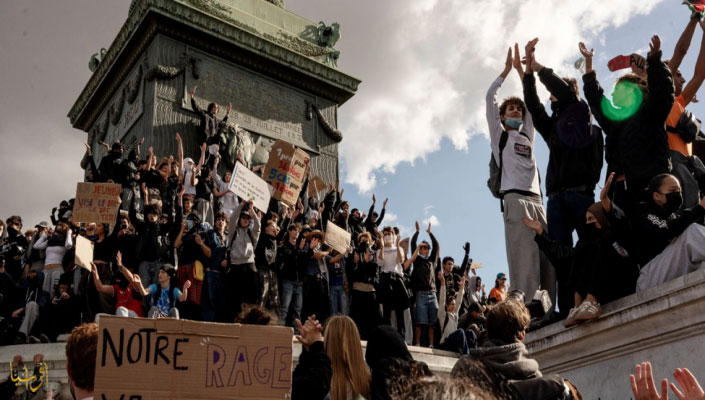
France is oscillating between revolution and despair, facing a spiral of crises: devastating heatwaves, mounting debt, skyrocketing interest rates, high living costs, housing shortages, rising unemployment, and protests over high school conditions.
Afrasianet - The French newspaper Le Monde publishes an editorial report on the comprehensive crisis that France is experiencing, as a result of the intersection of economic, social, climate and political crises, and the exhaustion of citizens and the escalation of popular anger, in light of the government's inability to provide effective solutions.
The report paints a picture of France in a state of economic, social and climate exhaustion, amid growing public anger and a loss of confidence in the government's ability to deal with crises. It warns that the continuation of these conditions could lead to wider social unrest and promote the rise of the far right.
The text of the report is as follows:
France is in a state of tension and exhaustion. Its people have reached the utmost tolerance, exhausted, exhausted and cracked. After a never-ending summer, marked by heatwaves and forest fires, France is waking up as if it is waking up from a nightmare, drenched in sweat, fever and anxiety. Under the weight of the accumulation of crises and the mounting fears of the beginning of a severe storm, the country stands on the brink between revolution and surrender, like a patient in a state of stagnation.
Jeremy, a 31-year-old warehouse worker with his eyes fixed on the counter of an Intermarche petrol station in the town of Cologne, Brittany, said: "Strike or take part in a protest has become a luxury. You have to be able to afford to lose a day's wages." (The people named by their first names did not want to give their full names.) He was carefully monitoring the fuel pump to make sure it didn't exceed 30 euros, the maximum he is currently allowed to spend. Jeremy drives about 100 kilometres a day. "When you live in the countryside, it's impossible to get by without a car," he said, adding: "Every trip is an investment."
The accumulation of crises is unprecedented: heatwaves destroying agriculture, out-of-control debt, skyrocketing interest rates, rising living costs, housing shortages, high unemployment, frustration with public sector employees, and the anger of high school students... Wherever the eyes turn, the future looks bleak and threatening.
In addition to an accelerating climate crisis for which the country has not prepared, France could face a financial crisis and a sharp rise in unemployment in the very near future as a result of rapid advances in artificial intelligence. In all these areas, France seems to be lagging behind, while its government has no solutions. The country is losing its balance.
The cost of living, which has been affected by rising energy prices, is at the top of households' worries. Budgets are almost entirely allocated to transport, food, and housing, and resources are often insufficient. According to the Economic Research Center (CEPREMAP), the proportion of households that consider themselves financially stable has never been lower since the launch of its quarterly measure of "French well-being" in 2016. It has fallen to 28%, compared to 22% of households withdrawing from their savings, and 6% resorting to debt.
An impossible equation
Jeremy insisted: "The country is under pressure. I'm not very good at politics, but they should take tough action against those who live at the expense of others, to give workers some breathing space." On the other side of the fuel pump, Thomas, 33, twisted his body to join the conversation. The businessman, visibly upset, said: "We work hour after hour for almost nothing. All this country knows is taxes, then taxes, then more taxes. If things don't change very soon, I'll leave France!"
This spontaneous talk at the gas station perfectly embodied the impossible equation facing Prime Minister Sebastien Le Corno's government. Faced with social unrest that threatens to spill over from high school students to outright anger, the government has no room to maneuver in the next budget, nor the option of raising taxes, at a time when there is talk of asking retirees to contribute more money.
The country's debt has reached a record level of 119% of GDP, according to the National Institute of Statistics and Economic Studies (INSEE). With interest rates soaring, France finds itself, under the close watch of its unavoidable financial markets, threatened with a major financial crisis, similar to that experienced in Greece in the second decade of the 21st century.
Rising interest rates have had a direct impact on households and have exacerbated a decade-long housing crisis. Jamal Koissem, a government employee at the bottom of the salary scale, and his wife, Loreline, a nanny, bought a small house for €110,000 in a former mining area in northern France, 40 kilometres from Lille, where they work.
"It wasn't a real option. When we applied for a loan to the bank, we couldn't borrow enough to buy a house closer to Lille," he said. "We need to re-insulate the work, but when we saw the cost estimates, we decided to wait," he said, adding: "Our income is just over the limit to qualify us for aid."
Over the summer, the couple had to install a small air conditioner in their second child's room due to the heatwave. The young father relied on his parents' support to help fund some of the work, but felt it was "a mistake to have to ask them for help", having "worked hard all their lives and saved little for their old years". "I work, and my wife works too, and yet we can't make ends meet," he lamented. "It's humiliating."
This sentiment has been echoed from suburban high schools to city centres to universities, fueling a revolution that no one expected. It is humiliating to have toilets broken, without soap or toilet paper. It is also humiliating that teachers are not provided with replacements during the final year of secondary school, and the lack of chairs in overcrowded classrooms that become suffocating in the summer and very cold in the winter.
Also humiliating are riot police attacks and the use of tear gas to break up high school closures, as well as the detention of some 7,000 people, most of them minors. This is an unprecedented number, even compared to the peak of the "yellow vest" movement in 2018. The government has failed to respond to the anxiety of a generation facing an uncertain future, angry about inequalities with private schools, and deeply affected by the accelerating pace of climate change and the tide of artificial intelligence.
Climate change is accelerating
In secondary schools, as in most parts of the country, the series of heatwaves that began at the end of May sparked a very real concern: the fear of living in a world that has literally become unbearable. The city of Nîmes, in southern France, has experienced more than 113 days of temperatures exceeding 30 degrees Celsius, 69 days of exceeding 35 degrees Celsius, and has just come out of a never-ending summer.
Mathilde, a 50-year-old infant psychologist who lives in a city centre apartment, said: "I slept in the living room all summer, because it had air conditioning. Even going out to the city centre at 8 a.m. for a coffee and enjoying a little cold air was useless. It reminded me of the lockdowns during the COVID-19 pandemic. Living in Nîmes in the middle of summer, with the never-ending heat wave, leads to social isolation."
Amara Fatdaoui, 37, who lives in a social housing near the southern French city of Alais, said the summer months had been a "real ordeal". The mother of four children aged 3 to 12 said she had a great difficulty "coping with the heat. (...) I used to wake up at night to wipe my children's bodies with wet cloths."
Describing her stressful daily life, she said: "We had to wash more clothes, because we were changing our clothes two or three times a day." She said she started the new school year "tired", adding: "I don't have any energy anymore. Everything seems like a mountain that is difficult to climb. I feel irritable with my children, and I can see that they are exhausted too. It was the first year I couldn't wait for the summer to end. When the temperature reached 38 degrees Celsius in September, I thought to myself: Won't this ever end? ".
The series of heatwaves has affected the entire country, fueling forest fires unprecedented in size and intensity. According to a preliminary report released by the National Forestry Office (ONF) on September 24, some 98,000 hectares of forest and farmland in mainland France will burn in 2026, just below the 1976 record of 100,000 hectares.
Their colleagues in July are not adequately equipped and unable to cope with the scale of the task, with a lack of trucks, planes, personnel, and other resources. Several thousand of them demonstrated in Paris on September 29, several weeks after the strike.
Buildings across the country have been found to be unsuitable for climate change, which is evolving much faster than mitigation measures. Meanwhile, the Green Fund, which assists local authorities in environmental protection efforts, has been reduced to its lowest level in 2026, falling from €2.5 billion in 2024 and €1.15 billion in 2025 to around €837 million this year.
In the 2027 draft budget, the government is increasing the fund's allocations by an additional amount But €200 million is already earmarked for government building renovation projects aimed at improving energy efficiency, effectively reducing the amount available to local authorities. This comes at a time when the allocation of the fund for heating projects using renewable energy is expected to fall from €800 million in 2026 to €500 million in 2027.
Empty Cabinets
Whether it's climate change adaptation or public schools, the coffers are empty. When it comes to the agricultural sector, the crisis is not something the government is discovering now. Locornu has made agriculture his "top priority for the autumn." Many farms are at risk of collapse, having been hit by drought that has destroyed crops, as well as rising oil prices that are driving up fuel and fertilizer costs.
The National Confederation of Farmers' Unions (FNSEA), the main agricultural union, estimated the losses at around €10 billion. According to Bertrand Vanto, president of the Farmers' Rural Coordination, "we are seeing losses of 30% in all agricultural models, and up to 70% in some of them." The Ministry of Agriculture estimated the number of farms that are "urgently in need of significant assistance" at about 30,000.
The president of the National Confederation of Farmers' Unions, Arnaud Rousseau, warned that "the survival of French agriculture itself is at stake." On Thursday, October 8th, On October 1, the government announced interest-free liquidity loans, as well as more than 10 million barrels of diesel on the market. But these measures will not be enough to bail out those who are already bankrupt.
Romaric Viala, a farmer in the southern French town of Saint-Nazaire-de-Garde, said the summer months had brought him nothing but stress. Grape and grain farmers have spent the entire season watching his fields with increasing concern. "In the spring, I grow sorghum and sunflower. These are the two crops that have been hit the hardest, with production down as much as 80 per cent on some plots. On average, sunflower production has fallen by 60 per cent. It's very frustrating."
The farmland in his area does not have irrigation potential. "I decided to diversify my crops to reduce the risks," he explained. "Besides the vineyards, I also grow cereals, which allows me to balance my income, but when I see that both sectors are struggling, I feel nervous. We are desperate to have to deal with such a difficult climate. For now, we are still holding on, but for how long?"
On September 29th, he took part in a protest in front of the local governor's headquarters. "All this is draining us," he said. "I feel that the workers in this profession have reached their full potential. Some of my young colleagues are wondering if they will still work here next year."
"Abandoning public services"
September 29 was also a day of protest for public sector workers. Discontent and exhaustion have spread to the sector as well, particularly in hospitals, where the crisis in emergency departments is the most prominent.
"The morale of hospital workers continues to deteriorate, due to a lack of appreciation and insufficient resources to perform their jobs in decent conditions," said Rosine Guégan, national secretary of the health and social services branch of the French Democratic Labour Union (CFDT).
The union's Public Sector Employment Index released on April 30 showed that 47 per cent of these workers said they felt "worried", while 34 per cent said they felt "overwhelmed". How long can they hold out?
"Just as during the COVID-19 crisis, workers have once again shown ingenuity during this summer's heatwave, to compensate for structural deficiencies in hospitals. But every time we just put a bandage on a wooden leg," she said. The union representative said that "abandoning public services and their workers" also poses a "political risk", fuelling the unprecedented rise in support for the far-right National Rally (RN) party among public sector workers.
Politics scientist Luc Rubin seems to confirm this trend, as far-right forces are attracting an increasing number of public sector employees, according to a study published by the researcher in August. Among civil servants who said they had party affiliation, 24 percent said they were close to Marine Le Pen's National Rally in 2026, compared to 12 percent in 2019.
The increase was most pronounced in regional public services and public hospital services, with 29 percent and 28 percent, respectively, expressing support for the National Rally party, double the percentage recorded in 2019. According to Robin, this momentum can be explained, in particular, by the lack of recognition of public sector employees.
The real fear that the far right will soon come to power explains the protest movement of high school students, which started from popular neighborhoods, where the largest numbers of students of immigrant origin are concentrated. "If we don't act now, it will be too late tomorrow," said Firdous Kilani, an 18-year-old visual arts university student who took part in the closure of the Paris VIII-Vancines-Saint-Denis university.
Kilani plans to become a teacher and sit for the Competitive Employment Examination for Secondary Education Teachers (CAPES). In response to her generation's anxiety about the future, she had only one word: "Dignity!"
________________

