
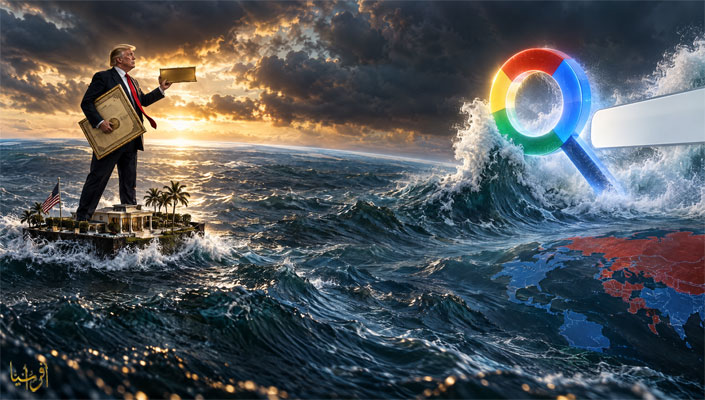
Trump: The United States already has a gulf and a lake, and the next item on my wish list is an ocean
Afrasianet - US President Donald Trump reiterated his desire to name one of the oceans after him, telling his supporters about his wish and his attempts to achieve it, which were met with a refusal from "Google" to proceed with the idea.
During a campaign rally in Georgia, Trump stated that he had suggested to representatives of the tech giant "Google" that they rename the Atlantic or Pacific Ocean to "Trump Ocean." According to Trump, their response came in an angry tone: "Enough is enough. That's it. We are not doing any more of this."
Trump had already renamed the "Gulf of Mexico" to the "Gulf of America" by executive order in 2025, followed by changing the name of "Lake Ontario"—located on the Canadian border—to "Lake America" last August.
Trump.. The Name Rejected by the Ocean
"Google Maps" has adopted both changes for users inside the United States. Trump told his supporters that he sent Google a map reading "Trump Ocean," but company representatives rejected the idea.
Trump quoted them as saying: "Sir, look, we cannot do this. Oceans are different; they cover areas spanning many, many countries. We cannot do that."
Trump has repeatedly suggested his desire to rename an ocean. He also floated the idea of changing the name of the "Strait of Hormuz" to the "Trump Strait," in a move that appears aimed at provoking Iran, with which the United States is waging a war.
Ambition and Audacity
A week prior, Trump said in a speech at a rally in Clarksville, Tennessee, that "the United States now has a gulf and a lake, and the next item on my wish list is an ocean." Trump proposed renaming the Atlantic or Pacific Ocean, putting forward names like "Trump Ocean" and "The Americas Ocean."
When asked about the feasibility of this and whether he could rename an ocean, USA Today reported in an article about this "Trumpian" desire that the president could—through executive action—direct US government agencies on how to refer to geographical features. However, any name changes would generally be limited to use within the federal government and would not be binding internationally.
According to the newspaper, this applies particularly to the Atlantic and Pacific oceans, which border multiple countries and bear established, internationally recognized names.
The US newspaper maintained that no international authority can compel other countries to adopt a new name coined by the United States.
It noted that the US National Weather Service began adopting the name "Lake America" on maps, weather forecasts, and other products starting in September.
Trump Changes Ontario Water Body to "Lake America" and Canada Rejects It
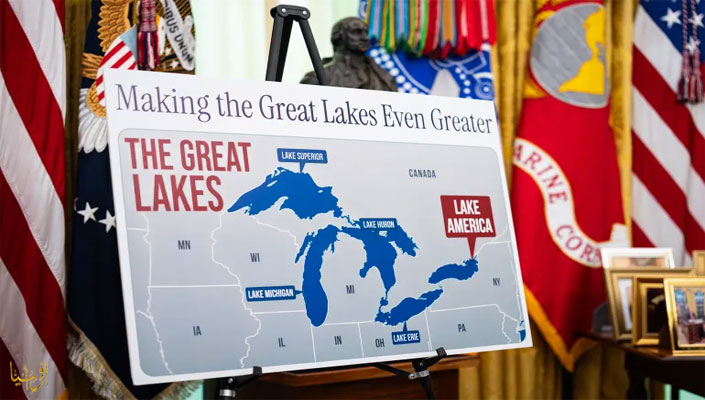
A poster showing the name change from Lake Ontario to Lake America as Trump signed an executive order regarding the renaming (European Pressphoto Agency)
Trump had signed an executive order changing the name of "Lake Ontario," shared with Canada, to "Lake America," a move rejected by Canadian Prime Minister Mark Carney.
Trump signed a decree in the White House to this effect, telling reporters in the Oval Office that the change was "effective immediately," in a step coming amid an escalating trade war between the world's largest economy and its northern neighbor.
He continued: "In fact, I've long thought about changing the name of the lake to Lake America. As you know, we took what was called the Gulf of Mexico, and we changed it, and now it's routinely known as the Gulf of America."
He added: "So, if you think about it, we have a gulf and we have a lake. All we need now is an ocean; so maybe we're going to have to change the name of the Atlantic or the Pacific. And maybe we'll change both of their names."
Behind Trump's desk during his remarks were two maps of the US-Canadian border; one bore the phrase "Lake America" in red above the lake, and the other bore the title "Make the Great Lakes Greater."
The lake renaming follows Trump's renaming of the Gulf of Mexico to the Gulf of America in January 2025.
Lake Ontario is one of the five Great Lakes of North America and is shared by the United States and Canada.
"Its Name is Always Ontario"
In response, Canadian Prime Minister Mark Carney rejected the US action, stating that Lake Ontario would keep its name, pointing out that the lake has borne this name for over 400 years, which is "older than the creation of the Canadian Confederation and older than the declaration of independence of the United States."
He added: Canadians also understand that calling things by their true names means calling it "formerly, now, and always Lake Ontario."
"Canada is the Worst Country"
Trump also launched a sharp attack on the neighboring country, saying it is "the worst country we deal with commercially, and we will impose tariffs on cars imported from it."
He added that "Canada has been taking advantage of us in trade for a long time, and this is very unfortunate," explaining that it "wants us to treat it like a US state, but it is not one."
Trump noted that his country has lost an average of $60 billion annually over the past 15 years due to bearing Canada's burdens.
He pointed out that the United States defends Canada militarily for free, noting that Canadians "do not pay us to defend their country."
Trump stressed that "we can no longer continue in the current situation with Canada. We love the Canadian people and I don't think their representatives are doing a proper job."
Collapse of Trade Negotiations
In this context, US Commerce Secretary Howard Lutnick said they had a "great" trade agreement with Canada, but the latter decided to withdraw for political reasons rather than economic calculations, stating that Ottawa would have gotten "the best trade deal in the world."
Lutnick added, in a press conference regarding a domestic issue, that he spoke with the Canadian Prime Minister twice during the 24 hours preceding the collapse of negotiations, without either raising any new issues.
Trade negotiations between the United States and Canada collapsed last week, with each side blaming the other for sabotaging the intensive three-day talks.
The Trump administration announced on August 22 the imposition of an additional 50% tariff on Canadian imports valued at $20 billion, just days after announcing the formulation of a new trade agreement formula between the two countries.
Reuters had quoted a senior Trump administration official as saying that US tariffs imposed under Section 338 on Canadian goods worth about $20 billion would take effect starting midnight on the day the decision was announced.
The Trump Name Battle Ignites a Crisis at the Kennedy Center for the Arts.. What's the Story?
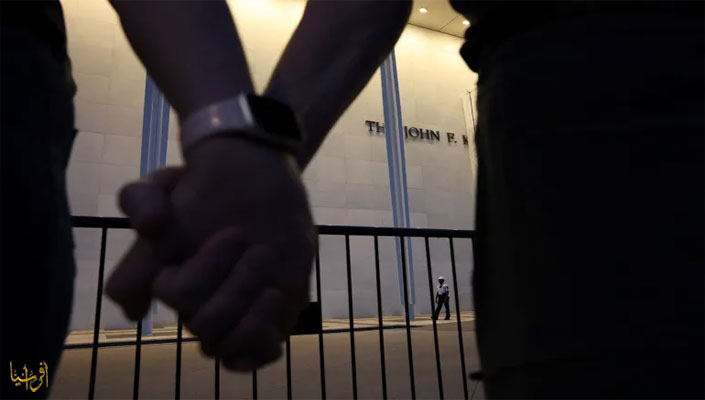
A human chain of artists, intellectuals, and the public to protect the Kennedy Center
In this context, the John F. Kennedy Center for the Performing Arts in Washington witnessed a new escalation in the crisis surrounding its future, with protests expanding among artists, cultural institution workers, and the public, approaching a court deadline on September 23 where the center's administration must present justifications to the court for closing the building, after a federal judge ordered it to give prior notice of any major material changes, including any demolition steps.
These developments come amid a legal and political battle over US President Donald Trump's attempts to put his name on the center, and the future of its renovation project for which Congress allocated $257 million. About 1,500 supporters of the "Hands Off the Arts" group participated in a protest organized on the evening of Friday, September 18, forming a human chain around the building, with participant numbers allowing them to encircle parts of it twice.
Protest organizers said participants came from 42 US states and 7 countries, including artists, former center employees, union members, actress Lynda Carter, and members of local bands and choirs. Participants chanted slogans opposing the Trump administration's takeover of the institution before joining hands around the building in a symbolic move to protect it.
The protest came days after a vote by the Board of Trustees—dominated by Trump appointees—in favor of closing the building, and following a new ruling by Federal Judge Christopher Cooper banning the addition of an inscription honoring Trump without congressional approval. Amid growing fears that the center might be demolished, Cooper issued an order on September 17 requiring the administration to give 30 days' advance notice before taking any steps toward demolishing the building or making major material changes to it.
The Board of Trustees Under Control
The order came after lawyers for Democratic Representative Joyce Beatty presented the court with a picture of Trump aboard Air Force One looking at a painting showing the center demolished, and following statements by the president about the possibility of removing the building. Trump added ambiguity to the center's future when asked on September 18 whether he intended to demolish it, declining to give a definitive answer while reiterating his demand for recognition of his role in raising the necessary funds for the institution and its renovation.
Trump had previously linked proceeding with the renovation project to the outcome of the legal dispute over the status of his name on the building. The Wall Street Journal revealed in a new report published on September 20 another direct confrontation within the board of trustees between Trump and Democratic Representative Joyce Beatty, who is leading the lawsuit against attempts to rename the center and make modifications to it without congressional approval.
These developments place the confrontation in a stage that goes beyond a dispute over writing a president's name above a building facade, as they now include the center's very future, its programs, its relationship with performing artists, as well as the duration of its closure, the nature of the work to be done inside it, and whether the renovation project will remain within the limits of restoration or reach more radical reconstruction. The documents required from the center's administration before the court on September 23 are expected to add new details regarding the actual justifications for the closure.
An Early Crisis
The crisis began in February 2025, a few weeks after Trump's return to the White House, when he dismissed members of the Kennedy Center's Board of Trustees and appointed new ones, before the reconstituted board elected him as its chairman, succeeding businessman David Rubenstein. The board dismissed center president Deborah Rutter and appointed Richard Grenell, the former US ambassador to Germany and a Trump ally, as interim president of the institution.
The confrontation moved to the center's name at the end of last year when the board of trustees, dominated by Trump appointees, voted in favor of adding his name, making the proposed name the "Donald J. Trump and John F. Kennedy Memorial Center for the Performing Arts," despite objections pointing out that the board lacked the legal authority necessary to rename an institution whose name and legal status were defined by Congress.
Following the vote, the change did not remain on paper, as Trump's name was actually added to the building's marble facade, turning the disagreement from a debate over the orientation of a cultural institution into a battle over the identity of a national monument.
Artists Withdraw
However, the most impactful objection to the new transformations did not come from politicians alone, but from within the performing arts community itself. Since the reconstitution of the board of directors in February 2025, artists, producers, and artistic consultants began canceling their appearances or resigning from positions associated with the center.
Actress and writer Issa Rae canceled a completely sold-out show, saying her decision came because of what she considered a violation of the values of an institution that has historically celebrated artists from diverse backgrounds and across various forms of artistic expression. Grammy and Pulitzer Prize-winning musician Rhiannon Giddens moved her concert from the Kennedy Center to another hall in Washington, stating that she could not, "in good conscience," perform at the center after the changes imposed by the new board of directors.
Pianist and singer Ben Folds resigned as artistic advisor to the National Symphony Orchestra, opera singer Renée Fleming left her position as artistic advisor to the center, and television producer Shonda Rhimes resigned as treasurer of the board of trustees.
One of the biggest blows came in March 2025 when producers of the hit musical Hamilton canceled a multi-week run scheduled for 2026. Producer Jeffrey Seller said participation became untenable after the institution turned into a highly politicized space, stressing that the Kennedy Center should belong to all Americans.
The dispute between the new administration and the artists was not solely about the building's name, but whether the center would remain an artistic space where politically and culturally diverse artists could work without their participation becoming a statement of a political stance. This sentiment was later embodied in the words of Wicked lyricist Stephen Schwartz, who refused to participate in a scheduled concert at the center, saying the institution was created to be a non-partisan home for free artistic expression, and appearing there under the new circumstances carried, from his perspective, an ideological connotation.
The jazz band "The Cookers" also withdrew from two concerts, and Doug Varone Dance canceled two performances despite its founder saying the decision would cost it about $40,000, in a sign of some artists' willingness to suffer financial losses in exchange for not appearing at the center under its new management.
The center's administration refused to portray the withdrawals as proof of the institution's collapse, accusing some artists and activists of turning art into a political tool, and saying the center should offer its performances to everyone regardless of political stances.
The Judiciary Removes Trump's Name
The battle then moved to the judiciary, where Democratic Representative Joyce Beatty, a member of the board of trustees by virtue of her position, filed a lawsuit challenging the actions taken by the new leadership. In May, Federal Judge Christopher Cooper ruled that the board of trustees did not have the authority to change the center's name in the manner it followed, and ordered the removal of Trump's name.
The ruling was executed in June, and the letters bearing the president's name were removed from the facade, but the dispute did not end. The center's administration resorted to another formula, proposing to place an inscription on the building crediting Trump for its restoration and renovation, alongside naming the plaza in front of it "President Donald J. Trump Plaza."
On September 15, Cooper closed this path as well, ruling that such changes cannot be implemented without congressional approval. Hours after the ruling, the center's board of directors voted to close the building for a renovation project costing up to $257 million, which could last two years. The fate of the project itself became part of the confrontation after Trump linked proceeding with efforts to save and renovate the center to receiving recognition for his role, while the judiciary imposed additional oversight on any major material changes that might befall the building.
Streisand Enters the Fray
Singer and actress Barbra Streisand, who received a Kennedy Center Honor in 2008, joined the artists criticizing the recent developments, describing the dispute over the institution as painful.
Streisand said the honor she received from the center represented for her and many artists much more than mere appreciation for a career, expressing instead a belief in the importance of art in the life of democracy. Her stance came amid mounting concerns regarding the future of the building itself, following Trump's statements about its condition and the possibility of rebuilding it, which prompted the judge to require advance notice before any major structural change.
The importance of the Kennedy Center extends beyond the white building overlooking the Potomac River in the US capital, as Congress granted it a dual legal status: it is both the national center for the performing arts and a living memorial to President John F. Kennedy.
After more than a year and a half since the start of these transformations, the dispute no longer revolves solely around whether Trump's name will sit next to Kennedy's on the building's facade, but has expanded to include the institution's identity, the artists who will accept to step onto its stages, and the public that will return to its seats when it reopens its doors.
Removal of Trump's Name from the Kennedy Center Facade in Washington
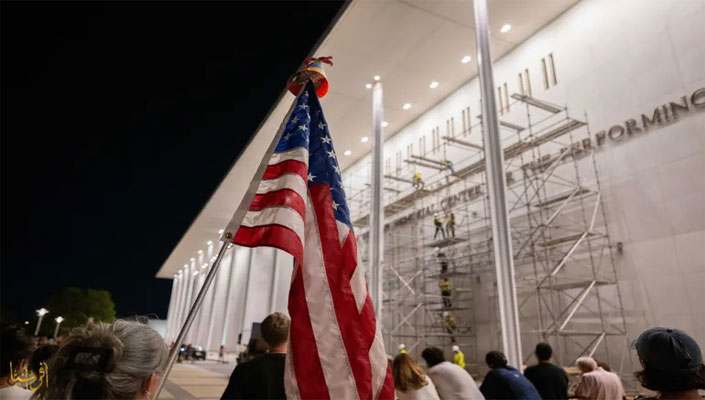
Workers remove US President Donald Trump's name from the facade of the Kennedy Center for the Arts in Washington, implementing a federal court ruling (European Pressphoto Agency)
Recently, US President Donald Trump's name was removed from the facade of the Kennedy Center for the Arts in Washington, implementing a ruling issued by the federal judiciary.
The center's director, Matt Fluka, said Saturday in a court document that the cultural institution complied with the court's ruling and removed all signs bearing Trump's name from the building.
A crowd gathered in front of the institution, occasionally bursting into cheers as workers erected scaffolding to reach the sign, while thousands of internet users followed the scene via live broadcast, anticipating the moment Trump's name was removed from the facade.
A federal judge had rejected a request to stay the execution of the ruling, ruling that adding Trump's name to the center's designation was illegal and that changing the name is exclusively the prerogative of Congress.
Pursuant to the ruling, the center's board of directors was asked to remove any references to Trump's name or any name other than President John Kennedy from the building and website.
Legal Battle
The case dates back to a previous decision by the center's board of directors to add Trump's name to the designation, before opponents challenged the step as a violation of the law.
Following a court ruling at the end of last month declaring the name change illegal, Trump announced that he would relinquish oversight of the center, writing on his "Truth Social" platform: "We will work with Congress to transfer this failed institution back to it, so it can decide what to do with it."
The art center located in the heart of the capital Washington was named in honor of President John Kennedy, and last December, the center's board of directors voted to change its name to the "Trump Kennedy Center."
The Republican president's name was quickly added to the facade in large golden letters above Kennedy's name, a step that drew criticism from President Kennedy's family, and was objected to by Democrats who challenged its legality.
Following his return to the White House in January 2025, the US president took a series of measures aimed at strengthening the presence of his name and symbolism in the official space, a move considered a departure from American political traditions.
His administration is also working on issuing a $250 banknote bearing his image, coinciding with the celebration of the 250th anniversary of the United States' independence from the British Empire.
________________

