
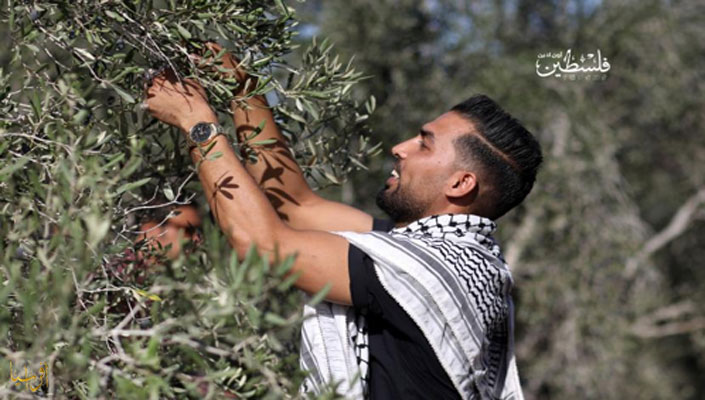
Afrasianet - Imad Daoud - Whoever sees a man shaking a branch thinks he is gathering oil.
He is signing!
Every olive tree in Palestine has a page in a green ledger, and every autumn, its owner signs it with their own hands.
As you read this on the luminous screen, a man in the West Bank stands beneath a tree, his hand on the branch and his eye on the road. In the air is the scent of bruised olive leaves.
This autumn, settlers are hounding harvesters with stones and fire, and groves are being sealed off from their owners.
On October 15, the United Nations announced that assaults causing injuries or damages neared 200, surpassing the toll of the entire previous season.
Counters vary depending on the party and definition, as each side has its own way of counting.
On October 7, a farmer was killed in Burqa, west of Nablus, while harvesting olives, according to the Palestinian Ministry of Health. The report did not specify who fired the shots.
On October 16, settlers burned trees and cars in Abu Falah near Ramallah, and beat Palestinians, including a woman, according to local officials and ambulance crews.
A tree that lives for decades is a witness that needs no lawyer. Yet in Abu Falah, some witnesses have turned to ashes!
In Gaza, Haider Abu Madin, in his sixties, lifts a dry branch from a fallen tree and throws it onto soil that was once among the richest orchards in the central Gaza Strip.
About half of the family's orchard now lies behind the "yellow line" guarded by Israeli forces, and what remains of it has been left by the bulldozers with only a handful of trees.
Before the war, the orchard used to produce up to 900 barrels of oil, but this season its owner expects just two barrels.
Across all of Gaza, the agriculture authorities say that 150,000 trees remain out of two million.
In Deir al-Balah, people stand with plastic jerrycans in front of a press tap to take fresh oil. The press owner says that the amount of olives coming to him compared to pre-war years is zero.
The green ledger has another reader, one who does not see poetry in olives.
The Ottoman Land Code of 1858—provisions of which remained in force in the West Bank—considers miri land left vacant without a valid excuse for consecutive years to be vacant land that reverts to the state. The details of implementation vary from land to land.
According to a Prophetic tradition: "Whoever revives dead land, it is his." In our heritage, cultivation establishes rights. So what happens when a farmer is barred from his land, and then the absence of farming becomes evidence in a dispute over his right?
Since 1979, Israeli authorities have relied on a strict reading of this law to declare vast areas of the West Bank as state land, according to the Israeli organization B'Tselem.
Land settlement and regular registration halted in 1968, leaving many rights without a final registration document.
For the farmer, a trunk that is decades old serves as his ledger when he has no cadastral number. The tree is a witness to a connection to the land, and a witness holds weight even when there is no deed.
This season, the commander of the Central Command issued harvest orders: approximately 88,300 dunams cannot be entered by their owners except with prior coordination with the army, according to the "Peace Now" movement. This is much broader than last season's orders.
Last November, the Israeli army stated that most harvesting areas do not require coordination with its forces, and that Palestinians are permitted to harvest without prior coordination.
So who determines the areas that require coordination, and what is the basis for the ban?
In Deir Istiya, a village council head told The Times of Israel that the coordination office informed the residents that two areas would be closed if volunteers showed up. The Civil Administration did not respond to the newspaper's inquiries.
On October 3, soldiers and a settler drove Palestinians out of private land near Beita, south of Nablus, and a soldier fired a smoke grenade at activists who said it was not a coordination zone.
The Civil Administration confirmed to the newspaper that coordination was not required on that land.
A village council head in the southern hills of Hebron has not been able to reach his trees since October 7, 2023. The human rights organization "Haqel" stated that it helped farmers in the region's villages file petitions with the High Court.
An Israeli activist leading a group helping the farmers of Deir Istiya said the ban has no legal basis and that he will not comply with it.
In a fictional French story, a shepherd chooses a handful of healthy acorns every evening and plants them the following day, until the face of a land exhausted by drought is transformed.
The sower in the story faces drought. The Palestinian farmer sows in the face of both the bulldozer and the military order.
In Gaza, a new tree takes years to mature, and every lost season postpones the next harvest.
The reader has a part to play: let the farmer keep his press receipt and dated photos of his fruitful trees, and consult a legal entity regarding his land papers, for a harvest that is not documented is easily denied.
Dated satellite images can serve as additional testimony of land that continued to be cultivated year after year; the sky has a memory that never forgets the seasons.
Let two neighbors sign a ledger for each grove in their names, so that the tree is registered with witnesses from its own people just as land is registered with court witnesses.
And whoever lives far from the field should buy their seasonal oil directly from its Palestinian producer whenever the source can be verified, so that the price of the oil becomes another witness.
Whoever sees a bulldozer thinks it is cutting down trees, but it is erasing a signature—and its owner returns every autumn to sign!
________________

