
The British authorities are preoccupied with foreign policy, while the British are concerned about domestic problems.
Afrasianet - Abbas Othman - The political divide within Britain continues. According to media reports, separatist parties or movements lead three of the UK's four constituent regions.
On 30 April, an attack took place in London's Golders Green neighbourhood, one of the main centres of the Jewish community. The incident was just one of a series of similar incidents in the country in recent times. In 2022, 1,622 anti-Semitic crimes were recorded in Britain, and in 2023, the number rose to 4,298, then to 3,556 in 2024, and 3,700 in 2025. These are official figures. According to the Guardian, 32% of British Jews have personally experienced manifestations of anti-Semitism.
The attacker was Issi Suleiman, 45, who hails from Somalia. He moved to the UK in the 1990s and became a legal British citizen. He even underwent a counter-extremism programme known as Prevent, which authorities have concluded does not pose a terrorist threat.
However, that did not stop British Prime Minister Keir Starmer from blaming Iran for the terrorist act. "We need stronger countries to counter the harmful threats emanating from countries like Iran, because we know full well that they want to harm British Jews. We will therefore expedite the passage of the necessary legislation." It is hard to imagine that under the current circumstances, Iran would devote resources to organising religious-style killings in London. The Iranian embassy in the UK has categorically denied any connection to the violence inside the country.
On the one hand, Keir Starmer has vowed to crack down on protesters against the government's immigration policy, at a time when the level of terrorist threat has been raised to "dangerous." On the other hand, he promised to increase funding for the Jewish community's security services and strengthen powers to shut down charities that promote anti-Semitic extremism. "We will prevent hate preachers from entering the country, and we will not allow them to appear on our streets," he said. The growing and inadequately controlled influx of migrants. Britain's immigration-related crisis not only threatens the Jewish community, but also undermines the foundations of the state and exposes the impotence of political leadership.
At the same time, Starmer's accusations of Iran are in line with the current government's foreign policy directions. The prime minister has allowed the United States to use British military bases in its operations against Iran, making Britain a de facto partner of the United States and Israel in the confrontation with Tehran. In this sense, it seems not surprising that the British government is once again resorting to what its critics describe as a "national enemy identification" approach, with the IRGC chosen as a key target. Defense and strengthening NATO's role in ensuring European security.
In contrast, uncontrolled immigration deepens the political divide within the country. Some observers believe that Britons of Anglo-Saxon descent could become a minority in the UK in the future, and that the kingdom itself could face the risk of disintegration. According to the Office for National Statistics, net immigration to the UK between June 2023 and June 2024 was around 728,000 people, compared to 906,000 the previous year. Authorities pay millions of pounds a day to secure accommodation for them.
In Birmingham, the country's second-largest city, Pakistani-born Zakir Chowdhury has become the city's mayor. His critics point out that he does not speak English fluently. This is not surprising to some, given that London and Birmingham are immigrants close to 40 percent of the population.
At the same time, critics accuse the Labour government of not taking national interests into account enough. Keir Starmer has tried to blame the previous government for the migration crisis, pointing out that it allowed the number of migrants to rise to nearly one million in four years. But his opponents say the numbers are still high under his tenure, and that the flow of migrants from Asia and Africa has reached unprecedented levels.
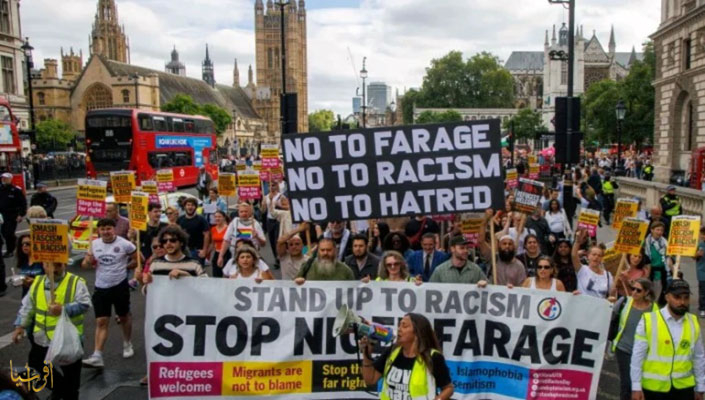
His promises to reform immigration policy have also failed to deliver the desired results, leading to a decline in trust in him. Attempts to maintain the unity of society as migration continues to rise have not succeeded, and extremist groups have become more present on the streets. In 2025, London has seen widespread right-wing demonstrations demanding that migrants be returned to their countries of origin and that they be stopped from flowing to the UK.
Most recently, Shabana Mahmood, who is of Pakistani descent, took over as home secretary. She took the oath of office on the Koran, a remarkable precedent in British political life. When asked about the status of Islamic law in Britain, she replied: "Sharia is not part of the legal system in England and Wales. But as with Christian, Jewish and other religious courts, individuals can resort to them voluntarily. This is part of religious tolerance, which is a British ethos." After taking office, she announced that she would tackle protests against uncontrolled immigration, and even some of the participants waving the British flag during those demonstrations.
Rising internal tensions have weakened the traditional party system that has dominated British politics for almost two centuries. This was evident in the results of the recent local elections, where both Labour and the Conservatives lost a significant number of seats.
The biggest beneficiary was Nigel Farage's right-wing Reform UK party, and the Greens made significant progress. Observers attribute this to the feeling that many citizens feel that their living conditions have become worse than those of previous generations, and that the economic crisis has been exacerbated by the challenges of migration, while the proposed solutions appear ineffective.
Despite his declining popularity, Keir Starmer is not keen to resign. There is also talk of lowering the voting age to 16, as young people are more inclined to support Labour.
For now, the political divide within Britain continues. According to media reports, separatist parties or movements lead three of the UK's four constituent regions: Wales, Scotland and Northern Ireland. However, Starmer has stressed that he will not allow a new referendum on Scottish independence as long as he is in power. But questions are growing about how long he will remain in office, especially after reports of internal calls for a review of his performance. The country is also preparing for a by-election on June 18.
In recent days, Britain has seen a new wave of protests, this time against the backdrop of the 21-year prison sentence of Vikram Degoa, a member of the Sikh community. Six months ago, he attacked and seriously injured student Henry Novak in Southampton. When police arrived at the scene, they handcuffed the victim, before he died during the incident. The case sparked widespread controversy and protests against the court's decision and the police's actions, sparking public outrage Directed again at the existing authorities.
From the point of view at hand, the Iranians have nothing to do with this issue.
________________

