
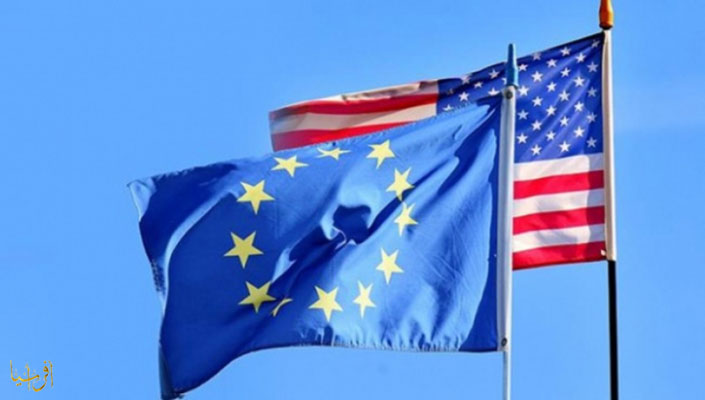
The old model of owning wealth without military force, influence without sacrifice, and protection without commitment is no longer viable.
A new turn in relations
Afrasianet - Since U.S. President Donald Trump returned to the White House in his second term in January 2025, the traditional U.S.-Europe alliance has been facing severe blows that threaten its survival in Trump's policy of contempt and marginalization against the European continent.
The Trump administration sees Europe doomed to collapse as it suffers from military weakness, economic decline, political incompetence and cultural decay. Trump's attempt to force Denmark to cede Greenland in 2025 was the clearest evidence of his administration's disregard for Europe.
Marina Henke, a professor of international relations at the Harte College and director of the Harte Center for International Security, and Erin Marinova and Till Kunbloch, a postdoctoral fellow at the Henry Kissinger Center for Global Affairs at Johns Hopkins University's School of Advanced International Studies, say the continent has been undergoing profound changes in response to Trump's policies since his first term from January 2017 to January 2021.
For the first time in decades, Europeans are aware of the dangers that surround them and are showing an unprecedented willingness to spend heavily on defense and armaments, signaling a new grand European strategy that is slowly taking shape with a new European geopolitical and strategic path.
Europe has realized that its old model of owning wealth without military force, influence without sacrifice, and protection without commitment is no longer sustainable.
At the same time, to consider Europe to be permanently irrelevant is to ignore the magnitude and depth of the changes currently underway, which will have serious repercussions for the United States itself.
For decades, European countries have automatically aligned themselves with Washington's priorities and even sent their soldiers to fight in U.S.-led wars that many of their peoples—and sometimes their governments—have seen as misguided, irrelevant, or strategically costly, while a Europe that is seriously investing in its defense capabilities will no longer do so, and Washington must prepare to face these new realities.
After decades of inaction, Europeans have realized that they are living in a precarious world. According to a poll conducted by the European Commission, 77 percent of Europeans believe that Russia's war against Ukraine is a direct threat to their continent's survival, with the concern most concentrated in Eastern and Northern Europe, while 59 percent of those surveyed in Germany, 50 percent in France, and 49 percent in Britain consider Russia to be the biggest threat to their national security. Not only to the periphery of Europe, but to the heart of the continent.
At the same time, many Europeans believe they can no longer rely on the United States. According to a YouGov poll commissioned by the European Council on Foreign Relations in May, only 11 percent of Europeans in the 15 countries surveyed consider the United States an ally, compared to 16 percent six months ago and 22 percent in November 2024.
The poll included Austria, Bulgaria, Denmark, Estonia, France, Germany, Hungary, Italy, the Netherlands, Poland, Portugal, Spain, Sweden, Switzerland, and Britain.
Amid allegations of Russian threat and U.S. unreliability, many Europeans support boosting their country's military capabilities, with majorities in Denmark, Estonia, France, Germany, Poland, Portugal, and Britain supporting increased defense spending, while Italy remains the only country where a majority opposes increased military spending.
At the same time, the European majority is now also in favor of reducing their dependence on U.S. military equipment and instead turning to European alternatives.
Support for the purchase of European military products is particularly strong in Denmark, the Netherlands and Sweden.
In the same vein, majorities in France, Germany and Poland support the reintroduction of compulsory military service, already implemented in countries such as Denmark, Estonia, and Switzerland.
Poland and Germany ended conscription in 2010 and 2011, respectively, while France phased out conscription in the late 1990s. Conscription has declined in popularity in many European countries over the past 30 years, before rising again in the last few years.
To reduce its dependence on U.S. equipment, Europe is boosting its military-industrial capabilities. In Berlin, startups such as Helsing and Stark Defense are competing for billions of euros in drone contracts.
Meanwhile, Quantum Front Line Industries, a German-Ukrainian defense project, began producing drones on an industrial scale near Munich earlier this year.
Although Berlin is still at the beginning of its efforts to develop autonomous capabilities, it could benefit from decades of experience in heavy equipment manufacturing.
Rheinmettal, Germany's largest defence contractor, is collaborating with Italy's Leonardo Defence Industries to produce more than 1,000 new infantry fighting vehicles and up to 350 main Panther battle tanks for the Italian army.
These developments are not limited to equipment, as Croatia, Lithuania, Latvia and Sweden have reinstated compulsory military service.
Germany, which suspended conscription in 2011, has decided to reactivate military service. Given its initial reliance on voluntary conscription, decision-makers, including German President Frank-Walter Steinmeier, have questioned whether enough young people will join the armed forces. But their fears have been allayed.
Analysts say it would be a mistake for Europe to wait for Trump's term to end in the hope of a more sympathetic U.S. president. Trump's departure will not necessarily restore the old order.
By the end of March 2026, 12,700 individuals were performing their voluntary military service in the armed forces, an increase of 13.5 percent from the previous year, while some 22,700 people had applied for military service, an increase of 20 percent.
This development puts the German armed forces on track to achieve the country's medium-term goal of 260,000 active and 200,000 reserve troops by the mid-2030s, furthering Chancellor Friedrich Merz's stated goal of making the Bundestag army once again "the most powerful regular army in Europe."
In Sweden, the shift is even more surprising: it has more qualified and enthusiastic applicants to serve in its armed forces than it can absorb, and accepts less than 10 percent of qualified young people who apply.
At the same time, this strategic alignment among European countries could be jeopardized. Divergent national preferences among these countries remain. Right-wing anti-EU parties also threaten the continent's cohesion.
Current opinion polls suggest that France's far-right National Rally (RN) is likely to win next year's presidential election.
Although the party has softened its calls for France's exit from NATO and the European Union, it remains committed to a program that would weaken French support for deepening European integration, constrain cooperation with the bloc, and complicate efforts to strengthen European security cooperation.
The anti-EU Alternative for Germany (AfD) has also emerged as a major force in Germany, with its national approval rating at around 28 percent. At the same time, the party's growing influence at the state level will limit Germany's commitment to European rearmament initiatives.
Therefore, the EU, with its 27 members, is unlikely to be able to jointly adopt any new comprehensive strategic framework, let alone the institutional adjustments needed to implement it.
The most likely development is the emergence of overlapping European security institutions. NATO will remain essential, as Europeans gradually move to take responsibility for the alliance's planning, leadership, and manpower.
Analysts say it would be a mistake for Europe to wait for Trump's term to end in the hope of a more sympathetic U.S. president. Trump's departure will not necessarily restore the old order.
Many Europeans also expect any upcoming democratic administration in Washington to rush to the Indo-Pacific region to meet China's challenge at the expense of the long-standing alliance with Europe.
At the same time, Trump's attack on democratic institutions, and the broader erosion of Washington's governance capabilities, raise serious doubts about the U.S. ability to meet its obligations in times of crisis.
Finally, after Spain refused to allow American warplanes participating in the Iran war to enter its airspace, Britain refused to allow American forces to exploit the Diego Garcia base in the war itself, and German Chancellor Friedrich Merz publicly criticized the war that angered Trump, it can be said that Europe is witnessing the emergence of new economic, political, and social circles that will hinder the return of transatlantic relations to what they were before Trump.
________________

