
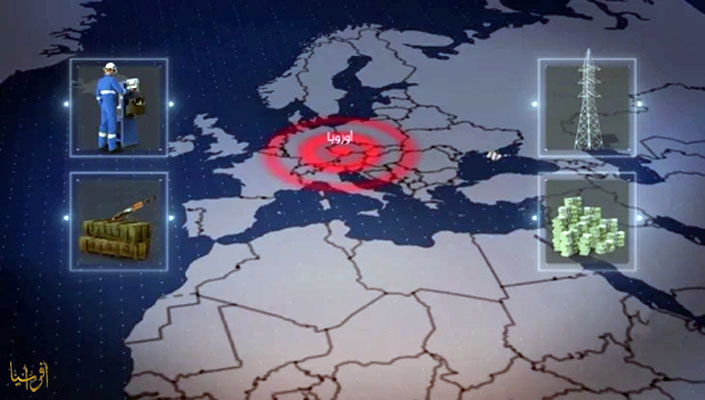
Years later. The Ukraine war bill weighs on the old continent.. This new crisis looks different, as EU leaders prepare to speak directly to Putin.
Afrasianet - The Financial Times publishes an article about the shift in attitudes of Ukraine and European countries towards US President Donald Trump, in light of the escalating differences between Washington and Kyiv over the war with Russia and the decline of US support for Ukraine.
The article highlights Ukrainian President Volodymyr Zelenskyy's gradual abandonment of Trump's policy of appeasement and appeasement, and his move to publicly criticize him, against the backdrop of the reduction of US support, especially satellite services on which Ukraine relies for its military operations.
The following is the text of the article:
The recent crisis in US-Ukraine relations has strong resonances for the darkest days of 2025. The famous televised confrontation from the Oval Office between J.D. Vance, Donald Trump, and Volodymyr Zelensky embodied fears that America was now siding with Russia. These fears came back to the forefront with the Trump-Putin summit in Alaska.
European leaders have responded to these past crises with a relentless policy of co-opting Trump. They embraced Zelensky, offering him advice on how to show gratitude and a conciliatory tone in his dealings with the U.S. president. They also flooded Trump with phone calls and compliments, in an effort to tone down the more hawkish aspects of U.S. policy.
But things look different this time. Zelensky has become much less conservative in his statements about Trump. He has directly accused the United States of restricting satellite services in Ukraine, and has hinted that Trump is attracted to autocrats.
The Ukrainians have also defied a U.S. demand to stop targeting Russian energy facilities. The weekend saw some of the biggest strikes yet on oil facilities in St. Petersburg.
Zelenskyy's outspoken remarks may have been driven largely by anger and resentment. But his change in tone is also likely to have some degree of political calculation.
With Trump's popularity in the polls declining, and Republicans seemingly headed for defeat in the midterm congressional elections, it may be worthwhile to address Americans directly, bypassing the president and his cronies.
Even some Republican candidates have questioned Trump's plan to buy Russian diesel. Polls suggest that Americans do not share Trump's admiration for Vladimir Putin.
There is also an important shift in the European approach to Russia. There is a growing consensus in European capitals that the continent's leaders can no longer accept a situation in which only Americans can speak to Putin.
Channels of communication with the Russians have already been opened, and a phone call between European leaders and Putin is likely to take place soon.
This change in approach reflects a belief that Trump's policy of co-opting is becoming increasingly less effective, especially as the president is preoccupied with the midterm elections and angry at what he sees as a European failure to help him in Iran.
Europeans also fear that U.S. policy is largely driven by a desire to strike trade deals with Russia, rather than a coherent security vision.
The current European approach rests on two main pillars: support for Ukraine and sanctions against Russia.
Both policies are crucial, especially as U.S. support for Ukraine declines. But direct European involvement in peacemaking efforts is also increasingly seen as a necessity, especially since it is European funds that keep Ukraine resilient, after the cessation of U.S. financial aid.
The Europeans seem confident that Putin will be ready for dialogue. But the Russian leader himself is believed to be floating the idea of a trilateral summit with Trump and Chinese President Xi Jinping.
Such a summit would serve Russia's aspirations to emerge as a great power and keep Ukraine and its most important backers out of the negotiating room.
Russia may become increasingly wary of dealing with the Europeans because of the nature of the proposals that can be put to the negotiating table.
If the European talks with Putin take place, or when they do, the Russian leader is likely to be presented with two possible paths to peace.
The first option is to freeze the conflict at the current Line of Control, in exchange for a guarantee that Ukraine will never join NATO.
The second option is for Ukraine to cede the rest of the Donbas region to Russia in exchange for its subsequent accession to NATO.
Some Ukrainians will see both options as treason. But with a strong desire for peace at home, Zelensky may be able to convince his people of either idea.
In contrast, Europeans are far less confident in Putin's willingness to accept either. However, they still see it as important to start talking directly to the Russians.
Beyond rethinking the diplomatic approach, Europeans are also increasingly determined to reduce their dependence on America for critical capabilities, particularly the satellite coverage provided by StarShield and Starlink.
Two Finnish companies, Nokia and Iceye, announced this month a partnership to develop satellite communications networks for military and civilian purposes.
But the first launches are not expected to be carried out before 2028, so this project cannot solve Ukraine's immediate problems.
For now, the Zelensky government continues to rely heavily on U.S. satellite capabilities, both to defend against incoming attacks and to provide the information needed to carry out offensive operations.
In fact, the Ukrainians have not lost hope of convincing the United States to expand satellite assistance, allowing them to target missile launch sites deep inside Russian territory.
The fact that Ukraine is still so dependent on U.S. capabilities may suggest that it is in Zelensky's interest to continue to flatter Trump and Elon Musk to the fullest extent possible, hoping that they will back down and provide Kyiv with the help it needs.
But the Ukrainian leader has instead gone in the opposite direction. He has even discussed the possibility that the United States could directly side with Russia against Ukraine.
"He has become Carney in every sense of the word," said a senior European official, describing Zelenskyy's stance, referring to his approach similar to Canadian Prime Minister Mark Carney's approach to Trump.
This is certainly a risky strategy. But Trump has not left the Ukrainians many better options.
________________

