
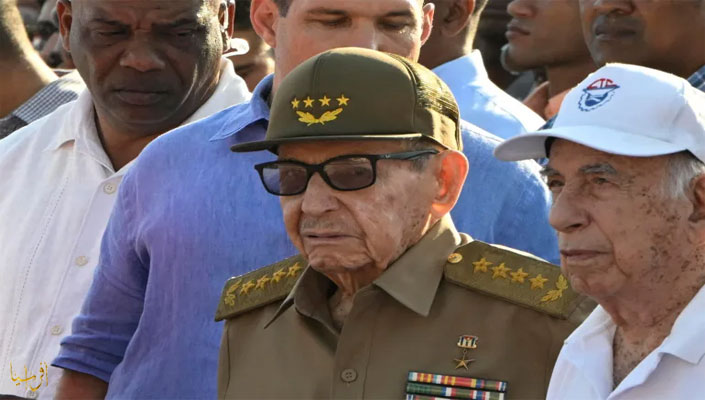
Former Cuban President Raul Castro (center) in his military uniform
Afrasianet - The US state of Florida has issued an arrest warrant for former Cuban President Raul Castro on murder charges, interspersing with a federal indictment previously unsealed in May.
Raul Castro, 95, is being charged with the 1996 downing of two civilian planes belonging to the Rescue Brothers, which helps Cubans flee to the United States by sea.
The younger brother of revolutionary leader Fidel Castro (1926-2016) was serving as defense minister of the socialist Caribbean state when the planes were attacked.
Raúl Castro stepped down as president in 2018, but remains an influential figure in Cuban politics.
The legal move comes as President Donald Trump's administration continues to intensify its economic, political and legal pressure on the Cuban government.
The United States is imposing a de facto blockade on Cuba by threatening sanctions on countries that supply it with fuel, causing power outages on the island. It has also caused a severe crisis in food, fuel and medicine.
Trump had invoked a U.S. indictment to justify a military operation in January in Venezuela that led to the arrest of President Nicolás Maduro , a close ally of Cuban authorities.
For his part, the current Cuban president, Miguel Díaz-Canel, stated that the US federal indictment against Castro "has no legal basis", describing it as an attempt to "justify the folly of launching military aggression against Cuba".
Washington Practices Colonial Policies Against Cuba
UN experts have accused the United States of following "colonial practices" in its dealings with Cuba, considering that attempts to destabilize the island come within a strategy based on "coercion" with the aim of influencing its political system.
In a statement issued in Geneva, the experts explained that the quest to change the constitutional order of a sovereign state through threat and pressure is reminiscent of the colonial era, noting that US President Donald Trump's statements about the "honor of dominating Cuba" reflect a troubling approach that goes beyond political rhetoric.
The UN Human Rights Council-mandated specialists , who do not speak on behalf of the organization, said the policy includes a decades-long embargo, the designation of Cuba as a terrorist list, energy restrictions, and coercive measures that extend to third parties.
The statement noted that these pressures come at a time when Cuba is facing a severe economic crisis that has recently been exacerbated by the tightening of sanctions and the oil embargo, warning that recent US steps, including prosecutions and military escalation in the vicinity of the island, represent a threat to its sovereignty and raise serious concern for regional and international stability.
The experts called on Washington to end any actions affecting Cuba's sovereignty and urged United Nations Member States to take appropriate steps to preserve the international legal order, calling on the Security Council and the General Assembly to consider these developments as a matter affecting international peace and security.
Last week, Cuban Foreign Minister Bruno Rodríguez Parrilla, in a speech to the UN Security Council, appealed to the international community to provide urgent assistance to his country to avert a catastrophe due to the US energy blockade.
U.S. President Donald Trump has publicly hinted at the possibility of controlling Cuba, saying after Washington carried out a military operation in which it captured President Nicolás Maduro in Venezuela that Havana could be his next target.
Late last month, the United States also stepped up its pressure on Cuba through a series of simultaneous steps that included security and political measures, most notably the announcement of the detention of the sister of a prominent Cuban official and Washington's confirmation of its intention to change the regime in Havana.
Cuba appeals to the international community to help it avoid catastrophe due to the US embargo
In a speech to the UN Security Council, Cuban Foreign Minister Bruno Rodríguez Parrilla appealed to the international community to provide urgent assistance to his country to avoid a catastrophe due to the energy blockade imposed by the United States.
"I call on the international community to act to prevent a humanitarian catastrophe that could be imposed through an arms embargo or a fuel embargo," Rodríguez said, adding that "the time has come for solidarity with Cuba."
Because of the U.S. trade embargo imposed after Fidel Castro came to power in 1959, Cubans are living in difficult economic conditions, suffering from shortages of food, medicine and other basic items, and nationwide power cuts are commonplace.
Things got worse when Trump cut off oil supplies from Venezuela, an ally of Havana, after Maduro's ouster.
The Trump administration tightened the noose on Cuba last week by accusing Raúl Castro of shooting down two small U.S. planes in 1996, raising fears that the United States is seeking to fabricate a pretext to overthrow the government in Havana.
The day after the indictment against Castro was announced, Secretary of State Marco Rubio warned Cuba that the United States was too focused on regime change.
On Tuesday, Rodriguez called the indictment politically motivated, denying U.S. claims that Cuba poses a threat to U.S. national security, telling the Security Council that "it's an idea that is contrary to logic and reason. Let Cuba live in peace."
Multi-instrumental escalation. Will Washington's actions lead to an open confrontation with Havana?
The United States has stepped up its pressure on Cuba through a series of simultaneous steps that included security and political measures, most notably the announcement of the detention of the sister of a prominent Cuban official, and Washington's confirmation of its intention to change the regime in Havana following criminal charges against former President Raul Castro, in the context of an unprecedented escalation in years in the tension between the two countries.
U.S. Secretary of State Marco Rubio announced that authorities had detained Addis Lastris Moreira after the State Department revoked her legal status as a permanent resident, explaining that she was "linked to the communist regime in Havana." Moreira is now in the custody of U.S. immigration authorities, in a move that carries political significance beyond her legal dimension.
According to the U.S. State Department, Moreira is the older sister of Anya Guillermina Lastris Moreira, a prominent Cuban military official who was recently sanctioned by the U.S. as the chief executive of the Cuban military-controlled Gaisa conglomerate.
Washington accuses the bloc of running a vast network of financial resources, allowing a limited elite within the regime to plunder economic resources and diverting up to $20 billion into secret offshore accounts.
Simultaneous escalation
The move coincided with a US escalation, as Washington reiterated its determination to change the regime in Cuba, with the US secretary of state calling the Cuban economic system "broken and irreparable under the current political system", accusing the Cuban authorities of relying on buying time for years. He added that this strategy is no longer feasible, stressing that the US is "very serious and very determined" to proceed with its current approach.
Rubio also claimed that Cuba represents a threat to U.S. national security, citing the presence of intelligence and military cooperation with Russia and China on the island, a point Washington uses to bolster the justification for tightening political and economic pressures.
This was preceded by US President Donald Trump's assertion that he can change the regime in Cuba but "wants to help the people because they don't have electricity or food," as he put it.
Military Messages
In parallel with this political escalation, the US military announced the deployment of the aircraft carrier USS Nimitz and its strike group in the Caribbean, in a move that reinforces US deterrence messages in the vicinity of Cuba.
Despite the military deployment, President Donald Trump denied that the goal was to intimidate Havana, stressing that the move was not directly targeting Havana, despite hinting two weeks ago that Cuba was "next after Iran" and saying it would announce its surrender as soon as an aircraft carrier reached its shores.
But this development, in an analytical reading, reflects a combination of psychological and military pressure, part of a broader strategy aimed at weakening the Cuban regime and sending clear signals about the United States' willingness to use multiple tools, from sanctions to military parades.
Castro's indictment is reported to have implications beyond the judicial file, as it points to the possibility of a repeat of previous scenarios, such as Washington's use of indictments against leaders in Latin America to justify political or military moves, as happened with Venezuelan President Nicolás Maduro.
Analysts say these steps could be aimed at creating an all-encompassing pressure environment on the Cuban regime, combining political isolation, economic deprivation and questioning legitimacy, opening the door to internal changes or greater external pressure.
Cuban President Miguel Díaz-Canel has previously called on his people to prepare for any possible U.S. attack, stressing that his country does not want war but is ready for it if it is imposed on it, and accused the United States of pursuing an aggressive policy against Cuba, blaming it for the difficult economic conditions due to the blockade imposed on the country.
Internal crisis
The U.S. escalation coincides with difficult domestic conditions in Cuba, where the country is suffering from a deep economic crisis that includes power cuts for long hours a day, fuel and water shortages, and a sharp rise in prices. The restriction on oil supplies, especially after the decline in Venezuelan subsidies, has also exacerbated the living crisis.
Havana accuses Washington of deepening the suffering of the Cuban people through sanctions and blockades, while citizens see U.S. actions as adding direct pressure on daily life. This reflects a stressful domestic environment that may increase the impact of external pressures, but at the same time may strengthen internal cohesion in the face of any external threat.
The United States has previously imposed sanctions on Cuba 's main intelligence agency and a number of senior leaders and ministers, as Washington has stepped up its pressure on the Caribbean island since January.
The United States has also cut off Cuba's supply of Venezuelan oil , which has been supplying the island with about half of its fuel needs, and Washington has imposed an oil embargo since January on the grounds that Cuba poses an "exceptional threat" to U.S. national security.
Trump began taking drastic measures to prevent oil from reaching the Caribbean island, following the ouster of Venezuelan President Nicolás Maduro on January 3 following a US military operation inside Venezuela that ended in the arrest of Maduro and his wife and their deportation from the country.
Risks of Escalation
Cuba maintains that the downing of the planes in 1996 was "legitimate self-defense," while warning that any military intervention could lead to a full-scale confrontation. Experts point out that the Cuban military, despite its decline compared to the Cold War era, is still able to engage in a protracted defensive confrontation using unconventional tactics.
Overall, the current developments reflect a new phase of tension between Washington and Havana, where legal, political, and military tools intersect within an integrated pressure strategy, amid questions about the limits of escalation and the possibility of it turning into a broader confrontation if there are no diplomatic tracks.
Washington Executions in Pacific and Caribbean
The American threats do not stop at the Cuban issue, but also extend to fishing boats in the Pacific and the Caribbean, claiming that they are boats for smuggling drugs.
Former Colombian President Gustavo Petro has accused the United States of carrying out "executions" over its strikes on boats in the Pacific andCaribbean , which he says are targeting drug traffickers.
Petro said that through these strikes, Washington is carrying out "extrajudicial executions ... in violation of international law," while the Colombian government called on the United States to stop the strikes that killed at least 37 people and destroyed nine boats, according to U.S. figures at the time.
Colombia's stance angered U.S. President Donald Trump , who denounced Petro as a "drug smuggler" and announced the cutting of vital military aid to Bogotá, according to Reuters.
U.S. Secretary of State Marco Rubio also called President Petro "crazy," while Colombia recalled its ambassador from Washington and called for dialogue.
Colombia's ambassador to Washington, Daniel García Pena, denounced Trump's remarks, which he called "unacceptable," saying after his country summoned him for consultations, "under no circumstances can such threats and accusations be justified that are completely baseless."
The Colombian president has announced that he will take legal action in the United States against the US president for defamation after Trump called him a "thug".
Petro said in remarks carried by local media that he would "defend himself legally before the US courts with the help of US lawyers".
The Colombian president said the accusations against him on U.S. soil were "false and fabricated by senior officials."
Colombia recalled its ambassador to the United States after U.S. President Donald Trump decided to halt aid, threatened punitive tariffs on Bogotá, and launched a sharp attack on his Colombian counterpart, Gustavo Petro.
Relations between Washington and Bogotá have been increasingly strained since Trump's return to the White House, with the United States revoking President Petro's visa after he participated in a pro-Palestinian demonstration in New York and called on American soldiers to disobey Trump's orders.
The Colombian president has also blamed his American counterpart for Israel's attacks in Gaza, calling him an accomplice in the genocide in the Strip.
Hundreds killed since U.S. campaign in the Caribbean began
Since early September, the United States has been conducting regular airstrikes in the Caribbean against boats it claims belong to drug trafficking cartels.
President Donald Trump's administration also announced the destruction of 18 boats, without providing evidence of links between the crews of these boats and drug trafficking.
"To all the drug terrorists who threaten our country: If you want to survive, stop smuggling drugs. If you continue to smuggle deadly drugs, we will kill you," Hegseth wrote on the X platform.
Experts question the legality of the strikes
Experts question the legality of these operations against suspects who have not been intercepted or questioned, but the US president justifies these actions by claiming that they are part of a war against gangs designated as "terrorist".
Trump specifically accused Venezuelan President Nicolás Maduro of belonging to one of these drug cartels, but the latter denied this and denounced U.S. attempts to destabilize his country.
The United States has deployed eight warships and an aircraft carrier to the Caribbean and has sent F-35 fighter jets to Puerto Rico.
From Venezuela to Cuba and Nicaragua. Washington Expands Its Ambitions in Latin America
The confrontation between the United States and the Latin American trio of anti-influence Venezuela, Cuba and Nicaragua, is heading for a new phase, as Washington has moved from a traditional policy of containment to more severe tools that combine political pressure, economic sanctions and military messages.
These three countries stand out at the heart of US President Donald Trump's strategy towards the region, which is based on re-establishing American influence in the Western Hemisphere and preventing the expansion of Washington's adversaries, especially China and Russia, near its southern border.
Venezuela was the most confrontational example of this policy, after witnessing a US military operation targeting President Nicolás Maduro, which ended in his arrest and transfer to the United States, in a move that reflected Washington's willingness to use unprecedented tools against its adversaries in the region.
Cuba is a model of long-term economic pressure, with Washington relying on tightening sanctions and shrinking energy sources to increase pressure on the Cuban government in an attempt to push it to change its domestic and foreign policies.
Nicaragua comes in third place in this track, after the government of President Daniel Ortega entered the circle of US escalation after he announced that he would not proceed with organizing new elections, prompting Washington to threaten to isolate his government and intensify pressure on it.
U.S. Secretary of State Marco Rubio said the United States "will not stand idly by" in what he called escalating repression and instability in Nicaragua, while U.S. officials said Ortega's government posed a challenge to U.S. security interests in the region.
Washington ties the three countries to a single political position based on rejecting U.S. hegemony and strengthening ties with their international adversaries, with Venezuela, Cuba and Nicaragua maintaining close ties with Russia and China, making them part of a broader power struggle.
The administration of US President Donald Trump is based on what is known as the "Monroe Doctrine", which sees Latin America as a vital area for the United States, a concept that Trump has revived as part of his vision to strengthen American influence in the region.
Despite the different situations of the three countries, Washington treats them as interconnected links in a single challenge: Venezuela has huge oil wealth, Cuba enjoys a strategic location close to the U.S. coast, and Nicaragua is important because of its location in Central America and its proximity to trade routes and sea lanes.
The United States uses a wide range of tools against these governments, from financial and economic sanctions, to trade and diplomatic restrictions, to security and military pressure in the case of Venezuela.
In return, these countries are betting on the support of Moscow and Beijing to mitigate the impact of American pressures, as China provides investments and markets, while Russia provides political and security support, but American influence remains stronger by virtue of their geographical location and economic connection to the United States.
Observers believe that Washington is not necessarily inclined to repeat Venezuela's scenario with Cuba and Nicaragua, but rather relies on a policy of gradual escalation aimed at increasing the cost of the three governments continuing to challenge American influence.
Latin America is becoming a new testing ground between Washington and its adversaries, as the United States seeks to consolidate its regional influence, while Venezuela, Cuba, and Nicaragua try to maintain their alliances with Russia and China and resist mounting pressure.
________________
Source: U.S. Agencies + Press

