
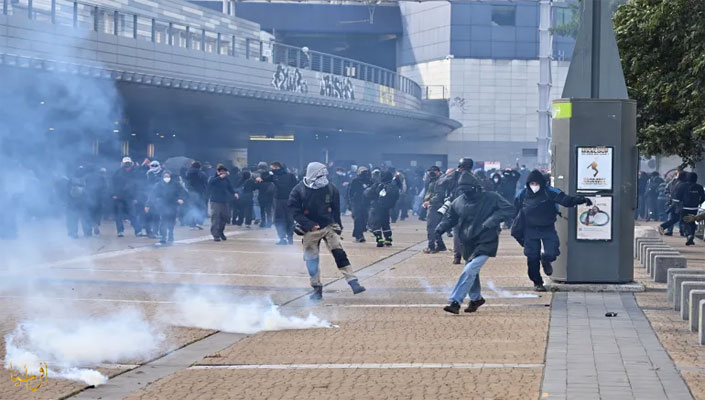
Hundreds of young people protest education reforms and budget cuts in Brussels, Belgium (Anadolu Agency)
Afrasianet - The wave of protests is escalating in a number of European countries, amid popular anger fueled by the crises of the cost of living and housing and the decline in public services, while some demonstrations have turned into violent confrontations, acts of vandalism and looting, putting governments in front of a complex security, political and social test.
While the protesters' demands focus on improving living conditions, education, and affordable housing, governments and political forces have different readings of the causes and responsibility for the unrest, in a scene monitored by the international press from multiple angles.
France is at the forefront of the scene, with protests spilling over from student demands related to school conditions to a wider movement against rising prices and declining purchasing power.
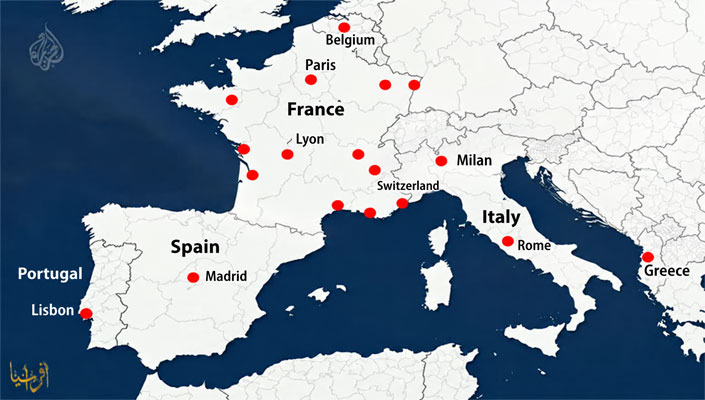
Map showing some of the areas that witnessed protests on Saturday, October 17, 2026 (Al Jazeera)
In parallel, Italy and Albania have clashed with police, while an estimated tens of thousands of demonstrators marched to protest the cost-of-living crisis, low wages, and the difficulty of obtaining housing in Portugal's major cities, amid fears of widespread unrest and its political and security repercussions.
France. Protests and Failures
The French newspaper Libération highlighted what it described as a failure to manage the October 17 protests, noting that the turnout exceeded the authorities' expectations, with estimates ranging from 500,000 to 800,000 demonstrators across the country.
Although the majority of participants marched peacefully, several cities saw looting, vandalism and arson, sparking criticism about police deployment plans and their ability to contain the events.
The newspaper addressed four main axes to understand what happened, including the appropriateness of the route of the march in Paris, the early use of tear gas, the adequacy of the number of security forces, and the identity of the groups that participated in the violence.
It also quoted criticism from demonstrators and police specialists about the way crowds were handled, while union officials defended security interventions, arguing that sporadic groups of saboteurs took advantage of peaceful gatherings to carry out their actions.
President Emmanuel Macron called for lessons to be learned from the events in the areas of intelligence and preparedness, while the authorities pledged clear responses to possible shortcomings.
Thus, the debate is no longer limited to the causes of the protests, but has extended to the methods of maintaining order, the limits of the use of force, and responsibility for the escalation of the confrontations.
The British newspaper The Independent focused on the roots of the movement, explaining that the protests began last September against the backdrop of a lack of resources in schools, before spreading to segments angry over the rising cost of living and the decline in social services.
She also pointed out that the crisis has entered into political calculations with the approach of the French presidential elections scheduled for 2027, and parties from the extreme right and the populist left have benefited from the escalation of popular discontent.
In a broader reading, the British newspaper iPaper warned that scenes of violence in France reveal the repercussions of political polarization and declining purchasing power, considering that the crisis bears indicators worth watching in Britain and other European countries.
The newspaper linked popular anger to rising food, rents and energy prices, along with pressures on public services, warning that the continuation of these crises could give populist forces more space in the political scene.
Italy and Portugal
In Italy, the British newspaper The Guardian monitored a march in Milan that began peacefully turning into confrontations between protesters and police, after masked men threw stones, cut sidewalks and set fire to makeshift barricades.
Police used water cannons and tear gas to disperse the crowds, amid reports that two policemen were injured and about 50 demonstrators were detained.
Prime Minister Giorgia Meloni condemned the violence, stressing that the right to protest does not justify burning down cities or attacking security forces. The mayor of Milan acknowledged that the motives for the protest were understandable, but refused to justify the attacks and damage to the city.
In Portugal, anger has taken a different course, with protesters setting up tents in central Lisbon's Rossio Square to demand measures to curb rising rents and the cost of living.
The move was an extension of housing protests that began in Porto, coinciding with rallies by thousands of people demanding better wages, pensions and public services, AFP reported.
The Guardian and AFP noted that house prices in Portugal rose by 124% between 2015 and 2024, according to official data, adding to pressure on young people and low-income families, particularly in Lisbon.
The protesters' testimonies reflected a sense that access to housing is becoming increasingly challenging, even for workers who contribute to the economy through taxes.
A comparison between the two countries reveals a difference in the nature of the movements: in Milan, security confrontations overshadowed the scene, while in Lisbon, protests related to housing and affordability emerged in Lisbon.
Albania. A crisis that goes beyond living demands
In Albania, the French newspaper Le Figaro focused on the escalating anger against Prime Minister Edi Rama, as student- and youth-led protests continued and expanded outside the capital, Tirana.
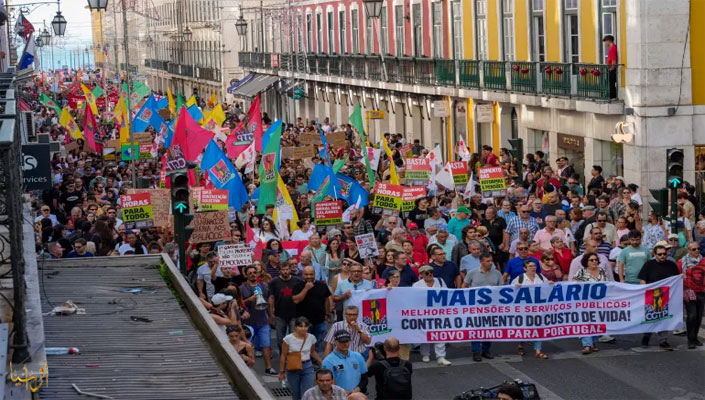
Portuguese protesters hold banners and flags at a demonstration demanding higher wages (Getty)
The demands were no longer limited to issues of education and corruption, but included rising rents, tuition costs, and declining chances of survival in the country for young people.
The newspaper reported on the clashes between protesters and police, who used tear gas, water cannons and rubber bullets, as protesters threw stones, fireworks and petrobombs.
It also quoted demonstrators criticizing the government over corruption and lack of economic prospects, while Rama refused to resign and accused outside parties of seeking to block his country's path to joining the European Union.
The Albanian protests are also linked to months of protests over a controversial tourism project, before overlapping with broader political and social demands, suggesting that anger in Albania is not only related to the cost of living, but also to trust in institutions, corruption and the future of young people.
Belgium and the Riot
In Belgium, fears of widespread violence have taken an institutional turn, with the Belgian newspaper The Brussels Times reporting that the Ministries of Defence and Interior are discussing the creation of a reserve of military-trained police officers who could be deployed in the event of a major riot.
Defence Minister Theo Franken said he wanted to create what he described as a "modern gendarmerie" force, under the authority of the interior minister, with the aim of bolstering the security response when violence exceeds the capacity of the usual agencies to deal with them.
The office of the Minister of the Interior, Bernard Quentin, confirmed discussions to strengthen cooperation between the police and the defence, including the protection of specific sites and the implementation of joint patrols.
The move reflects a trend toward reassessing security preparedness in the face of unrest, but it also opens a debate about what role the military should play in supporting the police during protests.
Multiple causes and common challenges
Despite the differences in national contexts, these press reports reveal commonalities between the waves of protest, most notably the living pressures, the housing crisis, fears of declining public services, and the widening gap between the protesters' demands and the responses of governments.
In France, educational and social demands are intertwined with political polarization, the housing crisis in Portugal is highlighted, the protests in Albania are taking on dimensions related to corruption and the future of governance, and in Belgium there are growing fears of security repercussions.
As governments seek to contain the protests and hold those involved in the violence accountable, the broader challenge remains to deal with the causes of the anger themselves, not just its manifestations in the streets.
Continued economic pressures and declining political confidence could prolong tensions, while the ability of governments to combine responding to legitimate demands with protecting public security will remain a critical factor in the course of the European crisis.
Guardian: That's why people across Europe are protesting
The Guardian newspaper tried to provide an explanation for these movements, which are led by large segments of the youth, pointing to the deterioration of educational conditions, the rising cost of living, and the housing crisis that has become a burden on families, especially those with limited incomes.
The moves reveal the intersection of social and economic crises with political tensions, at a time when governments are facing growing demands for reform and pressure to take urgent action to contain public anger.
Taken together, these moves reflect widespread dissatisfaction with the economic situation and public services, with no clear indications that they are coming to an end, and the possibility that they will continue unless government promises are translated into concrete solutions.
European governments face the dual challenge of responding to social demands and maintaining public order: in France, the authorities are hardening in the face of protests, while the upcoming Spanish elections may determine the fate of housing reforms.
________________
Source: iPepper + Guardian + Lofigaro + Liberation

