
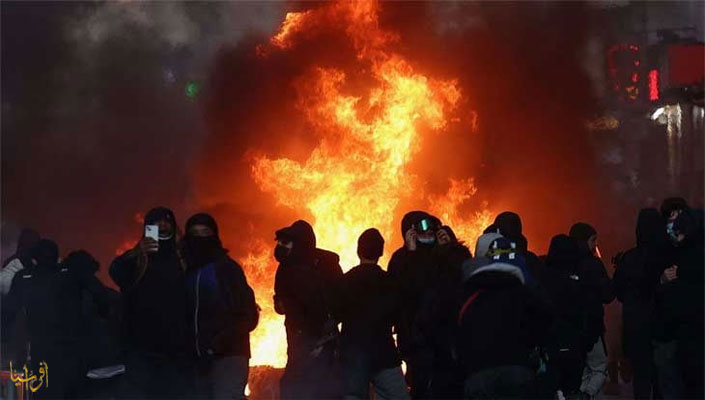
Why Are the French Protesting?
Afrasianet - The Guardian published an editorial stating that student protests in France have triggered profound polarization at a dangerous political juncture. The newspaper recalled what President Emmanuel Macron wrote in his book Revolution, published in 2017 before his presidential victory, where he promised to restore hope to a country losing faith in its future.
As his second term nears its end, France is witnessing an atmosphere akin to rebellion, marked by torched public buildings and looted shops—a scene that, according to the newspaper, exposes the failure of Macron's political project. The worst urban violence in years has overshadowed weekend protests, severely undermining what remains of the French president's authority.
With police losing control of the streets, over 2,000 stores were looted. Far-left groups targeted town halls and local facilities, clashing violently with police whose harsh response to high school student protests last week only escalated tensions.
The newspaper noted Macron's condemnation of the violence and how far-right leader Marine Le Pen is exploiting public discontent to position herself as the champion of law and order. However, the paper argues that the shocking actions of a minority should not overshadow the significance of the massive peaceful demonstrations sweeping France. Calls to unite student protests and the "Yellow Vests" movement—which disrupted Macron's first term over cost-of-living issues—have mobilized up to 800,000 people.
The root cause of the unrest, the paper suggests, lies in the widespread feeling that France's social contract has collapsed. Young people are disillusioned with an underfunded and unequal educational system, and they fear the future impacts of artificial intelligence and the climate crisis. Much like the rest of Europe, they have lost faith in traditional politicians' ability to find solutions. The scale of the weekend protests revealed a blend of millennial frustration and discontent among residents of marginalized cities and suburbs that have suffered repeated economic shocks since the COVID-19 pandemic.
Macron’s reaction—described by the paper as foolish and stubborn—was to stick to an expenditure-cutting plan to reduce France's public debt in an attempt to appease financial markets. Yet, at a time when the wealthy continue to make gains and thrive, claiming there is no alternative to cutting spending on schools and healthcare is unconvincing. Economist Thomas Piketty pointed out during last student protests that the growth of private wealth means that, despite public debt, "France has never been richer than it is now."
Macron's reckless decision to call a snap election in 2024, which cost him his majority, diminished his political standing. But his bigger mistake later, according to the paper, was his arrogant insistence on economic austerity policies despite clear evidence of worsening political polarization and rising public anger. With each passing week, the social fallout grows more dangerous, just six months ahead of the presidential election. The latest polls show the far-right widening its lead ahead of the vote.
Meanwhile, hard-left leader Jean-Luc Mélenchon continues to outpace his progressive rivals, though figures indicate he would lose by a large margin to Le Pen in a runoff. In an increasingly tense atmosphere, France is heading toward a decisive showdown in May. Disturbingly, the weekend civil unrest may be merely a harbigan of what is to come.
Similarly, The New York Times stated that Macron might ultimately get his "revolution," but not the one he intended, adding that Le Pen appears poised to win the French presidency for the first time. The paper noted that the government's failure to anticipate the student uprising has drawn criticism across the political spectrum.
"Macron's reckless decision to call a snap election in 2024, which cost him his majority, diminished his political standing. But his bigger mistake later, according to the paper, was his arrogant insistence on economic austerity policies despite clear evidence of worsening political polarization and rising public anger."
________________
Even before the outbreak of violence, Macron's approval rating was abysmally low at just 15%, and it is hard to see it falling much further. The current situation differs vastly from 2017, when Macron took office at 39 as a confident young leader promising sweeping economic reforms to rescue France from economic stagnation and the rise of the far-right—and above all, from the prevalent feeling that France was no longer a cohesive society.
Macron promised to unite a deeply divided nation and ensure French voters had "no reason to vote for extremism again." He ran on a free-market platform to facilitate corporate investment and lower business costs to generate jobs and economic growth, thereby winning back far-right voters.
However, over the past nine years, Macron has slashed corporate taxes and payroll taxes while abolishing the wealth tax. These measures failed to meaningfully boost economic growth or curb France's soaring debt, which is now widely viewed as unsustainable. Next year, French taxpayers may spend more on public debt servicing than on defense and education. A widespread sense of structural crisis and social injustice now prevails.
While many of these problems predated Macron, they have been exacerbated by events beyond his control, such as the pandemic. Under these conditions, the weekend protests escalated into the worst riots the country has seen in years.
The massive protests organized by students and trade unions show that nearly a decade of Macron's rule has failed to solve France's problems. The resulting violence and looting may drive some voters toward Le Pen, whom Macron vowed to block from the presidency. This means his legacy may differ from what he envisioned, and his political fate—much like Barack Obama's—will be shaped by his successor in the Élysée Palace.
The Financial Times commented on the French protests, viewing them as an expression of the failure of the entire political class. It noted that even for a country long inspired by mass protest, the violent riots and looting over the weekend were shocking.
The paper argued that the erosion of Macron's authority is now starkly visible in the ruins of the 19th-century Limoges town hall after angry crowds set it ablaze. While blaming far-left extremists and criminal elements for hijacking largely peaceful protests over declining living standards and deteriorating public services, the paper stressed that the government bears immense responsibility due to police intelligence failures and its mishandling of public disorder. On Monday, Macron refused to accept the resignation of Interior Minister Laurent Nuñez, a former senior Paris police official, even though ministers have resigned for less in the past.
The Financial Times warns that the wave of street violence paints a picture of a government that has lost control, undermining public trust in state authorities, shaking business confidence, and tarnishing France's international reputation with severe consequences for its vital tourism sector.
With little time left before next spring's election, the president and his prime minister must at least maintain national security. One reason the government struggled to contain high school protests—which now threaten to spread—is its lack of the financial resources traditionally used to pacify social grievances. Macron poured roughly 11 billion euros into aid to calm the Yellow Vests between 2018 and 2019, but today the treasury is entirely empty, meaning any spending-led exit strategy risks triggering a sell-off in bonds and soaring borrowing costs.
With six months until the presidential election, recent violent clashes have empowered political extremism while weakening the center. For Le Pen, the government's loss of control is a priceless asset, with her party blaming immigration for the violence and revealing its worst tendencies.
Conversely, hard-left leader Jean-Luc Mélenchon has encouraged and exploited the protests to boost his anti-establishment profile, though weekend rioting could hurt his recent polling surge. Meanwhile, center-right leader Édouard Philippe bears the fallout of his association with a weak government, struggling to chart a convincing new path. Ultimately, widespread grievances and tense atmospheres reveal the depth of France's social problems—none of which any candidate currently knows how to genuinely solve.
Why Are the French Protesting?
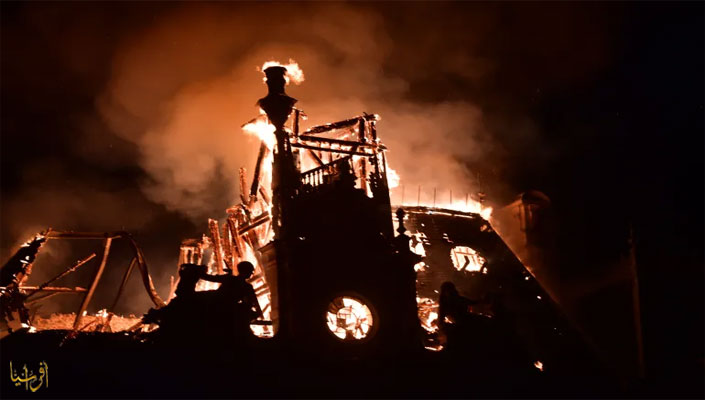
Fire in an administrative building in Limoges, France (French)
By Dr. Mada Al-Fateh: If you have the luxury of open borders and travel to Paris by long-distance bus from another European country, you will be surprised by how dismal the international bus station is. It lacks staff and basic amenities. If you need a restroom after a long journey, you will find it missing or out of order, which explains the foul smell greeting your first steps.
This smell accompanies you toward the metro. Paris metro stations, serving as homeless shelters by night, are mostly old—especially those in the heart of the capital—lacking even simple escalators, making access with heavy luggage difficult. Piles of garbage, the homeless, and environmental degradation reflect low government spending across multiple facilities, explaining slow bureaucratic transactions and the failure to properly house refugees.
I wanted to start with this to give readers context, as many view French protests as mindless chaos or assume the land of freedom, the Eiffel Tower, and the Champs-Élysées has nothing to trigger anger, expecting "spoiled" French citizens to be grateful.
"The danger is that this type of popular anger cannot be contained by the democratic game; rather, it is primarily anger against a political game that offers nothing but new names from the exact same old club."
________________
In reality, most people preferred to patience, blaming the government or president. Lately, however, patience has worn thin. It is no longer just about low government spending, rising prices, or stagnant wages; it is an unbearable squeeze on ordinary citizens making up the majority of French society, whose ambition is no longer buying a home or a luxury vacation, but simply living with dignity.
Consequently, the public periodically resorts to protests to tell politicians that the situation is no longer tolerable. The president and government's dismissal of these voices—trying to distract people with side issues like immigration and the hijab—drove protests to take on the powerful character witnessed on Saturday, October 17th, marking a milestone of public rejection of the political and social reality.
Organizers intended this mobilization to deliver a message too loud to ignore, pushing decision-makers to seriously seek solutions just months before the election. Expressing anger now carried a powerful message: the distress goes beyond the current president and government to the system itself. Hundreds of thousands who occupied streets and vandalized symbolic buildings meant to show their problem is with the system, not just a reshuffling of governmental names.
The protests were led by high school students whose schools lacked winter heating, summer cooling, and adequate teachers. By midday, these angry protests expanded to include parents, labor unions, and leftist parties, reviving the Yellow Vests.
While the left-wing La France Insoumise (Unbowed France) condemned the violence, it argued media coverage ignored police brutality, such as a protestor losing an eye. Eyewitnesses support this, noting that excessive force and tear gas were deployed before protests turned violent, seemingly to scare participants—though it only fueled their resolve.
Reading the scene reveals multiple "Frances": on one hand, the political and economic elite, unaffected by inflation or fuel prices, who panic over security disruptions and push for harsher police crackdowns. On the other hand, ordinary French citizens who have lost hope in a better future, approaching zero-sum choices with nothing left to lose.
Politically, opportunistic rivals seek to exploit the events: the far-left poses as the champion of the people, while the far-right blames immigration, highlighting participants of Arab or African origin—echoed by figures like Donald Trump urging France to close its borders.
European Protests: The Crisis of Trust Between Peoples and Authority
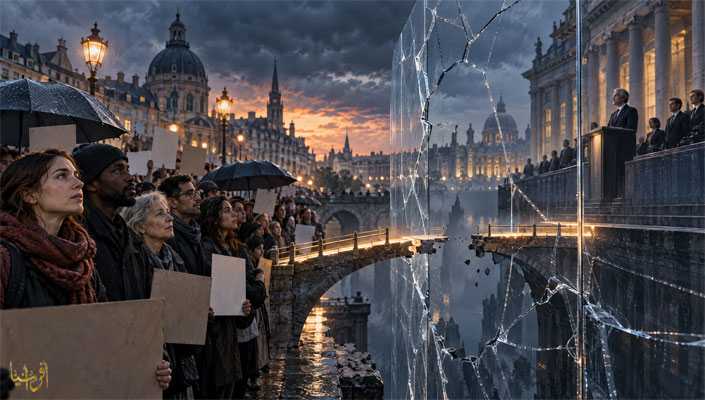
By Dr. Hussein Majdoubi: European nations, particularly France, are experiencing social protests against the ruling class, spanning from heads of state to municipal councils. These protests extend to Belgium and Italy, threatening to spill into Britain and Germany. Historically, such protests signal a major political uprising aimed at returning state institutions to track after falling at the mercy of transnational corporations.
Beginning in mid-September in France, protests started with high school students decrying poor public education—teacher shortages, overcrowded classrooms, deteriorating schools, and long hours—as well as the opaque "Parcoursup" university admission system.
"A specialized political elite has emerged, carving careers in ministries and public institutions, making decisions that do not necessarily serve the public while living a life of luxury."
________________
Quickly expanding, the protests tapped into broader social discontent over declining purchasing power, lower wages, expensive housing and energy, deteriorating public services, and austerity. Trade unions, workers, farmers, and Yellow Vests joined in.
In Italy, a general strike is planned for next month, while Belgium faces cuts to education, health, and social welfare alongside rising university fees. Spain sees sit-ins in Madrid demanding housing and anti-monopoly measures ahead of a November general strike.
Overall, protests are expected to spread across Europe, ushering in a new political and social spring. Emmanuel Todd’s book Where Did the World Go Wrong? (Defeat of the West) anticipated these uprisings. Looking beyond institutional analysis to social media provides a deeper look into protestors' grievances:
Growing Gap Between Political Class and the People: A profound disconnect exists between professional political elites living in luxury and ordinary citizens facing soaring grocery costs.
Domination of Transnational Corporations: Citizens, especially youth, reject the overt and covert influence of multinational corporations over elections and economic policy while enjoying tax exemptions.
Rejection of Involvement in the Russia-Ukraine War: Segments of European societies oppose funding the war in Ukraine, arguing military spending drains critical social sectors like education and healthcare.
Loss of Faith in Europe's Future: Youth feel political leaders are incompetent and corrupt, failing to compete with China and the US, viewing the EU as a bureaucratic entity operating against public interests.
While violence is unacceptable, history shows deep reforms are often accompanied by severe protests born of marginalization. Ultimately, these protests reflect a deep erosion of trust between citizens and authorities across Europe.
________________

