
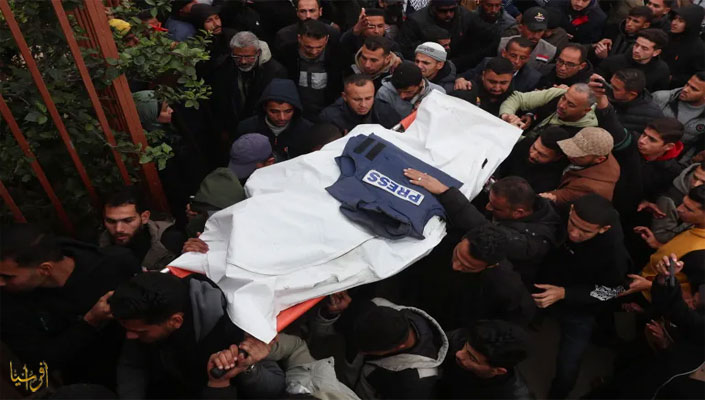
The funeral procession of one of the Palestinian journalists killed in an Israeli airstrike in Khan Younis, southern Gaza Strip (Reuters)
Afrasianet - Hassan Khader - The war on the truth does not end with the killing of the journalist who conveys it; it may continue through the destruction of their office, the severing of their connection to the world, the questioning of their testimony, and subsequently the presentation of a narrative that justifies what they were subjected to. Through this perspective, Francesca Albanese, the United Nations Special Rapporteur on the human rights situation in the Palestinian territories occupied since 1967, interprets the relationship between the targeting of the press and the Israeli war on Gaza, placing the practices of media institutions and digital platforms within the circle of accountability.
In her report titled "Truth Under Rubble: The Media in the Time of Genocide," submitted to the United Nations General Assembly via a memorandum dated July 21, 2026, Albanese utilizes the concept of "media ideocide" (or "ideicide in the media") to describe the systematic destruction of the public role of journalism—from the removal of witnesses and documentation tools to the dissemination of narratives that obscure atrocities or legitimize them.
The document is based on primary and general sources, consultations with survivors and experts, and 89 written submissions, 62 of which addressed media environments in Europe, North America, and Australia. It examined the coverage of 12 influential media institutions, stating that only three of them responded to requests for comment.
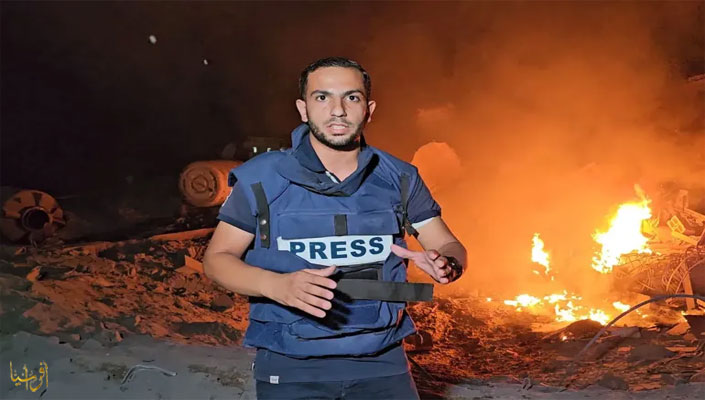
May God have mercy on the late Al Jazeera correspondent in the Gaza Strip, Anas Al-Sharif.
Silencing the Witness and Destroying Their Tools
According to data compiled by the report, Israeli forces have killed nearly 300 journalists and media workers since October 2023, including around 70 who were killed in retaliation for their work, and injured over 400 others. The document uses the term "journalists" broadly to encompass those working in the media field.
Albanese notes that many of the victims were wearing press vests and helmets, or operating inside vehicles and tents marked with distinctive press insignias. She argues that the means of identification meant to help protect them did not prevent their targeting.
The assault extends, according to the report, to the familial and professional circle, noting the killing of nearly 710 relatives of journalists and the destruction of over 150 of their homes. It highlights the experience of Al Jazeera correspondent Wael Al-Dahdouh—who lost his wife, several of his children, and family members, and subsequently lost his journalist son Hamza—as one of the cases revealing the vast personal toll of journalistic work.
In parallel, the report documents the destruction of 150 offices and media institutions up to October 2025, alongside frequent communication blackouts that hindered the gathering, verification, and dissemination of information. In Albanese’s view, the loss of a camera, office, and communication network undermines the capacity to prove what is happening, alongside silencing those who convey it.
Accusations Paving the Way for Targeting
The report links these attacks to smear campaigns against Palestinian journalists, drawing on reports of an Israeli military unit known as the "Legitimacy-Building Cell," which worked to portray journalists in Gaza as operatives within Hamas.
Albanese states that these narratives are used to intimidate journalists, create a climate conducive to attacks, or justify their killing after the fact. In this context, she highlights the cases of Hossam Shabat and Anas Al-Sharif, who faced accusations prior to being killed.
The document stresses that labeling a journalist a "terrorist" or attributing them to an armed group is insufficient to strip them of civilian protection, and that affiliations, work relationships, and opinions do not equate to direct participation in hostilities.
The Rapporteur argues that the systematic killing of witnesses belonging to a targeted group, coupled with cutting off their communication channels with the world, may constitute evidence of an intent to destroy that group—a legal conclusion put forward by Albanese in her report based on legal precedents, rather than a judicial ruling issued against the entities discussed.
When Censorship Controls What the Public Sees
The report does not separate the targeting of Palestinian journalism from the restrictions imposed on the flow of information inside Israel. It notes that in 2024, military censorship blocked the publication of 1,635 items and deleted parts of 6,265 others, equivalent to roughly 21 interventions per day.
Alongside this, it points to the barring of foreign journalists from independent access to Gaza, the ban on Al Jazeera, and the closure of Palestinian platforms as measures that narrow the space for independent documentation and increase reliance on the military narrative.
It also highlights inflammatory and dehumanizing rhetoric broadcast by Israeli media channels, including Channel 14, holding the authorities responsible for preventing incitement and punishing its perpetrators.
Conversely, the report underscores the role of independent Israeli media outlets, such as Haaretz and +972 Magazine, in exposing facts overlooked by other institutions, distinguishing between different roles within the media landscape itself.
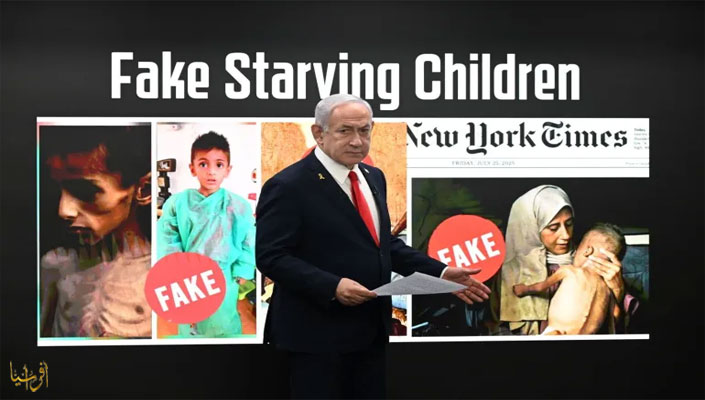
During the press conference, Netanyahu claims that there is no hunger in Gaza and that the scenes from the strip are fabricated
Bias Crafted by Language and Headlines
When addressing Western media, the report shifts from the question of information accessibility to how it is formulated, presented, and how responsibility is assigned for the events covered. It highlights editorial guidelines that it views as marginalizing historical and legal contexts, including leaked directives from The New York Times urging caution in using terms like "genocide" and "occupied territory," and restricting the use of the name "Palestine."
It cites an analysis indicating that references to Israeli responsibility were absent or minimized in 83% of relevant headlines at the BBC and 65% at The New York Times among the materials analyzed.
It also notes that the phrase "human shields" was repeated 176 times in the American newspaper and 81 times by the British broadcaster between October 2023 and August 2025. It suggests that the frequent repetition of this narrative, without sufficient scrutiny, gives Israeli justifications for attacks a presence that outweighs conflicting evidence.
The issue is not limited to vocabulary; the report discusses the disparity in humanizing victims through names, personal stories, and the space dedicated to their suffering. It argues that presenting one side's victims as individuals with lives and families, while reducing the other side's victims to mere numbers, skews the distribution of empathy and the understanding of responsibility.
Erasing Testimony and Marketing Denial
On digital platforms, the report traces the extension of the problem to the accessibility of the Palestinian narrative to the public. Citing leaked data, it notes the deletion or restriction of approximately 38.8 million posts on Facebook and Instagram since late 2023, and a 77% drop in engagement with prominent Palestinian news outlets, according to the cited source.
It reports compliance rates with Israeli removal requests reaching 99.2% on TikTok and 94% on Meta, contrasted with the continued availability of content containing incitement or humiliation of Palestinian detainees.
The report places these practices alongside Israeli advertising contracts approaching $50 million, involving entities such as Google and X, to spread messages denying famine. Albanese argues that platform responsibility extends beyond content moderation to examining the harm resulting from publishing paid propaganda and suppressing documentation.
Correction Equal to the Prominence of the Error
The report concludes with recommendations tying the protection of journalism to the preservation of evidence and the pursuit of justice. It calls for the establishment of an independent international mechanism to gather and preserve evidence of crimes committed against journalists and the media environment, opening Gaza to international media, and releasing arbitrarily detained journalists.
It also recommends that the Prosecutor of the International Criminal Court investigate direct and public incitement to genocide by officials and media figures.
As for media institutions and platforms, the report sets a clear professional standard: verifying claims made by parties to the conflict prior to publication, giving corrections the same prominence as the erroneous information, and halting the arbitrary removal of content documenting potential crimes.
Ultimately, the question the report poses to newsrooms goes beyond the volume of their coverage of the war to the nature of their role in it: do they scrutinize official narratives and preserve the testimony of victims, or do they grant unverified claims the power and credibility of news?
________________
Source: Al Jazeera

