
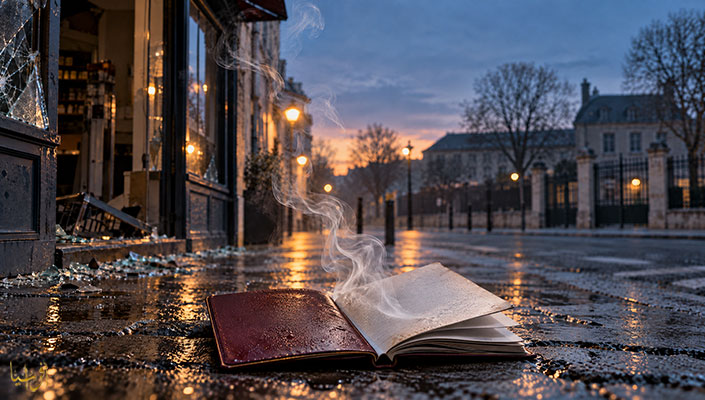
Afrasianet - Maryam Mashtawi - If smoke had a passport, some politicians would have found time to search it before calling the fire department. They would ask him for his full name, his grandfather's country of birth, and perhaps a certificate proving that he did not learn to ignite on the other side of the Mediterranean. As for the fire, wait a minute. The republic is busy determining the origin of the ashes, and this is apparently more urgent than saving the house.
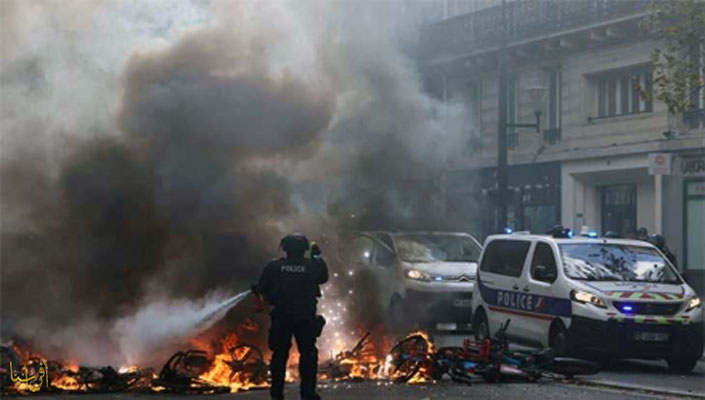
I look at the pictures of France, and I think of this amazing ability to condense an entire country into a strange face. Tired schools, crippling livelihoods, young people taking to the streets, glass facades shattered and shops looted. Between a demand that is raised and a façade that falls, the migrant appears in the speech as if he is the only employee who has not been absent from his job: the head of the disaster department, available around the clock, with no salary and no right to resign.
The protests began with students angry over teacher shortages and poor education facilities, and expanded to demands for public services and living standards. This is a beginning with doors, classrooms, and seats, and can be understood without the help of a genealogy expert. But explaining the teacher shortage requires a review of policies and budgets, while accusing an immigrant only needs a microphone. And microphones, fortunately, It was not covered by austerity measures.
I imagine a student holding a notebook, trying to explain that his future is wet under the roof of the school. Before he can finish his sentence, someone asks him to prove his affiliation. He comes to ask about a teacher, and he brings him before a committee to examine his love for his country. He must first love the pierced ceiling, then thank the rain for his visit, and then his request can be considered, when the weather and electoral conditions improve.
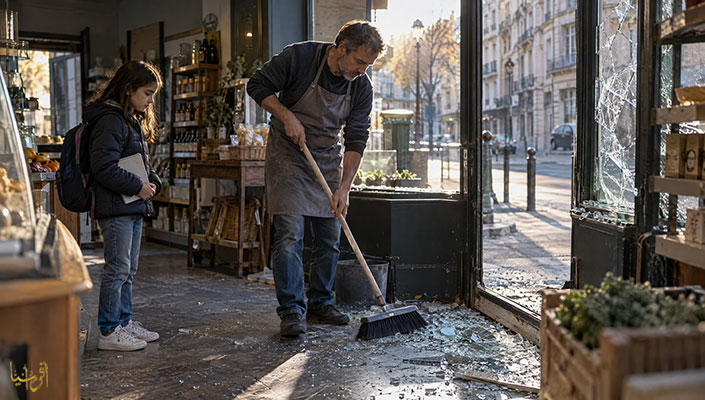
In the photos, too, shopkeepers watch their fatigue scattered. I don't see the looting of a small shop as heroic, nor do I see the theft of jewelry as a program to reform education. Behind every façade are deferred accounts, a loan, and a family waiting for the owner to return in the evening. The thief steals the goods, and then the person who steals the same incident comes along, carries them to the pulpit and sells them as proof of the conviction of people who did not approach the place.
She stopped at the circulating clip of a man trying to break into a store, and what he was messing with falls on him. The narratives accompanying the picture vary between a door and a sign, but the scene carries its paradox: the thing to be broken returns the blow. For a moment, gravity seems more committed to individual responsibility than some of the speeches... It hurt those in front of it, and it did not ask to punish their relatives or the community to which they might belong.
In the market of statements, the distance between a stone and a mass indictment is very short. Jordan Bardella called for a halt to immigration in his commentary on the riots. Border reform becomes an answer to the devastation of the interior, as if the absent teacher is being held at a transit point, as if the high rent arrived in a boat. What a convenient economic recipe: close the door, and the price of bread will go down on its own.
Beyond the Atlantic, Trump has linked the unrest to immigration, too. France no longer needs to listen to its children. There are those who hear their intentions from afar, and know why they are angry before they open their mouths. The student thinks he is protesting his school, and the worker thinks he is talking about his salary. How naïve they are, the person with the diagnosis seems to know more about their stomachs than they do about hunger.
Perhaps the most beautiful thing about a ready-made accused is that it saves the official the hardship of asking. There is no need to know how the anger accumulated, who was left out of opportunities, and who was around The demonstration turns into an opportunity for theft, it is enough to hang the picture of the migrant on the door of the crisis, then everyone can sleep, except for those whose shops have been burned, whose schools have remained cold, and the migrant who has to go to work tomorrow.
Homeland for Conditional Use
I imagine that immigrant the next morning. He folds the news of the accusation into his phone, and goes out to sweep a street where no match has been lit, on the sidewalk is black glass, and at home a child asks him in the evening: Do they hate us? Not knowing how to answer, he arranged the cover over his shoulders, as if the arrangement of the lid could arrange the world, and told him that he had to get up early for school.
This is the space where the outrage doesn't enter: the distance between the father's hand and the edge of the blanket. There, the real bill is paid for the big talk, the generalization doesn't stay in the studio, where the lighting is carefully distributed and the guests drink water. He goes out to the bus, to the work door, to the look of a classmate, a sentence that gives the author a round of applause that might give a child a new reason to hate his name.
In this sense, the migrant has a citizenship that can be morally withdrawn. When he works, pays, and is silent, he is allowed to stand inside the picture, and when a crime is committed by someone who looks like him, he is summoned out of it to apologize. He may be born in the country, and he knows no other country, but his origin remains a bag that others prepare for him whenever they need to send him away, even if only in words.
Investigative reports state that the mass blaming of migrants for the unrest is not supported by available evidence. But the evidence is a heavy guest on the campaign, entering slowly, asking for details, and spoiling the heat of the applause. The suspect is light-hearted, arrives before the investigation, chooses the best seat, and can appear on ten screens at the same time, wearing a carefully ironed garb of truth.
To hold accountable those who burned, stole and assaulted, in their name, deed, and evidence. This is a demand that protects the shopkeeper as well as the protester and the immigrant. Turning crime into an adjective It means that the punishment can reach the cradle before the child reaches the street, which is this justice that finds the accused in the family tree, and leaves the real perpetrator hiding behind a forest of faces?
I think of a shopkeeper who might also be an immigrant. What does he do when he loots his livelihood and then hears that people like him are the cause of the looting? Does he apologize for his broken façade about his assets? Does the request for compensation be accompanied by a confession that acquits and convicts the thief? The black irony here has a reception desk, and the victim has to pull two numbers: one to recover her right, and another to defend her right to be a victim.
Anger is not an open check for sabotage, and fear of vandalism is not a mandate to wipe out human beings. Between the two, there is a life that needs a policy that knows names and details, and accepts that fixing a school is less noisy than accusing a community, but it is more beneficial for the child waiting for lessons. But the school after it has been repaired does not cheer for a leader, and the new blackboard does not give him a television interview. So it may be a little late, until after the speech.
Perhaps the most difficult test for the republic was to look at this worker without asking him for an offer of innocence. To see him only tired, afraid for his wages and his child, neither as a representative of a continent nor a spokesman for a religion. People do not carry their homelands as evidence of crime in their pockets, carrying keys, breadcrumbs, small pictures, and sometimes a prescription for medicine for a distant mother waiting for a call to reassure her that her son is still fine.
At the end of the night, France imagines a woman sitting in front of her damaged house. She reaches for a hot stone, asks who will fix the wall, one preacher comes forward to explain to her the origin of the building, another comes forward to question the loyalty of the neighbors, only a tired worker bends down to pick up the rubble, no one asks him how he feels, they need his hands now. As for his name, they will check it when they are done saving the house.
________________

