
Afrasianet - Abd Al Rahman Maqni - Since the beginning of Operation Al-Aqsa Flood, there has been a lot of talk that it will not be just a military confrontation, but a turning point that could bring about a change in the structure of the existing international system. Martyr Yahya Sinwar expressed this early on when he said that it will be a regional war that will change the "green and the dry." The question today is: Are we really witnessing the features of this change?
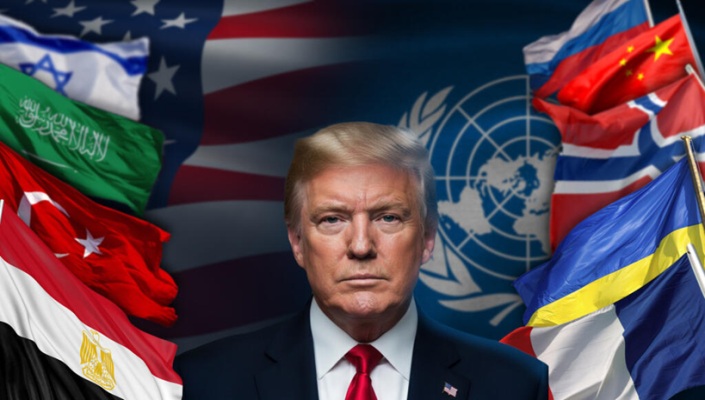
One of the most prominent features of this is the proposal for the so-called "Peace Council" for Gaza, but this council, in essence, is not so much about Gaza as it is an attempt to re-engineer the institutions of the international system, which has become incapable of serving its interests, from the point of view of the American Zionist project.
This council is not based on the principle of international balance, but on the logic of "who is with us", and excludes any party that refuses to comply, even if it is a historical ally. This is where the tension with Europe comes into play.
The Crisis of the Institutions of the Existing International Order
American Zionist circles, especially under the leadership of Benjamin Netanyahu and with the direct support of Donald Trump, have realized that the post-World War II system, from the United Nations to human rights organizations and the International Court of Justice, no longer provides the required political and legal cover.
These institutions are not neutral entities, but rather the product of a specific international order, and when this regime began to show relative bias towards Palestinian rights, or to impose legal restrictions on aggression, it became a burden that must be overcome.
Trump clearly expressed this shift when he acknowledged that "reality has changed," as the majority of countries sought rapprochement with Israel is now politically and morally costly to deal with. In this sense, the international system is no longer comfortable with the Zionist project, which necessitated the search for an alternative.
The Peace Council: A Cover for an Alternative International Order
In this context, the Peace Council has been proposed as a framework for managing the Gaza file, but it is in fact an attempt to establish a parallel international system that empties the Security Council and the United Nations of their powers and shifts the center of the decision to a narrow circle led by Washington, in which political loyalty is conditional rather than adherence to international law.
This Council is not based on the principle of international balance, but on the logic of "who is with us?" It excludes any party that refuses to comply, even if it is a historic ally. This is where the tension with Europe comes into play.
The Zionist project does not forget the opponents, but rather works to gradually weaken them, whether through political pressure, or by pushing for regime change by directed democratic means, or through an alliance with the European extreme right, in clear harmony with Trump's vision.
Europe and the Refusal of Exclusivity
France, as a permanent member of the Security Council, has realized that the Peace Council is not just a political initiative, but a project to exclude it, along with other countries, from its sphere of influence. In the Security Council, European countries have real tools of pressure and powers, while in the proposed Council, the decision will be centralized in the hands of the United States, and behind it the Zionist project.
Therefore, the European reservation was not a technical measure, but rather a political position aware of the danger of the ongoing transformation, especially since Europe has historical experience that makes it capable of reading long-term hegemony projects.
The Logic of Zionist Revenge
In addition to reshaping the institutions of the international system, the American Zionist project is governed by another mentality that is no less dangerous, namely the mentality of deferred political revenge; historical experience shows that any country or regime that obstructs Zionist interests is included in the "record of accounting," even if implementation is delayed until after the end of the war.
In this context, the positions of France, Britain, and other countries in the recent UN sessions will not be forgotten, when they were not fully in harmony with the American position. The Zionist project does not forget the adversaries, but rather works to gradually weaken them, whether through political pressure, or by influencing the domestic scene, or by pushing for regime change through targeted democratic means, or by allying with the European extreme right, in clear harmony with Trump's vision.
While the U.S. Zionist project seeks to impose a unilateral system based on loyalty and revenge, Europe is trying to maintain what is left of the international balance
Targeting and re-engineering arenas
This logic is not limited to Europe, but extends to a wider scope:
• The Arab and Islamic world: Anyone who opposes Zionist interests, even partially, is placed on the deferred targeting list.
• Iran: As the greatest strategic obstacle, attempts to isolate and overthrow continue with it.
• Turkey: Encircle its role through regional arrangements (through Israel, Greece, and Cyprus), and prevent it from becoming an independent regional power after any possible U.S. withdrawal.
• Saudi Arabia: Maintaining the stability of its orbit by depleting its regional surroundings, especially in Yemen.
• Lebanon, Gaza, and Syria: Direct and indirect strikes to weaken the capacity for refusal, particularly Syria for its refusal to coordinate security.
• Southern and Eastern Syria: Long-Term Plans for Geopolitical Redesign.
Alternative Legitimacy to International Law
Within this scene, the Peace Council becomes an implementation tool that gives Washington an alternative legitimacy that goes beyond the Security Council, by bringing together a sufficient number of countries (Arab, Islamic, and European) to create a new political legitimacy, not based on international law, but on the principle of alignment.
That is why Europe has reservations about this Council, as it sees it as a practical abolition of the idea of international balance and the transformation of the world into a unilateral system.
What is happening today is not just a debate over the management of Gaza, but a struggle over the composition of the new international order. While the U.S. Zionist project seeks to impose a unilateral system based on loyalty and revenge, Europe is trying to maintain what is left of the international balance. At the heart of this conflict, Gaza remains, once again, the flashpoint that reveals the reality of a world being reshaped.

