
Afrasianet - Amal Ghandour - You know my routine. I trick myself every Sunday in autumn, winter, and spring. If the sky is clear, I gaze toward the sea of Beirut. And if the horizon is not blanketed in a dark gray hue, I decide the air is clean enough for a brisk walk. Then I set off in a hurry for an hour or so, along that stretch of the Corniche below my home in Clemenceau.
I spy, eavesdrop, and watch as I walk at a brisk pace. I spy on every scene that conjures in my soul a memory worthy of contemplation, and I lend an ear to words that caress my ears or provoke my attention. A couple of Sundays ago, I caught sight of a man floating on the water with effortless ease, stretching his arms and legs wide, near the shore. He was singing at the top of his lungs, as if he wanted to expel from his chest the weariness of the week, or perhaps the weariness of life. And his voice was beautiful. Around him were wastes. And waste is never absent from the coast of Beirut. But he didn't care. I said to myself, "What a scene fit for an Instagram video!" And I went on my way.
There is no romance or creativity in a lifestyle that finds no way to endure except in a state of fragmentation, because it has no other choice. Some see in it a form of stubborn resistance, even if unconventional, or call it by that word whose praise we never cease to hear: "the ability to adapt" and steadfastness.
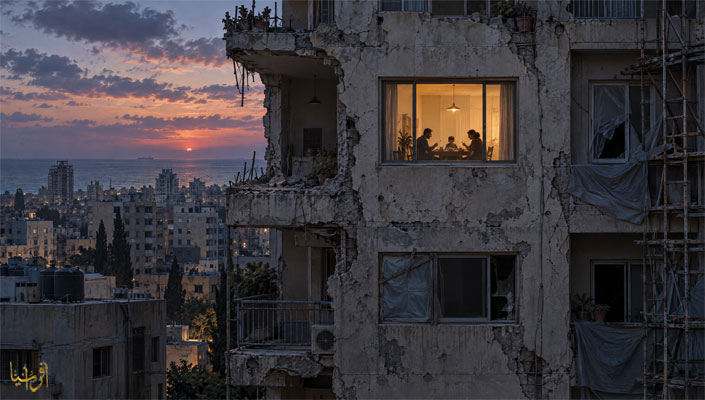
The displaced from the South are no longer here. Either they have returned to their homes, or they have found shelter elsewhere. The International Organization for Migration estimates that about 900,000 people have returned to their neighborhoods, cities, and villages in the Dahiyeh, the Beqaa, and the South, while nearly 330,000 remain stranded on this minuscule patch of God's wide earth.
And I imagine that many of them belong to the villages of the border region whose land Israel has uprooted (stripped of its roots). The uprooting of the land! Selma Dabbagh's definition is so precise that it wraps around the heart like a hangman's noose: "The military deformation of the land with the aim of creating collective wandering." Erasure, in the sense of being removed from existence. There is no close return for these people, or perhaps no return at all?
As for the others who made their way back to what remains of their homes, they may find themselves once again forced to flee toward this urban wilderness, if the war drums we hear are being beaten for the South as well. This, in any case, is what Israel—determined to wage endless wars—tells us. Almost everyone treats Tamir Hayman's assessment of Israel's national security concept after October 7 as if it were truly new.
Yet as I read the document, I was struck by the continuities in Israel's strategy before and after that fateful day. Among them, for example: "Defense is achieved by establishing residential clusters and outposts in all areas of friction with the Arab population, in the West Bank—which they call Judea and Samaria—and in the security zones in Syria, Lebanon, and the Gaza Strip"; and "the rejection of the independent existence of Arab states"; and "consequently, the destabilization of their stability is viewed as a natural path that Israel can manage more effectively than its ability to face strong nation-states; indeed, it must encourage it." But in light of what Gaza and southern Lebanon are subjected to in terms of land uprooting, the description "old and improved" is perhaps the most accurate expression of Israel's national security concept.
The people chatting in the makeshift cafes along the Corniche may not be privy to the terrifying details of these visions presented by experts, but they don't need to be. They know very well what they mean for all of us, stranded on this side of the border with Israel.
And what brings a measure of solace is that these cafes will undoubtedly continue to buzz with life along the Corniche. As will the fishing enthusiasts. As for the badminton players, they will undoubtedly continue to occupy that wide space opposite the mosque, and their loud cries upon defeat and victory will continue to startle young children and amuse the elderly.
And of course, the poor will remain present among these crowds. And so it should be. Fortunately, the open space on the Corniche equalizes people, to some extent. They may be a minority there, but in Lebanon, they constitute the largest segment of the population. The Multidimensional Poverty Index issued by ESCWA in 2021 estimated their proportion at about 82 percent.
That was after everything had collapsed, but before the war with Israel. A figure hard to believe, and some critics even find serious flaws in these numbers. But what does a few percentage points, up or down, change in the grand calculations of Lebanese affairs?
The Multidimensional Poverty Index has no choice but to be stern and unyielding with a country like Lebanon, as long as Lebanon itself shows no mercy to its poor. The index includes health, education, income, work, housing, public utilities, and assets and property. These categories cover almost every tangible standard of a decent life. And they are precisely the areas where the state's performance has unfortunately been disappointing.
Yet Lebanon, as a friend of mine remarked, seems as though it is on stimulants. She meant Beirut. The capital looms so large over the country that we often use the two names as synonyms. And she was not wrong—at least not regarding the Beirut in which we live.
She was not referring to the crowded restaurants and bars or the traffic jam, but rather to the food and art scenes, the lectures, poetry evenings, and plays, and to the cultural atmosphere and creative pulse of the place. Or rather, of this very small space in a country that never stops shrinking. And it occurs to me to add to the list the crowds of strollers, loungers, and runners who throng the Corniche morning and evening.
Does all this have any noticeable impact on a staggering Lebanon? In some parts of it, yes. As for the rest, not at all. You will not find any tangible impact on the national economy, whose meager size did not exceed $35 billion in 2025. For the record, this figure was $55 billion in 2018. Expatriate remittances and the consumption of imported goods are better able to explain the stimulants whose effect we still live on. But apart from statistics—or at least what can be trusted of them—don't we Lebanese remain an enigma difficult to decipher?
We cannot be understood unless we look at the parts of the picture, each separately. And I do not mean sectarian divisions, as some among us love to do. For it is precisely there that we reach the utmost degree of our incomprehensibility; rather, I mean those scattered fragments that gather anyhow, forming countless human islands, or corners and small worlds, or "bubbles" as we usually call them, where each proceeds according to its own rhythm.
Thus, as a Lebanese, I have understood our conditions. But lest there be any confusion, there is no romance or creativity in a lifestyle that finds no way to endure except in a state of fragmentation, because it has no other choice. Some see in it a form of stubborn resistance, even if unconventional, or call it by that word whose praise we never cease to hear: "the ability to adapt" and steadfastness.
An expression that, if it expresses anything, expresses death just as much as it expresses life. The death of politics, for example—that politics capable of launching a wide-scale collective movement and sustaining it. A movement that would uproot this corrupt ruling class, root and branch. Even many of the noble lords of high society have come to agree that this is a necessity if Lebanon is to have a chance. But don't make me say what I didn't say: not through revolution, God forbid!
I wander in my thoughts. And I play with words, too. These are just gossips you hear at dinner tables and on the Corniche. Not without significance, but not new either. We live in perpetual confusion regarding those who control our destinies, and regarding ourselves as well, even though there is no longer truly anything called "we," except in the loss of the single thing we all claim is dear to us.
________________

