
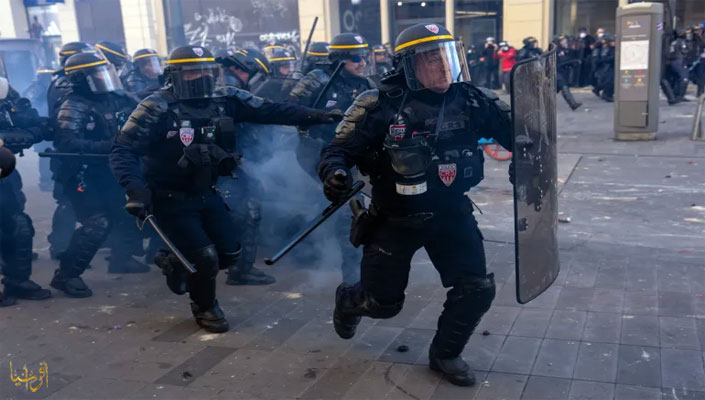
French riot police during the Oct. 17, 2026, protests (Getty Images)
Afrasianet - As France prepares for widespread protests, President Emmanuel Macron appears closer to adopting a security-driven approach rather than political solutions, according to analysts who believe the government is in a position that makes it incapable of handling this crisis.
The French Ministry of the Interior announced the mobilization of 70,000 personnel to secure the country during upcoming demonstrations, which have expanded from high school students' demands to broader vocational concerns regarding soaring prices and living conditions.
These forces will be supported by elite units, helicopters, and armored vehicles. Meanwhile, Interior Minister Laurent Nunez stated that authorities have detected online calls from groups he described as hard-left extremists inciting violence and targeting public buildings, affirming that the response to "riots and looting" will be strict.
In an even more advanced step, the government banned demonstrations in several cities, including Lyon and Marseille. Concurrently, Macron held a meeting with representatives of student organizations who called for continued mobilization after the talks.
A Rare Step
The government also announced the deployment of "Sentinel" force units to carry out "static security duties," which the France 24 news website noted are usually the responsibility of police officers. It described this as "a rare step in the history of the French Fifth Republic, as soldiers are not trained for public order maintenance and crowd control."
This choice serves as a strategic move to back up security forces, but it also carries a political dimension aimed at demonstrating that authorities will rely on a "large-scale" security deployment, according to the French website.
The idea of involving the military had been raised since Monday morning, particularly by former Prime Minister and candidate for the upcoming presidential election, Gabriel Attal.
Attal told Agence France-Presse (AFP) that it is necessary to "free up security forces handling static guard duties, even if it requires replacing them with reserve personnel or even military forces." He clarified that the purpose is "not to task the army with public order maintenance, but to have them replace the police in these duties."
Lack of Competence
This readiness highlights what political science professor Thomas Guénolé described as the French paradox: "While protesting students handle the situation calmly, the government acts childishly, refuses to make any concessions, and responds to people's demands with violence and tear gas canisters," as he phrased it.
What is happening in France today is not unprecedented, Guénolé noted during the Al Jazeera program "Beyond the News" (Ma Wara' al-Khabar). He recalled that in May 1968, the country witnessed student demonstrations that later broadened into popular demands and ended in a general strike, adding that current events are "similar to what happened at that time."
However, the major problem lies in announcing bans on demonstrations in a number of cities—a decision that violates the right to peaceful protest guaranteed by the constitution, according to Guénolé. He argued that these measures are illogical and reflect incompetence rather than a lack of security, because the state can handle hundreds of lawbreakers without depriving thousands of others of their constitutional right to express their opinions.
Jacques Rolland, a senior researcher at the Institute for World Policy, does not disagree with Guénolé regarding the French people's right to protest, and even stresses the necessity of government responsiveness. However, he believes the state is neither in a political nor an economic position to fulfill some of these demands.
The Government Relies on Force
France—as Rolland stated on "Beyond the News"—is suffering from a difficult economic situation, particularly due to unprecedented price hikes resulting from the American war on Iran, and thus will not be able to implement what the protesters are demanding.
Most importantly, in the researcher's view, the government failed to gauge these protests, expecting them to end with the school break. It underestimated the overwhelming anger of the students and failed to handle the situation when confronted with large participant numbers and the joining of other groups and unions. Furthermore, the government may falter in managing the situation in the coming days, according to Rolland, who noted that while Macron holds a parliamentary majority enabling him to impose security measures, the country is heading toward a presidential election, making many reject these measures—which may only serve to fuel an anger of unknown magnitude.
Meanwhile, Hosni Abidi, a professor of international relations, believes Macron is not in a position to offer concessions to protesters as he previously did with the Yellow Vests movement in 2018, due to severe national debt, high interest rates, and the impending elections.
Right-wing parties, led by Marine Le Pen’s National Rally, are calling for what they term the "restoration of the state"—meaning the use of more force against demonstrations, leaning heavier on a security approach, and potentially abusing that power. This has already manifested in recent days, prompting seven leftist parties to resort to the judiciary to overturn the demonstration ban, Abidi notes.
These parties hold no solutions to the crisis, much like Macron, whose grip on the situation has slipped, according to Abidi. He described the meetings held by the president with students as "routine given the scale of the crisis," indicating that he will continue down the security path.
Considering this heavy-handed reliance on security solutions, lowering the age of criminal responsibility to 16, and arresting large numbers of minors, France risks losing some of its achievements in the realm of human rights, Abidi concluded.
The crisis began with a protest organized by high school students in mid-September in the Créteil suburb southeast of Paris, then spread to other schools before expanding to major cities, resulting in clashes, acts of violence, looting, and the closure of hundreds of schools.
Later, various groups and trade unions joined the protest wave, which reached its peak on the 17th of this month amid widespread looting and arson in Paris, Marseille, Lyon, and other cities. This prompted authorities to ban demonstrations and impose curfews in certain areas concurrently with scheduled protests.
________________
Source: Al Jazeera

