
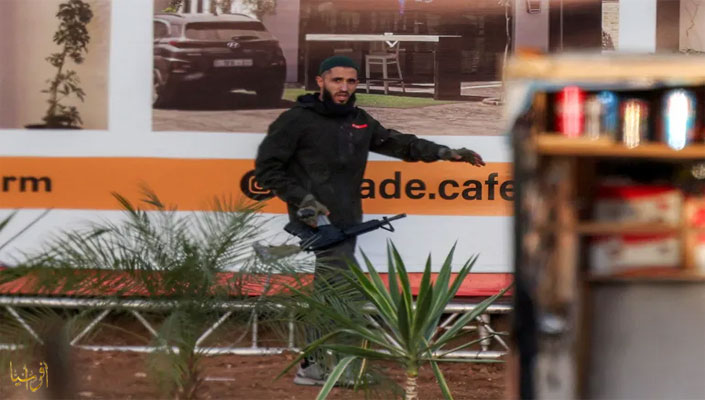
One of the perpetrators of the Hebron attack on Friday morning
Afrasianet - Mazen Al Najjar - For decades, an election campaign in Israel may not pass without the ruling coalition strengthening its credentials for the voters of its settler community, through more violence, repression and genocide against the Palestinian people, as this is the shortest way to the hearts and minds of frightened settlers who are living in the 80-year complex, the obsession with the end of the entity and the destruction of the Third Temple.
When the ruling coalition represents the most fascist, racist and extremist right-wing tendencies in the world, and is willing to practice ethnic cleansing and extermination to the last Palestinian on its land, it becomes even more dangerous, as is reflected in Bezalel Smotrich's vision, that the Palestinian has no choice but to "be enslaved, displaced or killed." This triad is translated daily by the occupation's practices, procedures and tools with regard to the lives of the Palestinian people, both individually and collectively.
Thus, we are witnessing the continuation of extermination, destruction and abuse: politics, rhetoric, settlements, and military plans for violence unprecedented since the 1967 invasion and occupation, consistent with the pledges made by Benjamin Netanyahu , the leader of the far-right coalition.
In addition, the doses of intimidation and threats that the leaders of the racist right have been broadcasting daily for decades into the consciousness of the settler community and its consciousness around the clock, like all totalitarian fascist regimes that seek the end of the world and history. This is perhaps what prompted the American writer Steve Owens to ask, on the Medium platform : Why does Israeli politics rely on the constant threat?
Owens pointed out that even though 78 years have passed since Israel's founding, the state still lacks a unified founding document. Rather, it is based on a mixture of basic laws and judicial and martial law. This is where the first structural weakness comes from, and everything else springs from it.
The occupation and ethnic cleansing can only call for the resistance of those who live under them, especially in light of the crimes and attacks of settlers on a daily basis in every town, village and district in the West Bank.
In this context, the ambush set up by the perpetrators of that attack came at the western entrance to the city, near the "Farsh Al-Hawa" checkpoint, of members of the reserve battalion "Ari" of the Israeli Home Front Command .
This checkpoint is one of the most prominent military checkpoints around Hebron, and represents a symbol for Palestinians of the daily humiliation they are subjected to, and of repeated closures that disrupt their lives, movement and movements.
"Netanyahu confirmed that the army will carry out a large-scale and powerful operation in the West Bank the likes of which have not been seen since the 1967 war. He added that his government has established more than 100 new settlements and outposts, pledging to build more"
________________
Collective Abuse and Punishment
The perpetrators of the attack targeted Hamouda Al-Jabeh and Firas Al-Jubeh, from Hebron, members of the occupation army who attack residents in markets and streets, set up checkpoints, cut off roads, disrupt life, and prevent ambulances from reaching hospitals.
The shooting led to a clash with the occupation forces that lasted for more than 20 minutes, which explains the delay in evacuating the wounded due to the long duration of the clash. The clash resulted in the death of two Israeli soldiers and the wounding of 4 others, and the martyrdom of the perpetrators, followed by extensive military measures and severe Israeli political tensions.
The perpetrators of the attack targeted soldiers of the occupation army, and none of the civilians were their targets, and there is no doubt that they did so, knowing the high price that the people closest to them will pay according to the occupation's policy in such events, such as house demolitions and brutal collective punishments. This has already happened, as the occupation forces stormed the houses of the resisters and made several arrests.
Prime Minister Benjamin Netanyahu instructed the security forces to impose a siege on Hebron and close the entire West Bank. Netanyahu threatened to prosecute the resistance elements and those behind them everywhere and at any time.
On a visit to Hebron, Netanyahu said that the army will storm the neighborhoods from which the attackers came out, evacuate their residents, and enter all the houses to collect weapons, adding that they will carry out what was carried out in the camps in the northern West Bank, including demolition, displacement and evacuation. The occupation forces have already ordered the residents to evacuate their homes in large areas of the city.
Israeli forces have imposed a blockade on Hebron and Halhul, and the government is considering expanding the operation to other areas. Netanyahu said the army would carry out a large-scale and powerful operation in the West Bank not seen since the 1967 war. He added that his government had established more than 100 new settlements and outposts, pledging to build more.
"Nothing should be ruled out in this tense election period, as Netanyahu and his coalition find themselves in an awkward position. The focus is now on a major escalation of the crackdown in the West Bank, in the days remaining until the elections"
________________
Palestinian bloodshed as an electoral tool
Hours after the Hebron incident, former Israeli negotiator Daniel Levy asked: Is Netanyahu waging a new war on election day or is he building a coalition?
If Israel's ruling coalition were to escalate further violently, it would not be surprising given its history of perpetual wars against the Palestinians and the region.
In addition, he has now sounded the alarm for a new military campaign in the West Bank, with Netanyahu promising new destruction "on a scale not seen since the Six-Day War." It follows the Hebron clash following ongoing Israeli provocations against Palestinians in the West Bank, which many saw as designed to create a pretext for Palestinian bloodshed as an electoral tool.
In the aftermath of the Hebron incident, Netanyahu and Ministers Smotrich and Ben-Gvir were quick to issue threats via cameras from Hebron, in anticipation of such an opportunity, without any security logic or security necessity.
Nothing should be ruled out in this tense election period, as Netanyahu and his coalition find themselves in an awkward position. The focus is now on a major escalation of repression in the West Bank, in the days remaining until the elections.
The results of the elections are expected to be close between the ruling coalition and the Zionist opposition, and voters can still be affected by such events. Despite reservations about the absence of a strong alternative from the Zionist opposition parties, and the need to recognize that the problem is much deeper, and that the win-lose approach to the Palestinians and the region is structurally and systematically entrenched in Israeli politics, these elections will be highly competitive and have far-reaching implications.
There is another consideration that does not find a balanced attention, but it is worth considering, especially if the days go by until polling day (Tuesday) without bombing Iran or a game-changing escalation. At this point, it seems likely that Netanyahu will see greater benefit in a major escalation as a means of shaping the environment for negotiating the formation of the next government after the elections, rather than moving before polling day. This depends in part on the outcome of the election and the circumstances surrounding it.
The clearest scenario, in light of the leaks currently circulating, is for Israel to launch a strike against Iran after the U.S. midterm elections, which will take place on November 3, a week after the Israelis vote. This will necessarily require the support, encouragement, or active participation of President Trump.
"When it comes to launching a large-scale military operation in the West Bank, the military leadership will not risk appearing lenient after the failures of October 7, 2023. The scenario of escalating the situation in the West Bank, as it currently is in Gaza, is a decision that belongs to Netanyahu alone and does not require U.S. intervention"
________________
The return of active strikes
According to Levy, the latest verbal escalation can be interpreted as a negotiating maneuver to subdue Iran, and Trump may be emboldened to believe that it can work. But the evidence is very strong that things won't work out that way. Trump's option to claim that the pressure worked, declare victory, and withdraw (without verifying his claims) was and still is, but given that he was not using it in more favorable circumstances, it now seems less likely.
There is a consensus among analysts that the next stage is likely to be the return of Israel and America to active strikes, on a new scale of intensity and destruction, but with divergent expectations and intentions between Israel and the United States. The former has excessive and excessive ambition, while the latter lacks a strategic plan.
Attention should be paid to dynamics that may emerge in Israel after polling day, and may be influential, and perhaps decisive, in what will happen later vis-à-vis Iran or the West Bank.
When it comes to launching a large-scale military operation in the West Bank, the military leadership will not risk appearing lenient after the failures of October 7, 2023. The scenario of escalating the situation in the West Bank, as it currently is in Gaza, is a decision that belongs to Netanyahu alone and does not require U.S. intervention.
Netanyahu will also be able to claim that he waited for the election to end so as not to be accused of mixing security with election propaganda, and that he should have acted a long time ago, but refrained from avoiding any hint of political calculations. He will argue that any further delay, of several weeks during coalition negotiations, is unacceptable from a security standpoint.
The Zionist opposition coalition, which includes hard-line forces and others in the center, is unlikely to adopt a unified position in these circumstances. Netanyahu will see this crisis as an opportunity to influence or even determine the course of negotiations to form a new governing coalition.
What could confuse the estimates of both Netanyahu and Trump is the outbreak of an all-out Palestinian intifada in the West Bank in the face of a new campaign of repression, uprooting and ethnic cleansing that began on Friday.
Despite the Ramallah Authority's stance against a popular uprising in the West Bank, the scope of this new Israeli campaign may go beyond suppressing the resistance and expanding settlements, to dismantling the Ramallah Authority itself, invading all areas, and canceling the arrangements associated with the Oslo Accords and the establishment of the Palestinian Authority, although this in turn will implicate Israel in the predicament of managing the lives of some 4 million Palestinians.
________________
Mazen Al Najjar - Researcher in History and Sociology.

