
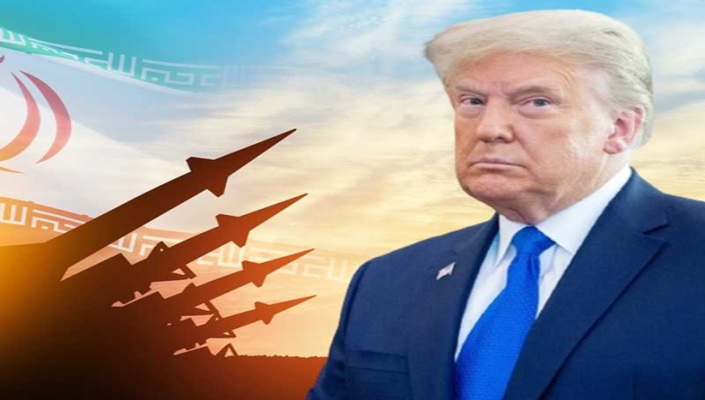
Afrasianet - The warnings that came through secret and public diplomatic channels painted a clear picture for Washington: Even those who see Iran as an existential threat do not want an open war at this moment.
Confusion of the opponent and confusion of observers
On the evening of January 3, the world seemed to be on the brink of a new abyss in an already raging Middle East. Sharp presidential statements and messages via Twitter (which has become the name "X") left no doubt that painful U.S.
military punishment was on its way to Iran, and media and political preparations sensed the approaching strike, anticipating a familiar scenario of the forceful deterrence exercised by previous U.S. administrations.
But the surprise awaited everyone. Within hours, the trajectory shifted from the edge of confrontation to a square The unexpected decision of President Donald Trump's administration not to go ahead with the attack is announced.
This abrupt shift, in the midst of widespread Iranian protests and acute regional tensions, raises a central question about the hidden and apparent factors that led Washington to rein in it, abandoning its escalatory rhetoric in favor of the wisdom of waiting, in a complex landscape that combined calculations of power, the necessities of diplomacy, the effects of allied pressures, and the president's volatile personality.
To understand the dimensions of this shift, it is necessary to recall the general context surrounding the decision. In the weeks leading up to the attack, Iran's domestic scene was buzzing with popular protests that erupted against economic and social backgrounds, which quickly turned into bloody confrontations in which casualties occurred, at a time when Tehran accused outside forces of being behind the unrest.
In this fraught atmosphere, Trump issued his public threats in early January, blaming the Iranian regime for the violence and vowing a harsh response if the crackdown continued. Intelligence Assessment
The first American was pointing out that the protests, while intense, do not pose an existential threat to the existing regime, which has provided room for verbal escalation.
But as events unfolded and the violence escalated, the assessment began to change, painting a more dangerous picture: any foreign military intervention could turn these protests into full-blown civil war, or unite the Iranian people behind the regime under the banner of defending national sovereignty, which would delegitimize any military action in the eyes of the Iranian people and the world.
This shift in intelligence assessment was the first indication that the ground was not ripe for a successful strike.
The apparent contradiction between overt threats and an actual flexible decision is not a weakness in this vision, but rather a deliberate method of crisis management by creating a state of uncertainty that prevents the adversary from speculating on responses.
But military and logistical factors on the ground were a greater obstacle to any military adventure. U.S. capabilities in the region were not at their peak, especially after the redeployment of a number of units and equipment to other regions such as the Caribbean and East Asia, as part of a strategy focused on competition with China.
This logistical shortage meant that any potential strike might not be decisive or quick enough to achieve stated objectives, but could turn into a limited operation that would provoke a violent Iranian response without a Achieve clear political cover.
Security concerns on the ground have centered on the fact that Iran's response will not be limited to Iranian territory, but will extend to threaten U.S. forces deployed in Iraq, Syria, and the Gulf states, as well as allies such as Israel and Saudi Arabia.
Given Iran's military history of missile warfare and cross-proxy operations, this danger was real and palpable. In addition, strategic estimates have suggested that any open confrontation will inevitably affect global energy security, as about one-fifth of the world's oil passes through the Strait of Hormuz, where Iran has the ability to shut down or disrupt navigation.
This nightmare scenario was enough to trigger a global economic crisis at a time when the world's economies had not yet recovered from the effects of the Corona pandemic. This complex military equation has made any strike risky and uncalculated consequences.
It was not only military pressure that surrounded the decision, but warnings from allies added another layer of complexity. In a phone call between President Trump and Israeli Prime Minister Benjamin Netanyahu, the latter expressed concern that any U.S. strike could prompt Iran to fire missiles toward Israel, at a time when Israel's home front was not fully prepared for such an attack.
This cautious Israeli stance, despite its long history of hostility toward Iran, has had an impact especially in the White House, because it means that Washington's closest allies in the region are not prepared to bear the consequences of escalation.
Gulf states, despite their political conflict with Tehran, have also expressed deep concern that any blow that would destabilize the entire region could redraw the political map in unpredictable ways.
These warnings, which came through covert and public diplomatic channels, painted a clear picture for Washington: Even those who see Iran as an existential threat do not want an open war at this moment.
This rare consensus on the need for restraint could not be easily overcome, especially under an administration that tends to prioritize bilateral alliances over multilateral coordination.
Trump's retreat from striking Iran does not mean closing the door to the military option forever, but rather postponing it for a while, waiting for developments that may or may not be more favorable to Washington.
But perhaps the most decisive factor in the change of course was the secret back channel that was opened between Iranian and U.S. officials. Through a European mediator, veteran Iranian diplomat Abbas Araqchi exchanged letters with U.S. official Steve Whitkoff, which included secret Iranian promises to halt executions of detainees during the protests and to curb violence against protesters.
These letters, while not a formal agreement, gave the administration margin to say that international pressure and covert diplomacy had made some gains.
The Iranian regime may be ready for de-escalation steps. For Trump, who values deals and tangible results, this element has been a politically promoted "win" as an alternative to risking a war that may not have domestic or international support.
This rear channel revealed a margin for maneuver that existed despite the open conflict, and the desire of both sides of the conflict not to slip into the abyss, even in moments of extreme threat.
At the heart of all of these factors is Trump's unique decision-making personality as a crucial element that cannot be overlooked. In a later statement, Trump said he had "persuaded himself" to back down, reflecting the extreme individualism that characterizes his style of governance.
The administration's decisions, especially in foreign policy, have often been shaped more by the president's intuition and momentary emotions than by security establishment analysis or long bureaucratic experience.
This style of leadership, while criticized as reckless and unmethodical, in this particular case may have led to a different outcome than expected.
Trump, with his focus on "smart power" and direct negotiations, has found in the retreat an option that combines a show of force (through threat) and flexibility (through retreat), in a complex psychological game aimed at confusing the opponent and confusing observers at the same time.
The apparent contradiction between hard public threats and flexible actual decision is not a weakness in this vision, but rather a deliberate way of managing crises by creating a state of uncertainty that prevents the adversary from predicting responses.
But this approach carries with it a great risk, because it may be read by the other side as hesitation or internal division, which may encourage it to challenge further in future crises.
Ultimately, Trump's retreat from striking Iran does not mean closing the door to the military option forever, but rather postponing it for a while, pending developments that may or may not be more favorable to Washington.
The decision reflects a combination of realistic military pressure, political warnings from allies, and subtle diplomatic signals from the enemy, all within the crucible of a president who tends to improvise and intuition.
This scene opens the door to deeply critical questions: Was the retreat a realistic wisdom that saved the region from a devastating war? Or was it weakness that emboldened Iran to take on more of the challenge?
Does this type of crisis management, based on mutual blackmail and backdoor negotiations, push toward fragile stability that can explode at any moment? Or is it establishing a new phase of "managed escalation" that avoids a major war but fuels ongoing small-scale conflicts?
The answer to these questions may not come now, but what is clear is that the game between Washington and Tehran is not over, but has entered a new, more complex phase, where public threats are mixed with hidden confrontations, and the calculations inside Iran intersect with the regional conflict and international competition, in an equation that makes it difficult to predict the next chapter.
Between war and negotiation. Washington Mobilizes, Tehran Strengthens Alliances
At a time when the regional arena is witnessing a state of anxious anticipation, Washington is moving with new military builds to the Middle East amid reports of the arrival of Eastern strategic weapons in Iran, raising fundamental questions about whether the region is on the cusp of a major round of escalation, or whether the scene is nothing more than the scene of a psychological battle and pre-emptive preparations to dictate the terms of future negotiations.
In light of Western reports that the US aircraft carrier "Abraham Lincoln" will continue to make its way to the Middle East amid talk about the possibility of the aircraft carrier "George W. Bush" moving to the region and the possibility of additional fighter squadrons reaching US bases in the coming period, there are reports in Iranian circles about the opening of an air channel with Russia It enabled the arrival of advanced arms shipments to Iran, a sign that international isolation is not absolute and that Eastern alliances are capable of boosting Iranian capabilities.
Eastern reinforcements
In light of the increasing regional escalation, political researcher Alireza Taghavinia talks about the air reinforcements and advanced military support that his country receives from its eastern allies Russia andChina, which may make a qualitative leap in its combat capabilities, stressing that the flow of heavy Russian cargo planes to Iranian airports in the past months was not random, but comes in the context of the partnership between the two countries.
Taqinia points to the arrival of advanced Russian Mi-28 attack helicopters, describing it as a "night hunter" with integrated combat capabilities, in addition to the arrival of advanced Chinese and Russian air defense systems, including systems such as the Chinese HQ-9, which is considered a counterpart to the American system "Patriot", and the famous Russian S-400 system.
Referring to Iranian press reports about Tehran 's receipt of a number of Russian Sukhoi-35 fighter jets , Taghavinia added that his country relies mainly on its own capabilities, including drones andballistic missiles , especially hypersonic ones, which produced huge numbers of them after last June's war, stressing that the eastern air reinforcements provided by Iran in recent months will pose a major challenge to any possible air aggression against it.
Iranian circles are divided over the current escalation between those who believe that war is coming to their country and those who believe that Washington does not intend to wage a new war, but seeks to break Tehran's will by waging a war of nerves and systematic intimidation campaigns, through military mobilization, and forcing it to retreat or make concessions without igniting a large-scale confrontation on the ground.
A likely war
While Iranian officials are publicly threatening to strike U.S. bases in the region if the Islamic Republic is attacked, political researcher Salahuddin Khedio is behind the flow of U.S. military supplies to the region "in preparation for a confrontation," arguing that Trump's retreat last week from the attack is due to logistical reasons and some political preparations needed by Washington and its ally Israel.
In his analysis, Khedive stresses that the option of war is still firmly in place, and that what happened at the Florida summit between US President Donald Trump and Israeli Prime Minister Benjamin Netanyahu, who is wanted by the International Criminal Court, is not just a passing meeting, but a plan that will be "implemented step by step", and that it is only a matter of timing and redrawing targets on the ground to achieve maximum impact.
The same analyst believes that Washington andTel Aviv view Iran's internal turmoil and economic deterioration as a "good opportunity" to achieve "strategic goals," noting that the focus of the U.S.-Israeli axis is mainly on weakening Iran's "missile capability" and the nuclear file, especially with regard to enriched material, as a gateway to imposing a broader agenda.
Khedive concludes that the likelihood of a direct military conflict between the United States and Iran is "higher than ever," especially in the past six months since the 12-day war, and expects the region to enter a decisive phase in the coming weeks, either toward settlements under threat, or toward a confrontation whose consequences are difficult to contain.
Psychological pressure
On the other hand, Reza Bardestani, a researcher in international affairs, believes that the US military moves are part of a complex psychological pressure strategy aimed at creating an environment of anticipation and constant pressure to force Tehran to retreat and extract concessions from it, based on the American conviction that "the management of the post-attack phase will have serious consequences and may be out of its control."
Although the United States possesses "strike power," it may lack the full capacity to manage the aftermath of a large-scale attack, providing an opportunity for the Iranian side, Bardestani said, adding that Tehran is able to turn the tables and take the initiative back from the attacker's hand through "deliberate steps and pre-prepared plans."
The same spokesman concludes that the path of Iran's response must depend on military readiness, but without engaging in a game that the adversary wants, but according to a smart, long-term strategy aimed at turning the threat into an opportunity, by boosting the economy to absorb the shocks of sanctions, building a media and counter-diplomatic narrative to reveal the nature of American policy, activating active regional diplomacy to strengthen alliances, and working to promote internal harmony.
Possible scenarios
In light of the sharp regional escalation, Mohsen Jalilvand, a professor of international relations at the University of Tehran, presents a pessimistic assessment of the near future, during which he outlines three possible scenarios for the outcome of the crisis, according to the following:
• The option of war is at the forefront of the most likely scenarios, with indications that there is advance planning by Israel and its longtime ally the United States.
He cites what he describes as the "Israeli silence" after the recent war, considering that it is not a passing silence, but part of a calculated strategy, and links this approach to the recent protests in Iran, which he believes are being invested within the American and Israeli strategy in dealing with Tehran.
• Internal dialogue: The Iranian regime is launching a serious internal dialogue with its people, through which it recognizes the demands of the citizens and embarks on deep economic and political reforms, but the spokesperson believes that the chances of achieving this scenario remain "limited."
• The diplomatic track: Galilund considers the third and weakest possible scenario, which is the resumption of negotiations with the United States, but he believes that it is difficult to rely on it for two main reasons: the first is the strict American conditions, and the second is that this is linked to an internal and external reality that does not provide enough space to make concessions.
• The U.S.-Israel Hybrid War Against Iran: Escalation Without All-Scale War and Chaos Without Horizon.
For years, the United States and Israel have been waging a large-scale "hybrid" war against Iran, based on suffocating sanctions, limited strikes, cyber warfare, assassinations, and disinformation campaigns, rather than descending into an all-out war that could lead to nuclear escalation.
In an article published by Common Dreams, US economist Jeffrey D. Sachs and researcher Sybil Fares said the question is no longer whether Washington and Tel Aviv will attack Iran, but when, noting that the logic of hybrid warfare explains the sharp contradiction in US President Donald Trump's rhetoric between threatening war and threatening peace offers that he described as "fake".
Experts say hybrid warfare logic explains sharp contradiction in US President Donald Trump's rhetoric between threatening war and waving "bogus" peace offers
The "deep state" in the United States and Israel has become systematically dependent on this type of war, through coordination between the CIA and the Mossad, and a vast network of military contractors and security services, which has led to chaos in large areas of Africa and the Middle East, from Libya, Somalia, and Sudan to Palestine, Lebanon, Syria, Iraq, Iran, and Yemen.
The report noted that the toll over more than a quarter of a century has been "catastrophic": economic destruction, disruption of development, widespread violence, and mass waves of refugees, without security, stability or lasting alliances loyal to Washington or Tel Aviv. These policies directly undermine the UN Charter, which prohibits the use of force against other countries and puts hybrid warfare in clear violation of international law.
The main beneficiary of this path is the "military-industrial-digital complex" in the United States and Israel, where technology and security companies are increasingly profiting from surveillance tools, artificial intelligence, and assassination algorithms. They recalled former US President Dwight D. Eisenhower's warning in 1961 about the danger of the military-industrial complex, considering that this danger has been exacerbated today with the use of artificial intelligence and large-scale propaganda.
The report addressed two simultaneous escalations that it described as "hybrid wars" in Venezuela and Iran. In Venezuela, Washington has been seeking for years to control vast oil reserves and topple the leftist government that has existed since 1999 through sanctions, asset confiscation, and paralyzing the oil sector, without succeeding in toppling the regime.
They added that the Trump administration has recently escalated through military operations and a naval blockade, in a move they called an "ongoing act of war," which has been publicly supported by Israeli Prime Minister Benjamin Netanyahu.
In Iran, the report warns that the ongoing hybrid war could easily descend into a destructive, and perhaps wider, regional confrontation, despite diplomatic attempts by countries in the region, especially the Gulf, to dissuade Washington from the military option. He recalled a long history of U.S. intervention in Iran, dating back to a 1953 coup against elected Prime Minister Mohammad Mossadegh, through support for the Shah's regime, and then the Iran-Iraq War in the 1980s.
The U.S.-Israeli goal is not a negotiated settlement that integrates Iran into the international system while consolidating its nuclear program, but rather to keep it "economically exhausted, diplomatically besieged, and internally squeezed." They saw Trump's withdrawal from the 2016 nuclear deal (JCPOA) as a central milestone in undermining the prospects for a political solution.
The report concluded by calling for broader international action, calling on UN member states, with the exception of the United States and Israel, to reject regime-change policies, unilateral sanctions, the weaponization of the dollar, and repeated violations of the UN Charter. The people, including the American people, do not support the "illegality" of these policies, but they find it difficult to make their voices heard, at a time when there is an increased risk of sliding into wider wars unless this path is reined.

