
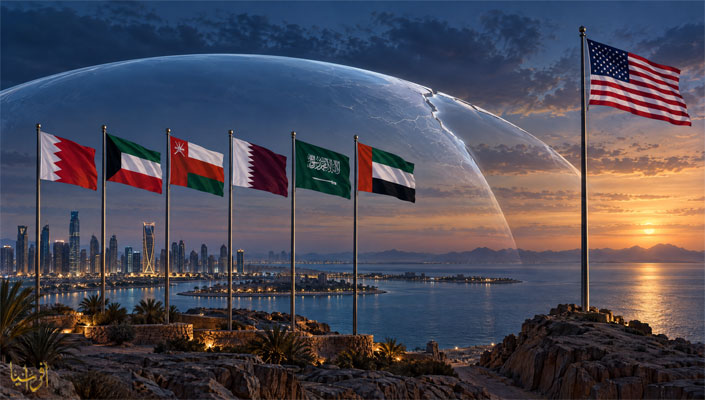
Afrasianet - Mahmoud Al Toukhi - The current war in the Middle East is transcending the boundaries of military confrontation into a geopolitical and economic "re-engineering" process, in which the hypothesis of America's abandonment of the Gulf emerges as a reality on the ground.
In this context, Dr. Nayef bin Nahar, director of the Ibn Khaldun Center at Qatar University, believes that Washington no longer trades the security of allies for interests, but rather sees the drain of the "Gulf model" as a direct strategic and economic gain for American energy companies, in a historical moment similar to the "1956 war" that ended Britain's influence in the region.
As Gulf capitals pay the bill for the destruction of their infrastructure from Iranian attacks, the budgets of U.S. energy companies are recording record profits, reinforcing Ben Nahar's thesis that the region is becoming a "sacrifice" to secure the new U.S. hegemony and inaugurating a "Middle East" in which the traditional balance of power shifts.
The bleeding of billions of Gulf countries and the paradox of Washington's profits
Goldman Sachs estimates that Kuwait and Qatar could see a 14% decline in GDP if the ongoing war continues until the end of April. Saudi Arabia and the UAE face contractions of 3% and 5%, respectively.
Meanwhile, Capital Economics points out that the region's GDP is threatened with a 10-15% decline if the war continues for at least three months and causes permanent damage to energy infrastructure.
Peter Martin, head of economics at Wood Mackenzie, estimates the daily revenue losses in Iraq on the back of a 70% drop in its oil production, at about $3 billion.
In light of this, Bin Nahar confirms in his analysis published on his account on the "X" platform, that the Gulf losses are not collateral damages, but directly in the interest of American companies, especially after Washington ignored the warnings of the Qatari Minister of Energy that striking Iranian gas would necessarily lead to a strike on the Gulf gas fields.
Data released by commodity analysis firm KPLER on March 13 reveals that oil producers in the Gulf have lost about $15.1 billion in energy revenues since the start of the Iranian attacks and the near-complete closure of the Strait of Hormuz.
Until then, Saudi Arabia had suffered losses of $4.5 billion, while Iraq faces an existential risk of relying 90 percent on oil revenues to fund the government's budget, according to data from Peter Martin, head of economics at Wood Mackenzie.
In contrast, the flip side of America's policy of abandoning the Gulf is in the huge gains, as energy research firm Rystad predicts that U.S. oil companies will reap unexpected gains of more than $60 billion this year if prices stabilize at an average of $100 per barrel.
Investment bank Jefferies notes that these producers raked in $5 billion in additional cash flow in March alone, after prices rose 47% since the conflict began on Feb. 28.
The military field and the political pressures that dragged the Gulf into war
Lack of protection and targeting the "Gulf model"
On the defensive front, the American platform "Jewish Insider" reveals a stark paradox on the ground in the course of the conflict: while military operations are conducted under the cover of the protection of allies, the UAE has been subjected to the majority of Iranian missile and drone attacks.
Since the war began on February 28, Tehran has responded with large-scale attacks, but it has borne the brunt of this escalation: on March 11 alone, the UAE Ministry of Defense reported that its air defenses intercepted 357 ballistic missiles, 15 cruise missiles, and 1,806 drones, demonstrating a "failure of the U.S. protection umbrella," or rather, a reality perpetuating America's abandonment of the Gulf on the ground in Israel's favor.
Bin Nahar believes that these attacks are not random, but part of a strategy aimed at draining the Gulf and exhausting its societies, citing the Pentagon's publication of images of missile launches from bases in the Gulf, asking whether the purpose of this action is to plunge the region into a direct battle with Tehran.
Bin Nahar stresses that the desire to drain the Gulf has become clear in the statements of American and Israeli officials who repeat the "Gulf participation" in the war, with the aim of striking two birds with one stone: the overthrow of the Iranian regime and the overthrow of the stable Gulf model in preparation for future changes.
Pressure from Trump and his circle and the discontent of Gulf capitals
In mid-March, the US president said in statements to the Hebrew Channel 14 that the Arab countries should join the war on Iran, justifying that they are the ones who benefit from the opening of the Strait of Hormuz because of their oil exports.
In this context, previous statements by the late Republican senator who is close to US President Lindsey Graham stand out as a tool of direct political pressure, as he predicted that the Gulf states would join the United States and Israel in their attack on Iran, claiming after a secret briefing in the Senate that "Arab partners will be more involved, not less." These statements are what Ben Nahar sees as a "veiled threat" to the Gulf to participate in a war in which America does not lack military capabilities, but aims to drain allies.
Reuters , citing informed Gulf sources, confirms that there is an inherent discontent in the region towards the US president, explaining that the prevailing belief is that Trump dragged the Gulf states into a war "formed by Israel" without preparing advance plans and without studying the consequences for his allies.
A Gulf official explained that the decision to launch the war was formulated by a small circle around the US president, describing them as "businessmen and dealmakers, not professional policymakers."
The agency quoted three regional sources as saying that airports, hotels, ports and oil facilities have been hit by Iranian strikes, which have led to a decline in business confidence. Ibtisam Al Ketbi, head of the Emirates Policy Center, said: "This is not our war. Yet we are paying the price in our security and economy."
The writer warned that America's abandonment of the Gulf at this time would mean leaving the region facing a "wounded lion," as Iran would remain a constant threat if Washington withdrew without achieving a decisive victory or left a power vacuum plagued by neighboring countries.
The Dangers of the Gulf States Joining the War and the Single "Victory" Scenario
America abandons the Gulf between the hammer and the anvil
The Chatham House Institute monitors a number of existential risks surrounding the decision of the countries of the region to join the war against Iran, considering that these countries have become "stuck between the hammer and the anvil."
According to the institute, direct Gulf involvement in the war could lead to more intense Iranian bombardment of vital assets that the Gulf states are trying to protect, including oil fields, airports, data centers, and desalination plants.
What makes the scene even more dangerous is the realization of the reality of America's military abandonment of the Gulf, as the institute stresses that "Israel remains the top American priority," especially in light of the severe shortage of interceptor missiles that Washington faces globally, which leaves the Gulf skies tactically exposed.
According to Chatham House analysts, a second danger is the "volatility of the political mood" in Washington, as President Donald Trump may decide to abruptly halt military operations against Iran and declare "victory," leaving Israel and the Arab Gulf states alone on the ground to confront an Iranian regime that has not completely fallen, but has become more willing to take revenge.
This scenario will inevitably complicate relations between the two shores of the Gulf in an unprecedented way, and may end up severing them completely, especially since these relations were not originally built on trust, and Iran will hold its neighbors accountable for any direct military confrontation, which will increase mistrust for decades to come.
In light of the escalation of Iranian strikes, leaders find themselves facing a bitter reality: the defensive approach alone may become unsustainable due to its cost and depletion of systems, but joining the U.S.-Israeli campaign may turn against the stability of these countries.
The institute concludes that this decision is "extremely difficult and risky," especially as the Gulf states feel compelled to make it alone, in light of the erosion of confidence in the possibility of relying on Washington as was the case in the past, which reinforces the conviction that America will abandon the Gulf at crucial historical junctions.
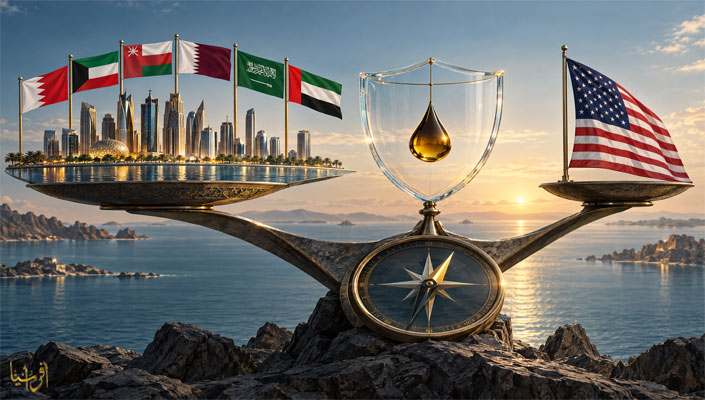
Cracking the "Protection Trade-off" and the Search for Security Alternatives
Reassessing alliances after U.S. abandonment of the Gulf
The current war has prompted countries in the region to drastically reassess their security dependence on Washington, amid growing indications that Tehran could be involved in new regional arrangements despite the collapse of trust, according to Reuters.
Fawaz Gerges, a professor at the London School of Economics, explains that for decades, relations between the two sides have been based on an implicit trade-off of the provision of Gulf energy and capital, including hundreds of billions spent on U.S. weapons and technology, in exchange for protection.
The current war has shaken these assumptions, prompting Gulf capitals to accelerate efforts to diversify foreign partnerships, after realizing that they "cannot truly rely on the United States to protect its resources, sovereignty, and people," which enshrines the reality of America's strategic abandonment of the Gulf.
These concerns are reminiscent of the "U.S. inaction" to respond following the 2019 attacks on Saudi Arabia's Abqaiq and Khurais facilities, which Abdulaziz Saqr, head of the Gulf Research Center, sees as evidence of Washington's failure to provide guarantees to its allies or secure energy flows during crises.
Saqr added in his statements to Reuters, that the current economic cost to the Gulf states has become "terrible," stressing that external powers tend to make their decisions based on their own interests rather than the interests of the region, which forces the Gulf states to adopt a more balanced and cautious approach, especially after the war proved the limits of reliance on external guarantees.
The "Survival and Victory" Strategy and Selective Targeting
Rob McKerr, a former British ambassador to Iran and a member of the Council of Chatham House, analyzes Iran's mentality in this conflict, stressing that Tehran is playing a "long-term game" centered on the regime's survival, as it considers that "mere survival equals victory."
Mackir dismantles Iran's strategy in the ongoing war, explaining that Tehran is aware of its inability to fight a direct war against American supremacy, so it seeks to regionalize the conflict by dragging the rich Gulf states into it, by targeting oil fields, airports, and civilian buildings, to force it to pressure President Trump for a ceasefire.
This analysis is consistent with Dr. Nayef Ben-Nahar's view of Iran's "selectivity", as he wonders why Tehran is targeting water reservoirs and the Education City in the Gulf under the pretext of US bases, while avoiding targeting gas pipelines in Azerbaijan, which houses Israeli bases and feeds a third of Israel's gas resources.
In his view, this behavior reveals an Iranian desire parallel to the American desire to drain the Gulf, warning that Tehran's departure from the logic of defense to revenge may legitimize Israel's "integration" into the Gulf security system, which he considers the "biggest strategic disaster" that may face the region.
Public rebuke and the moment of hegemony breaking
In a rare public rebuke of U.S. policy, Emirati businessman Khalaf Al Habtoor questioned the war's goals, asking in a post on his social media accounts: "President Donald Trump, a direct question: Who gave you the authority to drag our region into war with Iran? ".
In his post, which he later deleted, Al Habtoor explained that the countries of the region are the first to suffer from this escalation, criticizing Washington's disregard for the costs and collateral damage inflicted on the Gulf as a result of a conflict in which it was not a party.
In direct projection, Ben-Nahar likens the situation of American hegemony today to that of Britain after the 1956 war, seeing it as the "beginning of the end" of Washington's influence.
Chatham House experts warn that continuing with the defensive approach alone will drain the Gulf's expensive defense systems with cheap Iranian drones and missiles, making the transition to attack an option that seems logical operationally, but fraught with risks of "wounded Assad" and activating sleeper cells, which puts the countries of the region between Washington's hammer and Tehran's anvil, in light of America's abandonment of the Gulf at the first real test of interests.
Searching for alternatives and the "New Middle East" project
Corrosion of Warranties
It took only days of intensified Iranian attacks for the region's countries, which have long relied on U.S. security guarantees, to realize their need for urgent assistance from other parties.
According to the New York Times, the acute shortage of expensive U.S.-made interceptor missiles has led to a strategic shift, as Saudi Arabia has reached out to Ukraine to leverage its field experience in countering Russian drones modeled after Iranian aircraft. The UAE has received assistance from France and Australia, while several Gulf governments have asked Italy to provide it with anti-drone and anti-aircraft systems.
This shift reflects deep skepticism among the region's leaders about the usefulness of U.S. protection, as they now find themselves in the crosshairs of a regional war sparked by their ally Washington.
In the first public call to question the effectiveness of the U.S. umbrella, Omani Foreign Minister Badr al-Busaidi called on Gulf states to review their defense strategies.
This debate is further strengthened by the statements of Abdulaziz Al-Ghashian, a Saudi scholar and fellow at the Gulf International Forum, to the New York Times, stressing, "It is becoming more and more clear that what is certain is that there are no guarantees," which solidifies the conviction that America will abandon the Gulf as a new geopolitical reality.
NBC News quoted a U.S. official as saying that the Gulf states are eager to see an end to the conflict, but while some want the U.S. to find a way out as soon as possible, others are more concerned that the U.S. will leave the Iranian regime not only intact, but in retaliation.
The prophecy of "Greater Israel" and the reshaping of the region
Dr. Nayef Ben-Nahar stops by repeating the term "reshaping a new Middle East" by Israeli officials, including Benjamin Netanyahu, asserting that this term means that the Gulf is a targeted part of the reconfiguration process and not just Iran.
Ben-Nahar believes that "Greater Israel" is not just a religious myth or an extreme right, but a project being implemented on the ground: when Netanyahu referred to it on an official map, he was announcing a plan aimed at exhausting all regional powers to ensure absolute hegemony that leaves no room for an independent Gulf model.
The overthrow of the regime in Iran is just the "first step" in this project, Ben Nahar adds, questioning the location of the second step, which aims to drain the Gulf's wealth and dismantle its stable structure.
During his August 2024 election campaign, Trump told Hebrew Channel 12: "The area of Israel looks small on the map, and I've always thought about how it can be expanded."
The Trump administration's approach was later demonstrated last February, when its ambassador to Tel Aviv, Mike Huckabee, stated that it would be good for Israel to take over the entire region, claiming that it had a religious right to control large swathes of the Middle East, including parts of Lebanon, Syria, Iraq, Jordan and Saudi Arabia, in what is known as "Greater Israel."
The "1956 Moment" and the Historic Opportunity
In his analysis, Dr. Nayef Ben Nahar concludes that the region is currently experiencing the last phase of American hegemony, likening the current war to the "War of 1956", which was a nail in the coffin of British influence.
He believes that the fact that America has abandoned the Gulf in exchange for the profits of oil and gas companies in the United States imposes a crucial question on Gulf capitals: "How do we turn this crisis into an opportunity to ensure that we do not fall back between America's hammer and Iran's anvil? "
These facts, according to Ben Nahar, confirm that it is the "general of geography" and the "general of steadfastness" who ultimately decide the battle, which requires the Gulf states to formulate an independent strategy that refuses to be "collateral damage" in the deals of the major powers, and seeks to wrest their sovereignty away from the illusion of American protection.
________________

